Topic 19 · page 11 of 13
Amino acids and polarised light
Most amino acids have a chiral carbon, so a single enantiomer rotates the plane of plane-polarised monochromatic light. Glycine has no chiral carbon and does not, and a racemic mixture shows no net rotation.
Read first: Amino acids as acids and bases
Which amino acids are chiral 19.11(ii)
A carbon atom with four different groups attached is a chiral centre. A molecule with one chiral centre exists as two enantiomers: mirror images that cannot be superimposed (Topic 15).
In a 2-amino acid, RCH(NH₂)COOH, the carbon in the middle carries H, NH₂, and R.
- Alanine, R = CH₃: four different groups (H, CH₃, NH₂, ). It is chiral.
- Glycine, R = H: two of the four groups are H atoms. It is not chiral.
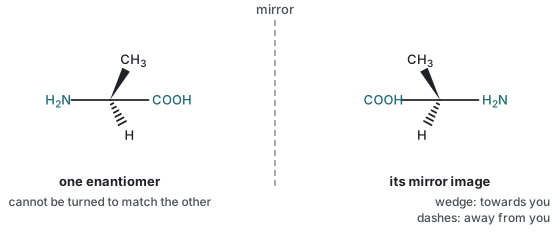
Every 2-amino acid in proteins other than glycine has this chiral centre.
Plane-polarised light 19.11(ii)
Ordinary light vibrates in all planes at right angles to its direction of travel. A polariser lets through only the light that vibrates in one plane, which gives plane-polarised light. Monochromatic light has a single wavelength (one colour), such as the yellow light of a sodium lamp.
A racemic mixture has equal amounts of the two enantiomers. Their rotations cancel, so there is no net rotation.
Experiment: the polarimeter 19.11(ii)
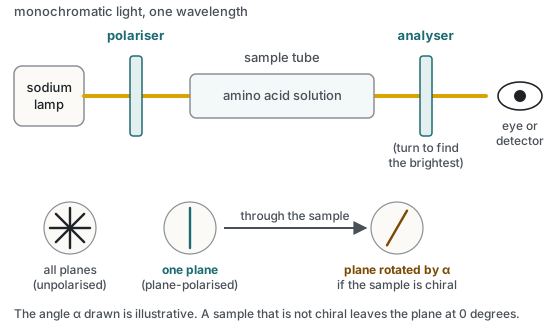
PracticalMeasuring optical rotation
- Shine monochromatic light (a sodium lamp) through a polariser. The light leaving it is plane-polarised.
- Pass the light through a tube of the amino acid solution.
- Look through the analyser, a second polariser that can be turned. With the sample absent (or a non-chiral sample), the analyser is set so that the light is brightest.
- Turn the analyser until the light is brightest again. The angle it has been turned through is the rotation.
- A chiral amino acid gives a non-zero angle. A non-chiral one gives an angle of zero.
Monochromatic light is used because the angle of rotation depends on the wavelength. With white light, each colour would rotate by a different angle and no single plane would be found.
Worked exampleInterpreting readings
Four solutions of 0.10 mol dm⁻³ are measured in the same tube (illustrative data). What does each reading show?
| Sample | Rotation |
|---|---|
| A | +8.5° |
| B | 0° |
| C | −8.5° |
| mixture of equal volumes of A and C | 0° |
- A rotates the plane clockwise (positive) so it is optically active: one enantiomer of a chiral amino acid, such as alanine.
- C rotates by the same angle the other way, so it is the other enantiomer.
- The 1 : 1 mixture of A and C is a racemic mixture: the rotations cancel.
- B could be a non-chiral amino acid such as glycine, or a racemic mixture of a chiral one. A single reading cannot tell which.
Check yourself
- Draw 2-aminopropanoic acid and mark the chiral centre.
- Explain why glycine is not optically active.
- What is a racemic mixture? What reading does it give in a polarimeter, and why?
- State two features of the light used in a polarimeter and explain why each is needed.
- Describe how to measure the optical rotation of an alanine solution.
- A solution of one enantiomer rotates the light by +12.0°. What would you expect for the other enantiomer at the same concentration, and for an equal mixture of the two?
Answers cover these until you have tried the questions
- CH₃–C*H(NH₂)–COOH, with the central carbon (carbon 2) marked: it bonds to H, CH₃, NH₂ and .
- Its central carbon bonds to two H atoms, so it does not have four different groups. It has no chiral centre, so it has no enantiomers and does not rotate plane-polarised light.
- A mixture of equal amounts of two enantiomers. It gives no net rotation (0°), because the equal and opposite rotations cancel.
- The light is plane-polarised so that a change of plane can be detected, and monochromatic because the angle of rotation depends on the wavelength, so one wavelength gives one definite angle.
- Pass monochromatic light through a polariser, then a tube of the solution, then an analyser. Turn the analyser until the light is brightest again. The angle turned is the rotation.
- The other enantiomer: −12.0°. The equal mixture (a racemate): 0°.