Topic 19 · page 2 of 13
Amines and water
Short amines mix with water because they hydrogen bond to it, and they make the solution alkaline because the nitrogen lone pair accepts H⁺. How well it does so depends on what is attached to the nitrogen.
Read first: Names and formulae
Why short amines mix with water 19.3
Butylamine is miscible with water: the two liquids mix in all proportions. The reason is hydrogen bonding between the amine and the water molecules.
A hydrogen bond needs two things: an H atom bonded to a very electronegative atom (N, O or F), and a lone pair on a second electronegative atom. An amine has both:
- the lone pair on nitrogen can form a hydrogen bond to a δ+ hydrogen atom of a water molecule;
- the N–H hydrogen is δ+ and can form a hydrogen bond to a lone pair on the oxygen of a water molecule.
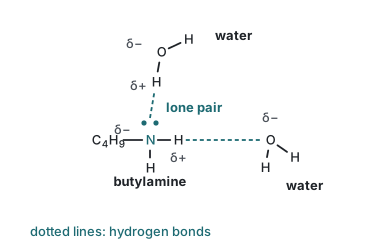
These new hydrogen bonds are about as strong as the hydrogen bonds between water molecules that have to be broken, so mixing releases enough energy and the amine dissolves.
The alkyl chain cannot hydrogen bond. As the chain gets longer, more of the molecule is hydrocarbon, and solubility falls. Phenylamine is only slightly soluble, because the large benzene ring does not hydrogen bond to water.
Amines as bases 19.2(i)
A base is a proton acceptor. The lone pair on the nitrogen atom of an amine accepts H⁺ from water:
The ion formed, C₄H₉NH₃⁺, is the butylammonium ion. The hydroxide ions make the solution alkaline. A solution of butylamine has a pH of about 11 to 12 at typical concentrations, close to that of ammonia.
Phenylamine does the same, but it is only slightly soluble and a very weak base:
Its solution is only very slightly alkaline. The next section explains why.
Why the three bases differ 19.3
Ammonia, butylamine and phenylamine all have a lone pair on nitrogen. The strength of the base depends on how available that lone pair is for accepting H⁺.
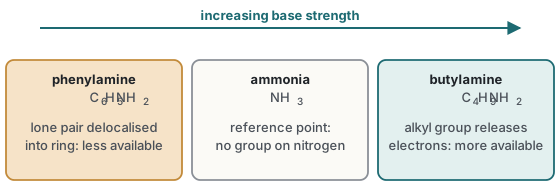
Butylamine is stronger than ammonia. The butyl group is electron-releasing (it has a positive inductive effect). It pushes electron density towards the nitrogen, so the lone pair is more available to accept a proton.
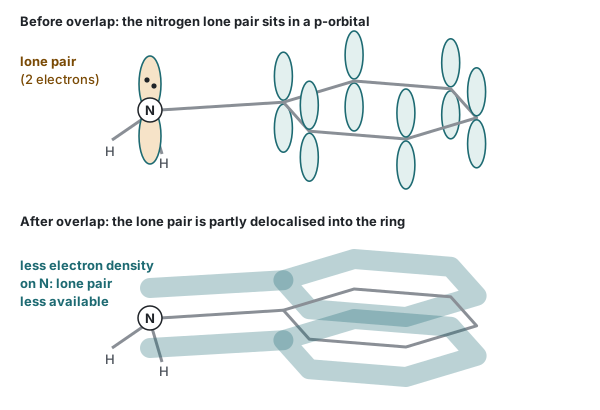
Phenylamine is weaker than ammonia. The nitrogen lone pair overlaps with the delocalised π system of the benzene ring. The lone pair is spread over the ring, so the electron density on nitrogen is lower and the lone pair is less available to accept a proton.
Worked examplePut in order and explain
Put ammonia, butylamine and phenylamine in order of increasing pH for solutions of equal concentration, and explain the position of butylamine.
- Order of increasing pH (increasing base strength): phenylamine < ammonia < butylamine.
- The butyl group is electron-releasing, so the electron density on nitrogen in butylamine is higher than in ammonia.
- The lone pair is more available to accept H⁺, so more OH⁻ forms and the pH is highest.
Check yourself
- Explain why butylamine is miscible with water but butane is not.
- Draw one hydrogen bond between an amine molecule and a water molecule, marking the partial charges and the lone pair.
- Write the equation for the reaction of butylamine with water. Explain why the solution is alkaline.
- Why is the arrow ⇌ and not → in your answer to question 3?
- Explain why butylamine is a stronger base than ammonia.
- Explain why phenylamine is a weaker base than ammonia.
Answers cover these until you have tried the questions
- Butylamine can hydrogen bond to water: its N lone pair bonds to a δ+ H of water, and its N–H hydrogen bonds to the lone pair on O. These hydrogen bonds release enough energy to replace the hydrogen bonds between water molecules. Butane has no N or O, so it cannot hydrogen bond to water and only has weak London forces, so it does not mix.
- A dotted line from the lone pair on N (δ−) to an H atom of water (δ+); or from the H of the N–H bond (δ+) to the O of water (δ−), which has a lone pair on it. See the figure on this page.
- . The lone pair on nitrogen accepts a proton from water, producing OH⁻ ions, so the solution is alkaline.
- Butylamine is a weak base. It accepts only a small fraction of protons, so the reaction is reversible and the equilibrium lies mostly to the left.
- The butyl group is electron-releasing. It increases the electron density on nitrogen, so the lone pair is more available to accept H⁺. Ammonia has no such group.
- The nitrogen lone pair in phenylamine overlaps with the delocalised π electrons of the ring. This lowers the electron density on nitrogen, so the lone pair is less available to accept H⁺.