Topic 19 · page 12 of 13
Peptide bonds
Amino acids join by condensation to form peptide links, and adding water back breaks them. To show which amino acids were joined, hydrolyse the peptide with acid, then identify the amino acids by paper chromatography with ninhydrin.
Read first: Polyamides and proteins, Amino acids as acids and bases
Joining amino acids 19.11(iii)
An amino acid has an –NH₂ group at one end and a group at the other, so it can join to two neighbours. When the of one amino acid reacts with the –NH₂ of another, a molecule of water is lost and a peptide link, –CO–NH–, forms. This is condensation polymerisation (page 7).
The amino acids can join in two orders, because each has one amino end and one carboxyl end. Two different amino acids make two different dipeptides:
| Dipeptide | Formula | Free –NH₂ end | Free end |
|---|---|---|---|
| Gly-Ala | H₂NCH₂CONHCH(CH₃)COOH | glycine | alanine |
| Ala-Gly | H₂NCH(CH₃)CONHCH₂COOH | alanine | glycine |
Both dipeptides have the formula C₅H₁₀N₂O₃ and = 146.0, and both give glycine and alanine on hydrolysis.
Worked examplePeptide equation and mass
Write the equation for glycine and alanine forming Gly-Ala. Calculate the mass of dipeptide formed from 3.75 g of glycine and excess alanine, at 100% yield.
- M(glycine) = 2 × 12.0 + 5 × 1.0 + 14.0 + 2 × 16.0 = 75.0 g mol⁻¹, so n = 3.75 ÷ 75.0 = 0.0500 mol
- Ratio 1 : 1 : 1, so n(dipeptide) = 0.0500 mol
- M(dipeptide) = 75.0 + 89.0 − 18.0 = 146.0 g mol⁻¹, so mass = 0.0500 × 146.0 = 7.30 g
Breaking peptide links by hydrolysis 19.11(iii)
Hydrolysis reverses condensation: water adds across the peptide link, which breaks the C–N bond and gives back and –NH₂ groups. In acid the amino groups end up as –NH₃⁺.
A peptide with x amino acid units has (x − 1) peptide links, so it needs (x − 1) molecules of water to hydrolyse fully. This is the experiment used to show which amino acids were joined.
Experiment: showing which amino acids were joined 19.11(iii)
PracticalHydrolysis and chromatography of a dipeptide
- Hydrolyse. Heat the dipeptide (or protein) under reflux with 6 mol dm⁻³ hydrochloric acid. The peptide links hydrolyse.
- Neutralise the mixture.
- Spot the hydrolysed mixture on a pencil start line on chromatography paper, alongside spots of known amino acids.
- Run the paper in a suitable solvent until the solvent front is near the top. Mark the solvent front in pencil.
- Spray with ninhydrin and warm it. Amino acids are colourless, and ninhydrin turns them purple, so the spots become visible.
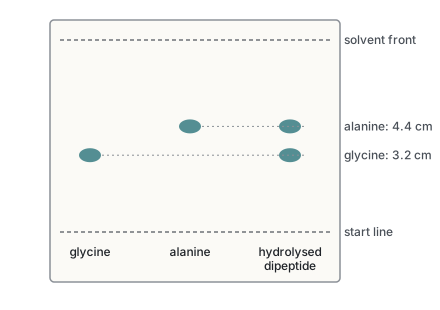
Observation. The hydrolysed sample gives spots at the same heights as the amino acids that were joined, so the dipeptide contained those two amino acids.
Worked example values
In the chromatogram above, the solvent front moved 8.0 cm, glycine moved 3.2 cm and alanine 4.4 cm (illustrative data). Find the values.
- Glycine: 3.2 ÷ 8.0 = 0.40
- Alanine: 4.4 ÷ 8.0 = 0.55
- Two spots from the hydrolysed dipeptide at 3.2 cm and 4.4 cm have the same values, so the dipeptide contained glycine and alanine.
Check yourself
- Write the equation for the formation of Ala-Gly from alanine and glycine. Name the link formed.
- How many different tripeptides can be made using one molecule each of three different amino acids?
- How many water molecules are needed to hydrolyse completely a peptide made of 8 amino acids?
- Describe how you would show that a dipeptide contains alanine and glycine.
- Why is ninhydrin used?
- In a chromatogram the solvent front moves 9.0 cm and a spot moves 3.6 cm. Calculate its value.
Answers cover these until you have tried the questions
- . The link is a peptide link, –CO–NH–, which is an amide link.
- 3 × 2 × 1 = 6 different tripeptides.
- 8 amino acids have 7 peptide links, so 7 water molecules.
- Hydrolyse the dipeptide by heating under reflux with 6 mol dm⁻³ HCl, then neutralise. Spot the mixture beside glycine and alanine on chromatography paper, run it in a solvent, and spray with ninhydrin. Two purple spots at the same heights as glycine and alanine show that the dipeptide contained both.
- Amino acids are colourless on the paper. Ninhydrin reacts with them to give purple spots so they can be seen and their positions measured.
- = 3.6 ÷ 9.0 = 0.40