Edexcel International A Level Chemistry
Topic 11: Kinetics
Turns "faster" and "slower" into numbers. A rate equation says how the rate depends on concentration, the orders come from experiment, and the equation points to the slow step in the mechanism.
The one idea
The rate of a reaction depends on concentrations in a way you cannot read from the balanced equation. You find it by experiment, and write it as a rate equation. Once you have the rate equation, it tells you two things: how to predict the rate for any concentrations, and which species are in the slowest step of the mechanism. Temperature enters through the rate constant, and the Arrhenius equation turns the way k changes with temperature into the activation energy.
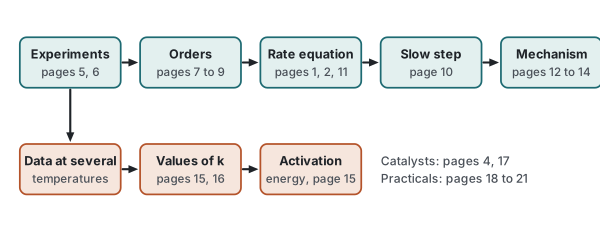
The topic has five jobs, and the pages follow them in order:
| Job | What you do | Pages |
|---|---|---|
| Language | rate, order, rate constant, half-life, activation energy, catalysts | 1 to 4 |
| Data | pick a technique, run initial-rate and continuous experiments | 5 and 6 |
| Orders | from initial rates, concentration–time graphs, rate–concentration graphs | 7 to 9 |
| Mechanisms | rate-determining step, iodination of propanone, SN1 and SN2 | 10 to 14 |
| Energy and practicals | activation energy, solid catalysts, Core Practicals 9a and 9b | 15 to 21 |
Before you start
This topic extends Topic 9 (collision theory, activation energy, Maxwell–Boltzmann curves, finding a rate from a tangent) and uses the curly-arrow mechanisms of Topic 10. You also need the titration calculations from Topic 1 for the core practicals.
Three constants are used throughout: R = 8.31 J mol⁻¹ K⁻¹, K = °C + 273, and ln 2 = 0.693.
How to use these notes
- Read the pages in order the first time. Later pages assume the earlier ones, especially the rate-equation pages (1, 2) and the rate-determining step (10).
- Each page opens with its one idea in a sentence. If you can explain that sentence to someone else, you know the page.
- Coloured boxes mean the same thing on every page: definitions you may be asked to quote, key ideas, common mistakes, exam technique, and beyond the spec (interesting, but you will not be examined on it).
- Each page ends with questions and fully worked answers. Cover the answers, try the questions, then mark yourself.
- Numerical data in the worked examples and the practicals are labelled "illustrative". They are invented to show a typical result, not measured values.
- Use the topic on a page the night before an exam.
Pages
- Rate, rate equation and order
A rate equation links the rate of a reaction to the concentrations of the reactants. The power of each concentration is its order, and the orders can only be found by experiment.
- The rate constant and its units
The rate constant k turns concentrations into a rate. Its value depends on temperature and catalyst but not on concentration, and its units depend on the overall order, so you derive them each time.
- Half-life
The half-life is the time for a concentration to halve. Read two or more successive half-lives from a concentration-time graph, and if they are all equal the reaction is first order.
- Activation energy and catalysts
Activation energy is the energy barrier colliding particles must clear. A catalyst gives a route with a lower barrier. It is homogeneous if it is in the same phase as the reactants and heterogeneous if it is not.
- Choosing a technique to follow a reaction
To measure a rate you need something that changes as the reaction goes and that you can measure while it happens. Match the technique to the reaction, then justify it by naming the species and the property.
- Initial rates and continuous monitoring
Two ways to collect data for finding orders. The initial-rate method uses many separate experiments and one rate from each. Continuous monitoring uses one experiment and follows the whole curve.
- Orders from initial-rate data
Compare two experiments in which only one concentration changes. How much the initial rate changes tells you the order for that reagent. Then use any experiment to find k.
- Orders from concentration–time graphs
A straight line means zero order. For a curve, measure successive half-lives. If they are constant the reaction is first order, and if each is double the last it is second order.
- Orders from rate–concentration graphs
Plot the rate against the concentration. A horizontal line is zero order, a straight line through the origin is first order, and an upward curve is second order. Tangents on a concentration–time graph supply the rates.
- The rate-determining step and the rate equation
The slowest step in a mechanism controls the overall rate, so the species in the rate equation are the ones in that step. Use this to go from a mechanism to a rate equation, and back.
- Iodination of propanone: data and predictions
In the acid-catalysed reaction of propanone with iodine, the rate is first order in propanone, first order in hydrogen ions and zero order in iodine. That tells you which species are in the rate-determining step.
- Deducing a mechanism
Write the slow step from the rate equation, then add fast steps until the steps add up to the overall equation. Check both conditions, and remember that the rate equation can rule a mechanism out but cannot prove it.
- Primary halogenoalkanes: the SN2 evidence
When the rate of hydrolysis of a primary halogenoalkane depends on both the halogenoalkane and hydroxide ions, both are in the rate-determining step. That points to a one-step mechanism, named SN2.
- Tertiary halogenoalkanes: the SN1 evidence
When the rate of hydrolysis of a tertiary halogenoalkane does not depend on hydroxide ions, only the halogenoalkane is in the rate-determining step. That points to a two-step mechanism through a carbocation, named SN1.
- Activation energy from a graph
The Arrhenius equation links k to temperature. Taking logarithms turns it into a straight line, so a graph of ln k against 1/T has a gradient of minus the activation energy divided by the gas constant.
- Activation energy by calculation
Subtract the Arrhenius equation at two temperatures and the constant A cancels. The result links two rate constants, two temperatures and the activation energy, and can be rearranged for any of them.
- Solid catalysts in industry
In gas-phase industrial reactions a solid catalyst provides a surface. The gases adsorb, react on the surface and desorb, by a route with a lower activation energy. A bigger surface area gives more places to react.
- Core Practical 9a: iodine and propanone by titration, method
Mix propanone, acid and iodine, take samples at timed intervals, stop the reaction in each with sodium hydrogencarbonate, and titrate the iodine left with thiosulfate. The titre is proportional to the iodine concentration.
- Core Practical 9a: results and evaluation
Titre against time is a straight line, so the rate does not depend on the iodine concentration and the reaction is zero order in iodine. Repeating with more propanone or more acid shows each is first order.
- Core Practical 9b: the iodine clock, method
Hydrogen peroxide oxidises iodide to iodine, and a small, fixed amount of thiosulfate removes the iodine as it forms. When the thiosulfate is used up, the starch turns blue-black. The time to that moment, t, is proportional to 1 ÷ rate.
- Core Practical 9b: results, order and activation energy
A graph of 1 ÷ t against the volume of iodide is a straight line through the origin, so the reaction is first order in iodide. Repeating at different temperatures and plotting ln(1/t) against 1/T gives the activation energy.
Also in this topic: Topic 11 on a page
Spec checklist
Every point you can be examined on in this topic, and where it is explained. Tick them off as you go.
| Spec | You should be able to | Where |
|---|---|---|
| 11.1(i) | understand the terms: rate of reaction | Rate of reaction |
| 11.1(ii) | understand the terms: rate equation, rate=k[A]^m[B]^n where m and n are 0, 1 or 2 | The rate equation |
| 11.1(iii) | understand the terms: order with respect to a substance in a rate equation | Order and overall order |
| 11.1(iv) | understand the terms: overall order of a reaction | Order and overall order |
| 11.1(v) | understand the terms: rate constant | What the rate constant is Units of k Calculating with k |
| 11.1(vi) | understand the terms: half-life | What half-life means |
| 11.1(vii) | understand the terms: rate-determining step | The slowest step |
| 11.1(viii) | understand the terms: activation energy | Activation energy |
| 11.1(ix) | understand the terms: heterogeneous and homogeneous catalyst | Catalysts Homogeneous and heterogeneous |
| 11.2 | be able to calculate the half-life of a reaction, using data from a suitable graph, and identify a reaction with a constant half-life as being first order | Reading half-lives from a graph Constant half-life means first order First or second order |
| 11.3(i) | be able to select and justify a suitable experimental technique to obtain rate data for a given reaction, including: titration | Titration and quenching Choosing and justifying |
| 11.3(ii) | be able to select and justify a suitable experimental technique to obtain rate data for a given reaction, including: colorimetry | Colorimetry Choosing and justifying |
| 11.3(iii) | be able to select and justify a suitable experimental technique to obtain rate data for a given reaction, including: mass change | Gas volume and mass change Choosing and justifying |
| 11.3(iv) | be able to select and justify a suitable experimental technique to obtain rate data for a given reaction, including: volume of gas evolved | Gas volume and mass change Choosing and justifying |
| 11.3(v) | be able to select and justify a suitable experimental technique to obtain rate data for a given reaction, including: other suitable technique(s) for a given reaction | Other techniques Choosing and justifying |
| 11.4(i) | understand experiments that can be used to investigate reaction rates by: an initial-rate method, carrying out separate experiments where different initial concentrations of one reagent are used. Note: a 'clock reaction' is an acceptable approximation of this method. | The initial-rate method Clock reactions Comparing the methods Aim and the two reactions Why it works Controlling the variables The results |
| 11.4(ii) | understand experiments that can be used to investigate reaction rates by: a continuous monitoring method to generate data to enable concentration-time or volume-time graphs to be plotted | Continuous monitoring Comparing the methods Getting the graph from one experiment |
| 11.5(i) | be able to deduce the order (0, 1 or 2) with respect to a substance in a rate equation, using data from: a concentration-time graph | Three shapes Zero order First or second order The results Reading the graph |
| 11.5(ii) | be able to deduce the order (0, 1 or 2) with respect to a substance in a rate equation, using data from: a rate-concentration graph | Three shapes Getting the graph from one experiment Confirming second order |
| 11.5(iii) | be able to deduce the order (0, 1 or 2) with respect to a substance in a rate equation, using data from: an initial-rate method | The comparison A full worked example Zero order and three reagents When two concentrations change Getting the orders The order with respect to iodide |
| 11.6(i) | understand how to: obtain data to calculate the order with respect to the reactants (and the hydrogen ion) in the acid-catalysed iodination of propanone | The reaction and how to follow it Getting the orders Aim and chemistry Checking the quantities The rate and the other orders |
| 11.6(ii) | understand how to: use these data to make predictions about species involved in the rate-determining step | What the rate equation predicts Reading the graph |
| 11.6(iii) | understand how to: deduce a possible mechanism for the reaction | The iodination of propanone |
| 11.7 | be able to deduce the rate-determining step from a rate equation and vice versa | From mechanism to rate equation From rate equation to mechanism |
| 11.8 | be able to deduce a reaction mechanism, using knowledge of the rate equation and the stoichiometric equation for a reaction | A method that works The iodination of propanone |
| 11.9 | understand that knowledge of the rate equations for the hydrolysis of halogenoalkanes can be used to provide evidence for SN1 and SN2 mechanisms for tertiary and primary halogenoalkane hydrolysis | The experiment What the rate equation shows The experiment What the rate equation shows Telling SN1 from SN2 |
| 11.10 | be able to use calculations and graphical methods to find the activation energy for a reaction from experimental data. Note: the Arrhenius equation will be given if needed. | The Arrhenius equation A straight line from logarithms A worked graph Clock reactions Using the equation directly The two-temperature equation The activation energy |
| 11.11 | understand the use of a solid (heterogeneous) catalyst for industrial reactions, in the gas phase, in terms of providing a surface for the reaction | Why a solid for a gas-phase reaction Providing a surface Surface area |
| 11.12 | CORE PRACTICALS 9a and 9b: following the rate of the iodine-propanone reaction by a titrimetric method and investigating a 'clock reaction' (Harcourt-Esson, iodine clock). | Aim and chemistry The method Why each step is there The results Evaluating the experiment Aim and the two reactions The method Why it works Controlling the variables The results The activation energy Evaluating the experiment |