Topic 11 · page 20 of 21
Core Practical 9b: the iodine clock, method
Hydrogen peroxide oxidises iodide to iodine, and a small, fixed amount of thiosulfate removes the iodine as it forms. When the thiosulfate is used up, the starch turns blue-black. The time to that moment, t, is proportional to 1 ÷ rate.
Read first: Initial rates and continuous monitoring
Aim and the two reactions 11.1211.4(i)
The aim is to investigate how the rate of the reaction between hydrogen peroxide and iodide ions depends on the concentration of iodide, using a clock reaction. It is named the Harcourt–Esson reaction in the specification.
The main reaction is slow:
A small, fixed amount of sodium thiosulfate is in the mixture. It reacts with the iodine as soon as the iodine is made, and this reaction is very fast:
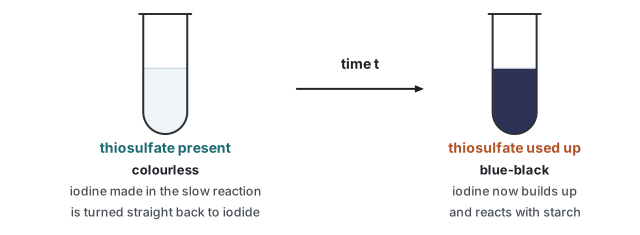
While thiosulfate is present, any iodine made is turned straight back into iodide, so the mixture stays colourless. The second reaction makes the iodide again, so the iodide concentration hardly changes. When all the thiosulfate has been used, the next iodine to form stays, and it gives a blue-black colour with starch. The time t from adding the hydrogen peroxide to that colour is the time taken to make a fixed amount of iodine.
The method 11.12
PracticalVarying the iodide concentration
- Into a conical flask, measure x cm³ of potassium iodide solution (0.10 mol dm⁻³) and (25.0 − x) cm³ of water. The two always make 25.0 cm³.
- Add 5.0 cm³ of sulfuric acid (1.0 mol dm⁻³), 5.0 cm³ of sodium thiosulfate solution (0.0050 mol dm⁻³) and 5.0 cm³ of starch solution.
- Measure 10.0 cm³ of hydrogen peroxide solution (0.10 mol dm⁻³) in a small measuring cylinder.
- Add the hydrogen peroxide to the flask, start the stopwatch at once and swirl.
- Stop the stopwatch when the blue-black colour first appears. Record the time t.
- Repeat with x = 5.0, 10.0, 15.0, 20.0 and 25.0 cm³ of potassium iodide, topping up with water each time. The total volume is always 50.0 cm³.
- Keep the temperature the same in every run, for example by using a water bath.
The volumes in the table below are the ones the method uses. The water makes up the difference so that the total is always 50.0 cm³.
| Experiment | KI(aq) / cm³ | Water / cm³ | [I⁻] in the mixture / mol dm⁻³ |
|---|---|---|---|
| 1 | 5.0 | 20.0 | 0.010 |
| 2 | 10.0 | 15.0 | 0.020 |
| 3 | 15.0 | 10.0 | 0.030 |
| 4 | 20.0 | 5.0 | 0.040 |
| 5 | 25.0 | 0.0 | 0.050 |
Why it works 11.1211.4(i)
Worked exampleThe amount of iodine made before the colour
Calculate the concentration of iodine that forms before the end point, and what fraction of the hydrogen peroxide has been used.
- n(S₂O₃²⁻) = 0.0050 × 0.0050 = 2.5 × 10⁻⁵ mol
- 2 mol of thiosulfate react with 1 mol of iodine, so n(I₂) = 1.25 × 10⁻⁵ mol
- [I₂] formed = 1.25 × 10⁻⁵ ÷ 0.0500 = 2.5 × 10⁻⁴ mol dm⁻³
- [H₂O₂] at the start = 0.10 × 0.0100 ÷ 0.0500 = 0.020 mol dm⁻³. One H₂O₂ makes one I₂, so the fraction used = 2.5 × 10⁻⁴ ÷ 0.020 = 1.25%.
Only 1.25% of the hydrogen peroxide is used by the end point. So the concentrations of hydrogen peroxide, iodide and acid are almost the same as at the start, and the average rate over time t is almost the initial rate.
The same amount of iodine, 2.5 × 10⁻⁴ mol dm⁻³, forms in every experiment. So
Worked exampleRate from a clock time
The blue-black colour appears at t = 61 s. Calculate the rate of formation of iodine.
- rate = 2.5 × 10⁻⁴ ÷ 61
- = 4.1 × 10⁻⁶ mol dm⁻³ s⁻¹
Controlling the variables 11.1211.4(i)
| Variable | How it is controlled | Why it matters |
|---|---|---|
| Volume of H₂O₂, H₂SO₄, thiosulfate, starch | the same in every run | their concentrations must not change |
| Total volume, 50.0 cm³ | water makes up the difference | [I⁻] is then proportional to the volume of KI added |
| Temperature | water bath | k depends on temperature |
| Time when the clock starts | the moment the peroxide is added | the reaction begins when all reagents are together |
| Colour judged by the same person against a white background | a consistent end point | the end point is a judgement |
Check yourself
- Explain why the mixture stays colourless at first and then turns blue-black suddenly.
- Calculate [I⁻] in the final mixture when 15.0 cm³ of 0.10 mol dm⁻³ KI is used in a total volume of 50.0 cm³.
- Calculate the amount of iodine formed when the thiosulfate has been used up, using 5.0 cm³ of 0.0050 mol dm⁻³ Na₂S₂O₃.
- Why is water added to keep the total volume at 50.0 cm³?
- The colour appears at 30 s. Calculate the rate of formation of iodine, using 2.5 × 10⁻⁴ mol dm⁻³ as the amount formed.
- Why must the amount of thiosulfate be small compared with the amount of hydrogen peroxide?
Answers cover these until you have tried the questions
- Iodine is made slowly, but the thiosulfate reacts with it at once, turning it back to iodide, so there is no free iodine and no colour. When the thiosulfate has all been used, the iodine made next is not removed, so it builds up and reacts with the starch to give a blue-black colour at a definite moment.
- [I⁻] = 0.10 × 15.0 ÷ 50.0 = 0.030 mol dm⁻³.
- n(S₂O₃²⁻) = 0.0050 × 5.0 × 10⁻³ = 2.5 × 10⁻⁵ mol. n(I₂) = ½ × 2.5 × 10⁻⁵ = 1.25 × 10⁻⁵ mol.
- So that the concentrations of the other reagents are the same in every run, and the concentration of iodide is proportional to the volume of potassium iodide solution used.
- rate = 2.5 × 10⁻⁴ ÷ 30 = 8.3 × 10⁻⁶ mol dm⁻³ s⁻¹.
- A small amount of thiosulfate means that only a small amount of the peroxide has reacted when the colour appears (here 1.25%), so the concentrations are still almost the initial concentrations. The measured time then gives a rate that is almost the initial rate.