Topic 11 · page 14 of 21
Tertiary halogenoalkanes: the SN1 evidence
When the rate of hydrolysis of a tertiary halogenoalkane does not depend on hydroxide ions, only the halogenoalkane is in the rate-determining step. That points to a two-step mechanism through a carbocation, named SN1.
Read first: Primary halogenoalkanes: the SN2 evidence
The experiment 11.9
A tertiary halogenoalkane such as 2-bromo-2-methylpropane, (CH₃)₃CBr, is hydrolysed by aqueous alkali.
The experiment is the same as for the primary halogenoalkane on page 13: initial rates, changing one concentration at a time. The result is different.
Worked exampleOrders for 2-bromo-2-methylpropane
(Illustrative data.)
| Experiment | [(CH₃)₃CBr] / mol dm⁻³ | [OH⁻] / mol dm⁻³ | Initial rate / 10⁻⁵ mol dm⁻³ s⁻¹ |
|---|---|---|---|
| 1 | 0.10 | 0.10 | 2.0 |
| 2 | 0.20 | 0.10 | 4.0 |
| 3 | 0.10 | 0.20 | 2.0 |
- 1 and 2: [(CH₃)₃CBr] ×2, rate ×2: first order in the halogenoalkane.
- 1 and 3: [OH⁻] ×2, rate unchanged: zero order in hydroxide.
- rate = k[(CH₃)₃CBr], first order overall.
- k = 2.0 × 10⁻⁵ ÷ 0.10 = 2.0 × 10⁻⁴ s⁻¹.
What the rate equation shows 11.9
Only the halogenoalkane is in the rate equation. Hydroxide is not in the rate-determining step. So the slow step involves the halogenoalkane alone. The hydroxide ion must react in a fast step after it, as the zero-order species always does (page 10).
That gives a two-step mechanism.
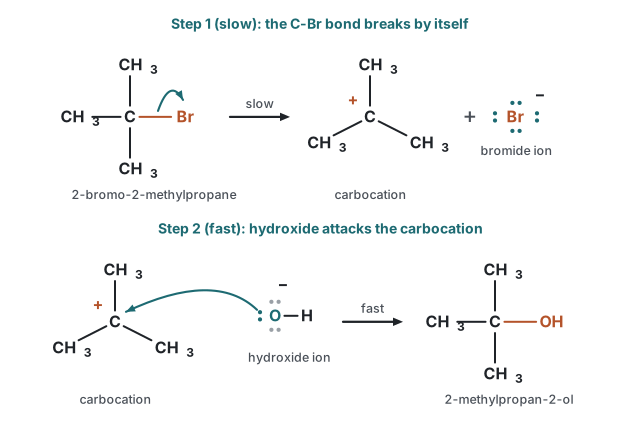
- Step 1 (slow): the C–Br bond breaks heterolytically. The bonding pair goes to bromine, which leaves as Br⁻, and a carbocation forms.
- Step 2 (fast): OH⁻ uses a lone pair to bond to the positive carbon, giving the alcohol.
The carbocation is an intermediate: made in step 1 and used up in step 2. It is not in the rate equation, because it is not in the slow step. The "1" counts the particles in the slow step (the halogenoalkane), not the number of steps. SN1 has two steps.
Telling SN1 from SN2 11.9
The two experiments on pages 13 and 14 differ in one result, the order with respect to hydroxide.
| Primary, SN2 | Tertiary, SN1 | |
|---|---|---|
| Rate equation | rate = k[RBr][OH⁻] | rate = k[RBr] |
| Order in OH⁻ | 1 | 0 |
| Overall order | 2 | 1 |
| Units of k | dm³ mol⁻¹ s⁻¹ | s⁻¹ |
| Steps | one | two |
| Intermediate | none | carbocation |
| Rate-determining step | the only step: RBr and OH⁻ | step 1: RBr alone |
| Effect of doubling [OH⁻] | rate × 2 | no change |
Check yourself
- 2-bromo-2-methylpropane is hydrolysed by aqueous hydroxide with rate = k[(CH₃)₃CBr]. State the order with respect to each reactant and give the units of k.
- Use the data below (illustrative) to find the orders and calculate k, with units.
| Experiment | [(CH₃)₃CBr] / mol dm⁻³ | [OH⁻] / mol dm⁻³ | Initial rate / mol dm⁻³ s⁻¹ |
|---|---|---|---|
| 1 | 0.050 | 0.050 | 1.0 × 10⁻⁵ |
| 2 | 0.10 | 0.050 | 2.0 × 10⁻⁵ |
| 3 | 0.050 | 0.15 | 1.0 × 10⁻⁵ |
- Explain how the rate equation provides evidence for a two-step mechanism, and say which step is slow.
- [OH⁻] is tripled. State the effect on the rate of hydrolysis of (a) 2-bromo-2-methylpropane and (b) 1-bromobutane.
- Describe the two curly arrows in the hydrolysis of 2-chloro-2-methylpropane.
- Name the intermediate formed and explain why it does not appear in the rate equation.
Answers cover these until you have tried the questions
- First order in (CH₃)₃CBr, zero order in OH⁻, first order overall. Units of k: (mol dm⁻³ s⁻¹) ÷ (mol dm⁻³) = s⁻¹.
- 1 and 2: [halogenoalkane] ×2, rate ×2: first order. 1 and 3: [OH⁻] ×3, rate unchanged: zero order. rate = k[(CH₃)₃CBr]. k = 1.0 × 10⁻⁵ ÷ 0.050 = 2.0 × 10⁻⁴ s⁻¹.
- Hydroxide is zero order, so it is not in the rate-determining step, which contains only the halogenoalkane. The OH⁻ must react after the slow step, in a fast step, so there are two steps. The first step, the breaking of the C–halogen bond to form a carbocation, is the slow one.
- (a) No change: it is zero order in OH⁻. (b) ×3: 1-bromobutane is first order in OH⁻.
- Step 1: arrow 1 starts in the middle of the C–Cl bond and ends at Cl, forming Cl⁻ and a carbocation. Step 2: arrow 2 starts at a lone pair on the oxygen of OH⁻ and ends at the positively charged carbon, forming 2-methylpropan-2-ol.
- The carbocation, (CH₃)₃C⁺. It is made in the slow step and used up in the fast step, so it is not a reactant of the rate-determining step. The rate equation has only the species that are in the slow step, and an intermediate is not one of them.