Topic 11 · page 4 of 21
Activation energy and catalysts
Activation energy is the energy barrier colliding particles must clear. A catalyst gives a route with a lower barrier. It is homogeneous if it is in the same phase as the reactants and heterogeneous if it is not.
Topic 9 introduced both ideas qualitatively, with collision theory and reaction profiles. This page fixes the definitions so that you can use them in rate equations, Arrhenius calculations and mechanisms.
Activation energy 11.1(viii)
Particles collide all the time, but only those with at least this energy react. The rest bounce apart. Activation energy is written and measured in kJ mol⁻¹ (or J mol⁻¹ in the calculations on page 15 and page 16).
A larger activation energy means that a smaller fraction of collisions is successful at a given temperature, so k is smaller and the reaction is slower. A reaction profile shows the barrier as the height from the reactants to the top of the hump.
Catalysts 11.1(ix)
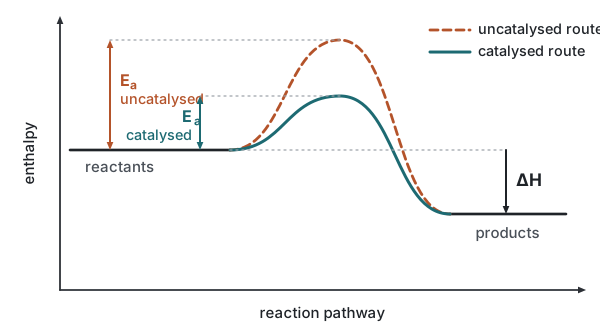
The catalyst changes the route, not the starting and finishing points. So:
- is lower, so k is larger and the reaction is faster
- ΔH is the same, because the reactants and products are the same
- the position of equilibrium is unchanged, because the forward and reverse reactions are speeded up equally
Homogeneous and heterogeneous 11.1(ix)
Catalysts are classified by their phase compared with the reactants. The phases are solid, liquid, gas and aqueous.
| Reaction | Catalyst | Phase of catalyst | Phase of reactants | Type |
|---|---|---|---|---|
| propanone with iodine | H⁺(aq) | aqueous | aqueous | homogeneous |
| hydrolysis of an ester by acid | H⁺(aq) | aqueous | aqueous | homogeneous |
| Haber process, N₂ + 3H₂ ⇌ 2NH₃ | iron, Fe(s) | solid | gases | heterogeneous |
| Contact process, 2SO₂ + O₂ ⇌ 2SO₃ | vanadium(V) oxide, V₂O₅(s) | solid | gases | heterogeneous |
| decomposition of hydrogen peroxide | manganese(IV) oxide, MnO₂(s) | solid | aqueous | heterogeneous |
The question to ask is "same phase as what?". It is the reactants, not the products and not the solvent in general. Sulfuric acid in water is aqueous H⁺(aq), and it catalyses a reaction between aqueous reactants, so it is homogeneous.
A homogeneous catalyst takes part in the mechanism and is given back. Because it can be involved in the rate-determining step, it can appear in the rate equation with an order of its own. The hydrogen ion does this in the iodination of propanone (page 11). Heterogeneous catalysts work on their surface, and page 17 explains how.
Check yourself
- Define activation energy.
- Define a catalyst, and state what it does to the activation energy.
- State what happens to ΔH and to the position of equilibrium when a catalyst is added.
- Classify these catalysts as homogeneous or heterogeneous, with a reason: (a) H⁺(aq) in the reaction of aqueous propanone with aqueous iodine, (b) solid iron in the reaction of N₂(g) with H₂(g).
- A student writes "a catalyst makes the reaction go faster because the particles have more energy". Explain what is wrong and give a correct explanation.
- Why can a homogeneous catalyst appear in a rate equation?
Answers cover these until you have tried the questions
- The minimum energy that colliding particles must have for a reaction to occur.
- A catalyst is a substance that increases the rate of a reaction by providing an alternative route with a lower activation energy, and is not used up. It lowers the activation energy.
- ΔH is unchanged, and so is the position of equilibrium. The catalyst only changes the route, and it speeds up the forward and the reverse reactions equally.
- (a) Homogeneous: H⁺(aq) is in the same phase (aqueous) as both reactants. (b) Heterogeneous: iron is a solid and the reactants are gases, so it is in a different phase.
- The catalyst does not give the particles more energy. It provides an alternative route with a lower activation energy, so a larger proportion of collisions has at least the energy needed, and more collisions succeed per second.
- It takes part in the mechanism, so it can be one of the species in the rate-determining step. Any species in the rate-determining step appears in the rate equation, even though the catalyst is regenerated and is not in the overall equation.