Topic 11 · page 5 of 21
Choosing a technique to follow a reaction
To measure a rate you need something that changes as the reaction goes and that you can measure while it happens. Match the technique to the reaction, then justify it by naming the species and the property.
You cannot watch a concentration directly. You watch a property that changes with it: the volume of gas given off, the mass of the flask, the colour, the amount of acid left. A technique is good for a reaction if the property changes clearly and you can measure it without disturbing the reaction.
MethodChoosing a technique
- Ask what changes. Is there a gas, a coloured species, an acid or alkali, or a change in the ions present?
- Ask whether you can measure it while the reaction runs (continuous) or only by taking a sample and stopping the reaction there (sampling).
- Check the change is large enough for the instrument. A balance reading to 0.01 g cannot detect a loss of 0.005 g.
Gas volume and mass change 11.3(iii)11.3(iv)
If a gas is produced, there are two continuous methods.
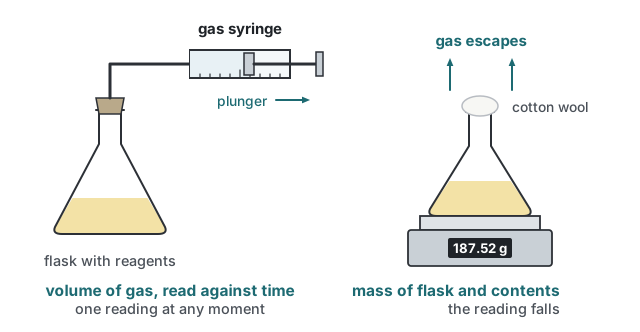
Volume of gas evolved. The flask is sealed and connected to a gas syringe. Start the clock the moment the reagents are mixed and read the syringe at regular intervals. It suits a gas that is not very soluble, such as H₂ or O₂. Gases that dissolve well, such as CO₂, SO₂ or HCl, are better measured another way, or in a syringe where little of the gas contacts water.
Mass change. If the gas escapes, the flask gets lighter, and the mass lost is the mass of gas. A plug of cotton wool lets the gas out and stops spray. It suits a dense gas, where a small volume has a large mass.
| Gas, 100 cm³ at RTP | Amount / mol | Mass lost / g | Can a 0.01 g balance follow it? |
|---|---|---|---|
| CO₂, M = 44.0 | 100 ÷ 24 000 = 4.17 × 10⁻³ | 0.18 | yes |
| H₂, M = 2.0 | 100 ÷ 24 000 = 4.17 × 10⁻³ | 0.0083 | no, less than one reading step |
So for CaCO₃ with acid, either method works, but for Mg with acid, which gives H₂, the gas syringe is the right choice.
Colorimetry 11.3(ii)
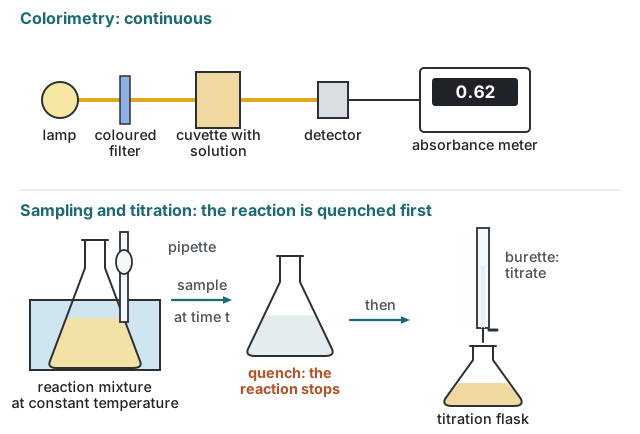
A colorimeter shines light through the mixture and measures how much is absorbed. If one species in the reaction is coloured, the absorbance changes as its concentration changes. The reading is continuous and nothing is removed.
Three details earn marks.
- Only one species should be coloured, or the others should absorb at a different colour. Then the absorbance is a measure of that species alone.
- Choose a filter of the colour that the solution absorbs most, which is the colour complementary to the solution. A brown or orange solution of iodine or bromine absorbs blue light, so a blue filter gives the biggest change.
- To turn absorbance into concentration, measure the absorbance of standard solutions of known concentration and draw a calibration curve. Read concentrations from it.
Titration and quenching 11.3(i)
A titration cannot be done in the reaction flask without stopping the reaction. So you take a sample with a pipette at a noted time, quench it, and titrate it.
A reaction can be quenched by:
- cooling the sample rapidly in ice
- diluting it with cold water
- removing the catalyst, for example neutralising an acid catalyst with sodium hydrogencarbonate
- adding an excess of a reagent that reacts with one reactant straight away, followed by a back titration
Record the time at which the sample is quenched, not the time at which it is titrated. Titration suits a reactant or product that can be titrated, such as an acid, an alkali or iodine (with sodium thiosulfate). Its weaknesses are that it gives separate points rather than a continuous curve, and that every sample uses up some of the mixture.
Other techniques 11.3(v)
Any property that changes with concentration can be used, as long as it is measured in a way that does not stop the reaction.
| Technique | Property | Suits | Example |
|---|---|---|---|
| pH meter | [H⁺] or [OH⁻] changes | acid or alkali used up or made | hydrolysis of an ester by NaOH(aq) |
| conductivity meter | number or type of ions changes | ions made or used up | (CH₃)₃CBr + H₂O → (CH₃)₃COH + H⁺ + Br⁻ |
A pH reading is logarithmic, so convert it to a concentration with before plotting a concentration–time graph. Timing how long a cloudiness takes to hide a cross (Topic 9) is another technique, for reactions that form a precipitate.
Choosing and justifying 11.3(i)11.3(ii)11.3(iii)11.3(iv)11.3(v)
"Justify" means more than naming a technique. Say which species or property changes, and why that makes the measurement possible.
Worked exampleBromine and methanoic acid
Suggest a technique to follow $$ \ce{Br2(aq) + HCOOH(aq) -> 2HBr(aq) + CO2(g)} $$
- Bromine is orange. Methanoic acid, hydrogen bromide and water are colourless.
- Colorimetry: the absorbance falls steadily as the bromine is used up, because bromine is the only coloured species.
- A gas syringe also works, because CO₂ is the only gas made, but CO₂ dissolves a little in water.
Worked exampleHydrolysis of an ester
Suggest a technique to follow the reaction of ethyl ethanoate with sodium hydroxide, CH₃COOC₂H₅ + OH⁻ → CH₃COO⁻ + C₂H₅OH.
- Hydroxide ions are used up, so the mixture becomes less alkaline. A pH meter or titration of quenched samples against standard acid can follow this.
- Hydroxide ions are replaced by ethanoate ions, which carry the charge less well, so the conductivity falls. This also works, and needs no sampling.
Check yourself
- Suggest a technique to follow the decomposition of hydrogen peroxide catalysed by manganese(IV) oxide, 2H₂O₂(aq) → 2H₂O(l) + O₂(g), and justify it.
- 60 cm³ of hydrogen at RTP escapes from a flask. Calculate the mass lost, in g, and explain why a balance reading to 0.01 g cannot follow this reaction. ( of H₂ = 2.0; molar volume 24.0 dm³ mol⁻¹)
- Explain why a sample must be quenched before it is titrated, and give two ways of quenching.
- A colorimeter is used to follow a reaction in which a yellow-brown solution of iodine loses its colour. State the colour of filter you would use and how you would turn absorbance readings into concentrations.
- Suggest and justify a technique for CH₃COCH₃(aq) + I₂(aq) → CH₃COCH₂I(aq) + H⁺(aq) + I⁻(aq).
- Suggest one technique for (CH₃)₃CCl + H₂O → (CH₃)₃COH + H⁺ + Cl⁻ that needs no sampling, and justify it.
Answers cover these until you have tried the questions
- A gas syringe: oxygen is the only gas made, and the volume of O₂ collected is proportional to the amount of peroxide that has reacted, so the volume–time readings can be taken continuously. (Mass change also works, but the change is smaller because O₂ is lighter than CO₂.)
- n(H₂) = 0.060 ÷ 24.0 = 2.5 × 10⁻³ mol. Mass = 2.5 × 10⁻³ × 2.0 = 0.0050 g. This is half of the smallest division on the balance, so the mass would hardly change over the whole reaction.
- If the reaction is not stopped it carries on while the sample is titrated, so the titre would not match the time of sampling. Quench by cooling in ice, by dilution with cold water, or by removing the catalyst, for example neutralising an acid catalyst with sodium hydrogencarbonate.
- A blue filter, because the yellow-brown solution absorbs blue light most strongly. Measure the absorbance of standard solutions of known iodine concentration, draw a calibration curve of absorbance against concentration, and read concentrations from it.
- Colorimetry, because iodine is the only coloured species, so the absorbance falls as iodine is used up. (Titration of quenched samples with sodium thiosulfate also works, because iodine can be titrated.)
- Conductivity: ions (H⁺ and Cl⁻) are made as the reaction proceeds, so the conductivity rises with the amount reacted. A pH meter would also work, because [H⁺] rises.