Topic 2 · page 14 of 15
Explaining ionisation energy trends
Across a period the first ionisation energy rises overall, with two dips at the start of each p sub-shell and at the first pair. Down a group it falls. Each trend is explained by nuclear charge, shielding and distance, and sub-shell.
Read first: Ionisation energy, Filling the orbitals
Your three tools 2.10
Every ionisation energy question comes down to the attraction between the nucleus and the electron being removed. You have three ways to change that attraction:
- nuclear charge: more protons, more attraction
- shielding and distance: more inner shells, a bigger distance, less attraction
- the sub-shell the electron is in, and whether it is paired: a higher-energy sub-shell, or repulsion from a partner in the same orbital, makes the electron easier to remove
A good answer names the factor, says which element has more or less of it, and ends with a statement about the attraction and the energy needed.
Across a period: the general increase 2.18(ii)
Here are the first ionisation energies (kJ mol⁻¹) of Periods 2 and 3. The dips are in bold.
| Group | Period 2 | Period 3 |
|---|---|---|
| 1 | Li 520 | Na 496 |
| 2 | Be 900 | Mg 738 |
| 3 | B 801 | Al 578 |
| 4 | C 1086 | Si 787 |
| 5 | N 1402 | P 1012 |
| 6 | O 1314 | S 1000 |
| 7 | F 1681 | Cl 1251 |
| 0 | Ne 2081 | Ar 1521 |
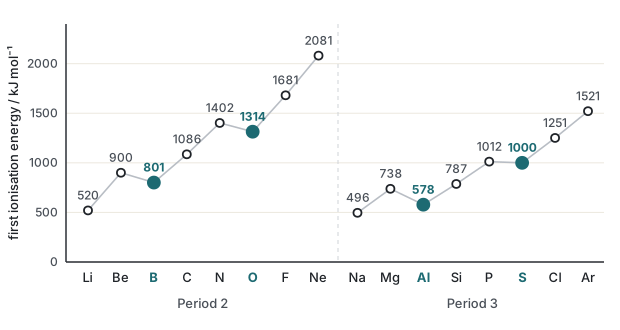
The overall trend is a rise from Group 1 to Group 0. Going across a period:
- The number of protons increases, so the nuclear charge increases.
- The electron removed comes from the same shell each time, so the distance and the shielding by inner shells hardly change.
- So the attraction between the nucleus and the outer electron gets stronger, and more energy is needed.
There is a large fall from the end of one period to the start of the next, for example from neon (2081) to sodium (496). Sodium's outer electron is in a new shell, further from the nucleus and shielded by the ten electrons of the inner shells. This outweighs the extra proton.
Two dips in every period 2.18(ii)
The general rise breaks twice in each period.
Be to B, and Mg to Al
Beryllium's outer electron is in the 2s sub-shell. In boron the outer electron is in 2p, which is at a higher energy than 2s. It is also partly shielded by the 2s electrons. These effects outweigh the extra proton. So boron's outer electron is easier to remove. Magnesium to aluminium (3s to 3p) is the same.
N to O, and P to S
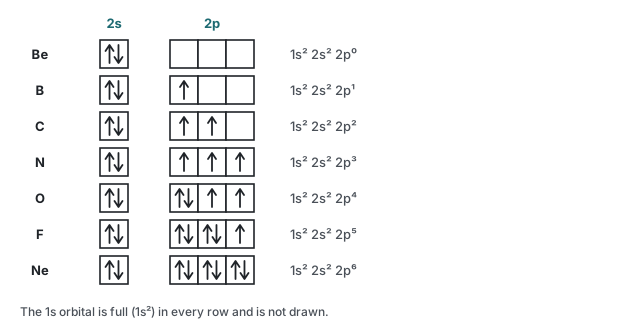
In nitrogen the three 2p electrons are in separate orbitals. In oxygen the fourth 2p electron must pair up in an orbital that already holds an electron. The two electrons in that orbital repel each other, so one is easier to remove. This outweighs the extra proton. Phosphorus to sulfur (3p) is the same.
Worked exampleWhy is the first ionisation energy of oxygen lower than that of nitrogen?
N: 1402 kJ mol⁻¹. O: 1314 kJ mol⁻¹.
- Nitrogen's 2p electrons are 2p³, one in each orbital. Oxygen's are 2p⁴, so one orbital contains a pair of electrons.
- The electron removed from oxygen comes from this pair, and the two electrons repel each other.
- This repulsion outweighs the extra proton in oxygen, so the electron is easier to remove and less energy is needed.
Worked exampleWhy is the first ionisation energy of aluminium lower than that of magnesium?
Mg: 738 kJ mol⁻¹. Al: 578 kJ mol⁻¹.
- Magnesium's outer electron is in the 3s sub-shell. Aluminium's is in 3p, which is higher in energy and is shielded by the 3s electrons.
- This outweighs the extra proton in aluminium.
- So aluminium's outer electron is held less strongly, and less energy is needed.
Down a group 2.18(iii)
Look at the first ionisation energy of any group going down. Both groups below fall.
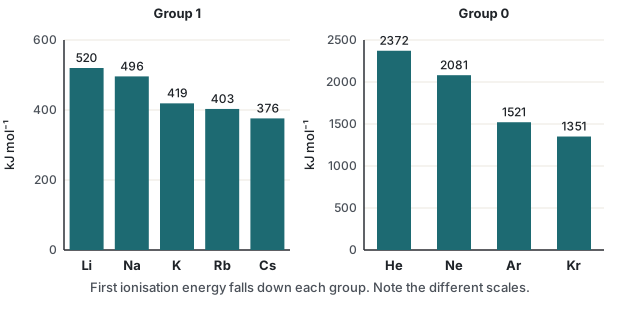
Going down a group:
- The outer electron is in a new shell, further from the nucleus.
- There are more inner shells, so there is more shielding.
- The nuclear charge increases, but the extra distance and shielding outweigh it. The attraction for the outer electron is weaker, so less energy is needed.
Check yourself
- Explain why the first ionisation energy generally increases from sodium to argon.
- Explain why the first ionisation energy of boron (801) is lower than that of beryllium (900).
- Explain why the first ionisation energy of sulfur (1000) is lower than that of phosphorus (1012).
- Explain why the first ionisation energy of potassium (419) is lower than that of sodium (496).
- Explain why the first ionisation energy of sodium (496) is much lower than that of neon (2081).
- The first ionisation energies of the Group 2 elements Be, Mg and Ca are 900, 738 and 590 kJ mol⁻¹. Describe and explain the trend, and predict whether strontium is higher or lower than calcium.
Answers cover these until you have tried the questions
- The nuclear charge increases from 11 to 18 protons. The electron removed is in the same shell (the 3rd) each time, so the shielding and distance are about the same. The attraction between the nucleus and the outer electron increases, so more energy is needed.
- Boron's outer electron is in a 2p sub-shell, which is higher in energy than the 2s sub-shell holding beryllium's outer electron (and it is shielded by the 2s electrons). This outweighs boron's extra proton, so less energy is needed.
- In sulfur the outer electron is removed from a 3p orbital that holds a pair of electrons. The repulsion between the two electrons makes it easier to remove. In phosphorus the three 3p electrons are all in separate orbitals. The repulsion outweighs the extra proton in sulfur.
- Potassium's outer electron is in the 4th shell, further from the nucleus than sodium's (3rd shell), and is shielded by more inner shells. This outweighs the greater nuclear charge, so the attraction is weaker and less energy is needed.
- Sodium's outer electron is in a new shell (the 3rd), further from the nucleus than neon's outer electron (2nd shell), and is shielded by the 10 electrons in the two inner shells. This outweighs sodium's greater nuclear charge. Neon's outer electron is in the 2nd shell, close to the nucleus.
- The first ionisation energy decreases down the group (900 to 738 to 590). Each outer electron is in a new shell, further from the nucleus, with more inner shells shielding it. These outweigh the increased nuclear charge, so the attraction is weaker. Strontium is one shell further down, so it is lower than calcium (it is 550).