Topic 2 · page 8 of 15
Successive ionisation energies
Take the electrons off an atom one at a time and the energies jump each time you start on a new shell. The jumps are evidence for shells, and the position of the first jump gives the group.
Read first: Ionisation energy
Evidence for shells 2.11(i)
Ionisation energies give two pieces of evidence for how electrons are arranged. The first comes from removing every electron from one atom, one at a time. These are the successive ionisation energies: the first, second, third, and so on.
Here are the values for sodium, which has 11 electrons.
| Electron removed | 1 | 2 | 3 | 4 | 5 | 6 |
|---|---|---|---|---|---|---|
| Energy / kJ mol⁻¹ | 496 | 4562 | 6910 | 9543 | 13 354 | 16 613 |
| Electron removed | 7 | 8 | 9 | 10 | 11 |
|---|---|---|---|---|---|
| Energy / kJ mol⁻¹ | 20 117 | 25 496 | 28 932 | 141 362 | 159 076 |
The numbers run from 496 to 159 076. On an ordinary axis the small ones would be squashed together at the bottom. So the graph uses the logarithm (lg, meaning log₁₀) of each value. The log of a number is the power of 10 that gives it, so lg 496 = 2.70 and lg 159 076 = 5.20, a much smaller range.
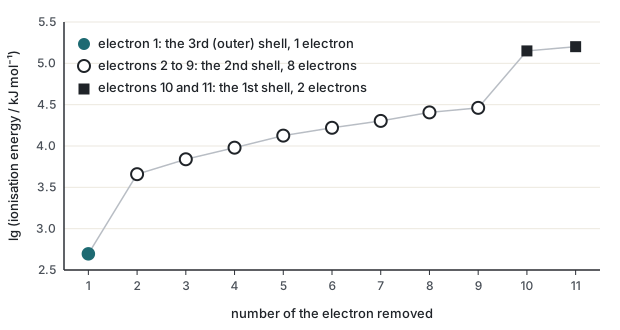
Read the graph from left to right:
- Electron 1 comes off easily. Then there is a big jump to electron 2.
- Electrons 2 to 9 rise gently. Then there is another big jump to electron 10.
- Electrons 10 and 11 are the hardest of all.
Within one shell, each electron is pulled off a particle that is more positive than before, so the energy rises steadily. A big jump means the next electron is in a different shell: one closer to the nucleus, with less shielding, so it is held far more strongly.
Finding the group 2.11(i)
The electrons in the outer shell are the easiest to remove. So the number of electrons removed before the first big jump equals the number of outer electrons, and that is the group number.
| Element | Successive ionisation energies / kJ mol⁻¹ | First big jump after | Group |
|---|---|---|---|
| Mg | 738, 1451, 7733, 10 543 | electron 2 | 2 |
| Al | 578, 1817, 2745, 11 577, 14 842 | electron 3 | 3 |
| Si | 787, 1577, 3232, 4356, 16 091 | electron 4 | 4 |
| P | 1012, 1907, 2914, 4964, 6274, 21 267 | electron 5 | 5 |
The bold value is the first electron on the far side of the jump. A jump between electron 3 and electron 4 means three electrons in the outer shell, not four.
Worked exampleWhich group is element X in?
X has successive ionisation energies of 578, 1817, 2745, 11 577 and 14 842 kJ mol⁻¹.
- Compare neighbouring values. 578 to 1817 is a rise of about 3 times. 1817 to 2745 is about 1.5 times. 2745 to 11 577 is about 4 times.
- The big jump comes between the 3rd and 4th electrons, so there are 3 electrons in the outer shell.
- X is in Group 3. (It is aluminium.)
Worked exampleShell structure from successive ionisation energies
Chlorine's 17 values show big jumps after electron 7 and after electron 15.
- Electrons 1 to 7 are the outer shell: 7 electrons.
- Electrons 8 to 15 are the next shell in: 8 electrons.
- Electrons 16 and 17 are the innermost shell: 2 electrons.
The electrons come off from the outside in, so the shells are counted 7, 8, 2. Written from the nucleus outwards, chlorine is 2, 8, 7. The 7 in the outer shell also puts chlorine in Group 7.
Check yourself
- Explain why the successive ionisation energies of an element always increase.
- An element has successive ionisation energies of 1086, 2353, 4621, 6223, 37 831 and 47 277 kJ mol⁻¹. Which group is it in?
- Another element has successive ionisation energies of 419, 3052, 4420 and 5877 kJ mol⁻¹. Which group is it in?
- Describe the shape of a graph of lg (ionisation energy) against number of electrons removed for magnesium.
- Explain the big jump between the 9th and 10th ionisation energies of sodium.
- Explain why a graph of successive ionisation energies uses a logarithmic axis.
Answers cover these until you have tried the questions
- Each electron is removed from a particle with one more positive charge than before. The nuclear charge is unchanged but there are fewer electrons, so there is less repulsion and the remaining electrons are held more tightly.
- The big jump is between the 4th (6223) and 5th (37 831) electrons, so there are 4 electrons in the outer shell: Group 4. (It is carbon.)
- The first jump is after the 1st electron (419 to 3052, about 7 times): Group 1.
- Electrons 1 and 2 form a low section, then a large jump up. Electrons 3 to 10 rise gently, then another large jump up. Electrons 11 and 12 are the highest. The groups are 2, 8 and 2.
- The 10th electron is the first from the shell nearest the nucleus (the 1st shell). It is closer and has no inner electrons to shield it, so the attraction is much stronger than for the 9th electron, which comes from the 2nd shell.
- The values range from hundreds to hundreds of thousands. A logarithm compresses the range so that all the points fit on one graph and the jumps can be seen.