Topic 2 · page 1 of 15
Inside the atom
An atom is a tiny nucleus of protons and neutrons with electrons around it. Two whole numbers, the atomic number and the mass number, tell you how many of each particle an atom or ion contains.
The structure of an atom 2.1
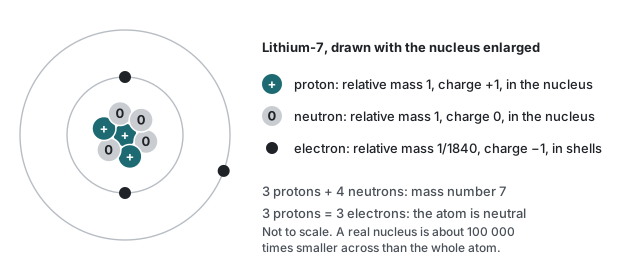
Every atom has two regions. At the centre is the nucleus, which contains protons and neutrons. Around the nucleus, in regions called shells, are the electrons.
The nucleus is tiny compared with the whole atom, yet it holds almost all of the mass. The electrons are very light but spread out, so they take up almost all of the volume.
Relative mass and charge 2.2
The mass of one proton is about 1.67 × 10⁻²⁷ kg, which is awkward to write. So the particles are compared with a proton, which is given a relative mass of 1.
| Particle | Where it is | Relative mass | Relative charge |
|---|---|---|---|
| proton | nucleus | 1 | +1 |
| neutron | nucleus | 1 | 0 |
| electron | shells around the nucleus | 1/1840 | −1 |
An electron has about one eighteen-hundredth of the mass of a proton. That is so small that electrons are ignored when you work out the mass of an atom.
A neutral atom has no overall charge, so it has equal numbers of protons and electrons. The +1 and −1 charges cancel.
Atomic number and mass number 2.3
Two whole numbers describe the nucleus.
Some books call the mass number the nucleon number, because protons and neutrons are both nucleons. They are written either side of the symbol:
The atomic number is the identity of the element. Every atom with 11 protons is sodium, whatever its number of neutrons. The mass number only tells you the mass of one particular atom.
Counting the particles in atoms and ions 2.4
Three rules give every count:
- protons = atomic number, Z
- neutrons = mass number − atomic number = A − Z
- electrons = Z in a neutral atom; for an ion, Z − charge
The last rule does the work for ions. A positive ion has lost electrons, so it has fewer than the atom. A negative ion has gained electrons. Forming an ion never changes the nucleus.
| Species | Protons | Neutrons | Electrons |
|---|---|---|---|
| ²³Na | 11 | 12 | 11 |
| ²³Na⁺ | 11 | 12 | 10 |
| ³⁵Cl | 17 | 18 | 17 |
| ³⁷Cl⁻ | 17 | 20 | 18 |
Worked exampleParticles in ⁵⁶Fe³⁺ and ³¹P³⁻
⁵⁶Fe³⁺ (Z = 26, A = 56, charge 3+)
- Protons = 26
- Neutrons = 56 − 26 = 30
- Electrons = 26 − 3 = 23, because a 3+ ion has lost three electrons
³¹P³⁻ (Z = 15, A = 31, charge 3−)
- Protons = 15
- Neutrons = 31 − 15 = 16
- Electrons = 15 − (−3) = 18, because a 3− ion has gained three electrons
Atoms and ions with the same number of electrons are often compared. Na⁺, Ne and F⁻ all have 10, so they have the same arrangement of electrons even though their nuclei differ. This idea returns when you write electronic configurations of ions.
Check yourself
- State the relative mass and relative charge of a proton, a neutron and an electron.
- How many neutrons are in one atom of ⁴⁰Ar and in one ion of ⁴⁰Ca²⁺? How many electrons does the ion have?
- A species has 16 protons, 18 neutrons and 18 electrons. Write its symbol with mass number and charge.
- Give the number of protons, neutrons and electrons in ²⁷Al³⁺ and in ¹⁹F⁻.
- Which of Mg²⁺, F⁻, Ne and Cl⁻ have the same number of electrons?
- A student says that ²³Na⁺ has a mass number of 22 because it has lost an electron. What is wrong?
Answers cover these until you have tried the questions
- Proton: relative mass 1, charge +1. Neutron: 1, 0. Electron: 1/1840, −1.
- Argon has Z = 18, so neutrons = 40 − 18 = 22. Calcium has Z = 20, so neutrons = 40 − 20 = 20. The ion has 20 − 2 = 18 electrons.
- 16 protons means sulfur. A = 16 + 18 = 34. Charge = 16 − 18 = −2. The symbol is ³⁴S²⁻.
- ²⁷Al³⁺: 13 protons, 27 − 13 = 14 neutrons, 13 − 3 = 10 electrons. ¹⁹F⁻: 9 protons, 19 − 9 = 10 neutrons, 9 + 1 = 10 electrons.
- Mg²⁺: 12 − 2 = 10. F⁻: 9 + 1 = 10. Ne: 10. Cl⁻: 17 + 1 = 18. So Mg²⁺, F⁻ and Ne have the same number of electrons.
- The mass number counts protons and neutrons only. Losing an electron changes the charge but not the nucleus, so the mass number is still 23.