Topic 2 · page 13 of 15
Blocks of the Periodic Table, and why configuration matters
The Periodic Table is organised by electronic configuration. Elements fall into s, p and d blocks by the sub-shell being filled, and the outer electrons decide how an element reacts.
Read first: Filling the orbitals, Potassium to krypton, and ions
Blocks 2.16
Each element is placed one step further along the same filling order that you have been using. So the table has a shape that matches the sub-shells.
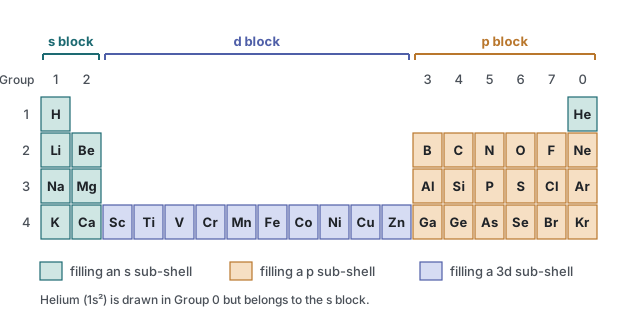
The width of each block is the capacity of its sub-shell:
| Block | Sub-shell | Electrons it holds | Columns wide |
|---|---|---|---|
| s | s | 2 | 2 (Groups 1 and 2) |
| p | p | 6 | 6 (Groups 3 to 0) |
| d | d | 10 | 10 (between Groups 2 and 3, from Period 4) |
The d block starts in Period 4 because 3d only fills after 4s. Period 4 is therefore 18 elements long: 2 (s) + 10 (d) + 6 (p).
You can read a lot from a configuration. The period is the highest shell number in use. For s- and p-block elements the group is the number of electrons in the outer shell, counting both s and p electrons.
| Configuration | Element | Period | Group | Block |
|---|---|---|---|---|
| [Ne] 3s² | Mg | 3 | 2 | s |
| [Ne] 3s² 3p⁴ | S | 3 | 6 | p |
| [Ar] 3d⁶ 4s² | Fe | 4 | (transition region) | d |
| [Ar] 3d¹⁰ 4s² 4p¹ | Ga | 4 | 3 | p |
Worked examplePlace the element with the configuration [Ne] 3s² 3p³
- The highest shell is 3, so it is in Period 3.
- The outer shell has 2 + 3 = 5 electrons, so Group 5.
- The last sub-shell filled is 3p, so it is in the p block.
- Count electrons: 10 + 2 + 3 = 15, so the element is phosphorus.
Configuration decides chemistry 2.15
A chemical reaction is a rearrangement of electrons, and only the outer electrons are involved. The inner shells are tightly held by the nucleus and stay put. So the outer configuration decides how an element behaves.
Elements in the same group have the same outer configuration, so they react in similar ways:
| Element | Configuration | Outer electrons |
|---|---|---|
| Li | [He] 2s¹ | s¹ |
| Na | [Ne] 3s¹ | s¹ |
| K | [Ar] 4s¹ | s¹ |
Each one has a single outer electron that is easy to lose, so each forms a 1+ ion and reacts with water in the same way:
The same idea explains other patterns:
- Group 1 loses its one s electron to form M⁺. Group 2 loses two s electrons to form M²⁺.
- Group 7 has the outer configuration s² p⁵. It gains one electron to make s² p⁶, forming X⁻.
- Group 0 has full outer s and p sub-shells (s² p⁶, or 1s² for helium), a very high first ionisation energy, and almost no tendency to react.
- Isotopes of one element have identical configurations, so they have identical chemistry.
Check yourself
- State the block of each of these elements: magnesium, aluminium, iron, bromine.
- An element has the configuration [Ne] 3s² 3p⁴. Give its group, period and block, and name it.
- How many elements are in the d block in Period 4? Explain why.
- Explain why sodium and potassium react with water in a similar way.
- Write the formulae of the ions formed by magnesium and bromine and explain each in terms of electronic configuration.
- Why is helium in the s block but placed above neon in the Periodic Table?
Answers cover these until you have tried the questions
- Mg: s (3s²). Al: p (3p¹). Fe: d ([Ar] 3d⁶ 4s²). Br: p (4p⁵).
- Highest shell 3, so Period 3. Outer electrons 2 + 4 = 6, so Group 6. The last sub-shell filled is 3p, so the p block. The electrons total 16, so it is sulfur.
- 10. The 3d sub-shell has 5 orbitals, each holding 2 electrons, so it holds 10 electrons and 10 elements fill it (Sc to Zn).
- Both have one electron in the outer s orbital ([Ne] 3s¹ and [Ar] 4s¹). Each loses that electron to form a 1+ ion, so the reactions are alike.
- Magnesium ([Ne] 3s²) loses its two outer electrons to form Mg²⁺ (1s² 2s² 2p⁶). Bromine ([Ar] 3d¹⁰ 4s² 4p⁵) gains one electron into 4p to form Br⁻ (4p⁶).
- Its configuration is 1s², so its last electron is in an s orbital. It is placed in Group 0 because it is a noble gas with a full outer shell, like neon.