Topic 2 · page 11 of 15
Filling the orbitals
Electrons fill the lowest-energy sub-shell first, spread out singly across the orbitals of a sub-shell, and only then pair up with opposite spins. Use these rules to write configurations from hydrogen to argon.
Read first: Orbitals, sub-shells and shells
The three filling rules 2.13(i)2.13(ii)
The electronic configuration of an atom says which orbitals its electrons occupy. To write it, add electrons one at a time using three rules.
- Lowest energy first. Each electron goes into the lowest-energy sub-shell that still has room (the order is 1s, 2s, 2p, 3s, 3p, 4s, 3d, 4p).
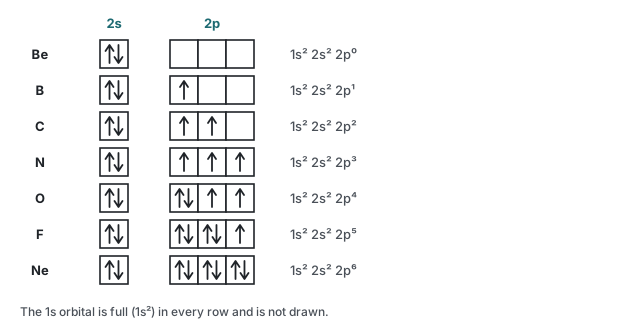
- Single before pairing. The orbitals in a sub-shell each take one electron before any orbital gets a second.
- Pairs have opposite spins. When an orbital does hold two electrons, they have opposite spin, drawn ↑↓.
Rule 2 is about repulsion. Electrons are all negative, so two electrons in the same orbital, in the same small region of space, repel each other more than two electrons in different orbitals. The atom has the lowest energy when the electrons spread out. Single electrons in separate orbitals are drawn with their arrows pointing the same way.
Two ways to write a configuration 2.14
s, p, d notation writes each sub-shell with the number of electrons as a superscript: 1s² 2s² 2p³ means two electrons in 1s, two in 2s and three in 2p.
Electrons-in-boxes notation draws one box for each orbital and an arrow for each electron. A pair is drawn ↑↓ in one box.
For atoms with many electrons, the inner part can be replaced by the symbol of the noble gas with the same core: [He] for 1s², [Ne] for 1s² 2s² 2p⁶ and [Ar] for 1s² 2s² 2p⁶ 3s² 3p⁶. Nitrogen is then [He] 2s² 2p³.
MethodWriting a configuration from the atomic number
- The number of electrons in a neutral atom equals its atomic number.
- Fill the sub-shells in energy order, using the capacities 2 (s), 6 (p) and 10 (d): 1s² 2s² 2p⁶ 3s² 3p⁶ 4s² 3d¹⁰ 4p⁶. Stop when you have used all the electrons.
- Check that the superscripts add up to the number of electrons.
- For electrons in boxes, draw the boxes of the last partly filled sub-shell and put in one arrow per box before you start pairing.
Worked exampleOxygen (8 electrons)
- Fill in order: 1s² (2 electrons used), 2s² (4 used), then 4 left for 2p.
- Configuration: 1s² 2s² 2p⁴, or [He] 2s² 2p⁴.
- The 2p sub-shell has 3 orbitals. Put one electron in each (3 electrons), then the fourth pairs up with the first: [↑↓] [↑] [↑].
- Oxygen has 2 unpaired electrons.
Worked examplePhosphorus (15 electrons)
- 1s² (2), 2s² (4), 2p⁶ (10), 3s² (12), leaving 3 for 3p.
- Configuration: 1s² 2s² 2p⁶ 3s² 3p³, or [Ne] 3s² 3p³.
- The three 3p electrons go one in each orbital, with no pairing: [↑] [↑] [↑].
Hydrogen is 1s¹ and helium is 1s². The table shows the configurations of Periods 2 and 3, group by group.
| Group | Period 2 | Period 3 |
|---|---|---|
| 1 | Li [He] 2s¹ | Na [Ne] 3s¹ |
| 2 | Be [He] 2s² | Mg [Ne] 3s² |
| 3 | B [He] 2s² 2p¹ | Al [Ne] 3s² 3p¹ |
| 4 | C [He] 2s² 2p² | Si [Ne] 3s² 3p² |
| 5 | N [He] 2s² 2p³ | P [Ne] 3s² 3p³ |
| 6 | O [He] 2s² 2p⁴ | S [Ne] 3s² 3p⁴ |
| 7 | F [He] 2s² 2p⁵ | Cl [Ne] 3s² 3p⁵ |
| 0 | Ne [He] 2s² 2p⁶ | Ar [Ne] 3s² 3p⁶ |
Read down a column and you can see the pattern: the outer electrons are in the same arrangement in a group, with the shell number one higher in the next period. This is why a group behaves as a family (see Blocks and chemistry).
Check yourself
- Write the full electronic configuration of a chlorine atom.
- Draw the 2s and 2p electrons of carbon in boxes.
- Write the configuration of phosphorus in [Ne] form. How many unpaired electrons does a phosphorus atom have?
- Explain why nitrogen's three 2p electrons are in separate orbitals rather than as a pair plus a single electron.
- Which element has the configuration 1s² 2s² 2p⁶ 3s² 3p²?
- How many unpaired electrons does an oxygen atom have? What about neon?
Answers cover these until you have tried the questions
- Chlorine has 17 electrons: 1s² 2s² 2p⁶ 3s² 3p⁵.
- Carbon has 6 electrons, so 1s² (2), 2s² (4) and 2p² (2). Boxes: 2s [↑↓]; 2p [↑] [↑] [ ]. The two 2p electrons are in separate boxes.
- [Ne] 3s² 3p³. Three unpaired electrons, one in each 3p orbital.
- Electrons repel each other. Two electrons in the same orbital are in the same region of space and repel more than two electrons in different orbitals. So the three electrons occupy the three p orbitals singly, which has the lowest energy.
- The superscripts add up to 14, so atomic number 14: silicon.
- Oxygen 2p⁴ is [↑↓] [↑] [↑]: 2 unpaired electrons. Neon 2p⁶ has all three 2p orbitals paired: no unpaired electrons.