Topic 2 · page 4 of 15
Relative atomic mass from mass spectra
The relative atomic mass of an element is the weighted mean of its isotope masses. You can work it out from a spectrum, and work backwards from it to the abundances of two isotopes.
Read first: Isotopes, The mass spectrometer
Relative atomic mass as a weighted mean 2.6(ii)
You met the definition in Topic 1. Here is the part that matters for this topic.
"Weighted" means that common isotopes count for more than rare ones. If you have 100 atoms and 75 weigh 35 while 25 weigh 37, the average is closer to 35 than to 36. A mass spectrum gives you the weights, because the peak height is the relative abundance.
The bottom line is the total of the abundances. When they are percentages it is 100. When they are peak heights it is whatever the heights add up to.
This settles the puzzle from the isotopes page. Chlorine has two peaks, at 35 and 37, with heights 100 and 33.
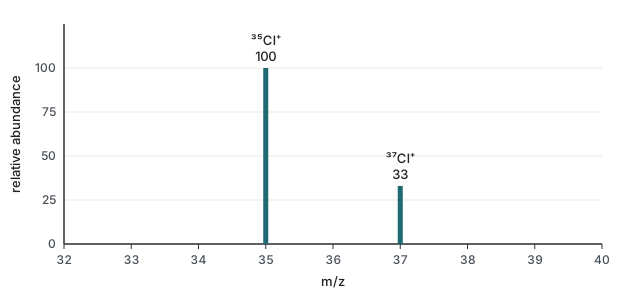
No chlorine atom has a mass of 35.5. That is the average of the mixture.
Worked exampleRelative atomic mass of magnesium
Abundances: ²⁴Mg 79.0%, ²⁵Mg 10.0%, ²⁶Mg 11.0% (the spectrum on the previous page).
- Multiply each mass number by its abundance: 24 × 79.0 = 1896; 25 × 10.0 = 250; 26 × 11.0 = 286.
- Add them: 1896 + 250 + 286 = 2432.
- Divide by the total abundance: 2432 ÷ 100 = 24.32.
- = 24.3
Worked examplePeak heights that are not percentages
Boron gives two peaks: m/z 10 with height 25 and m/z 11 with height 100.
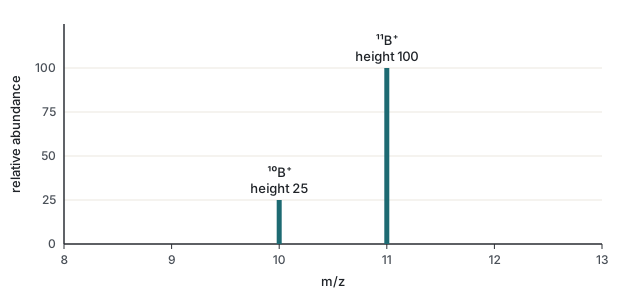
- Total height = 25 + 100 = 125.
- = [(10 × 25) + (11 × 100)] ÷ 125 = 1350 ÷ 125 = 10.8
Worked exampleThree isotopes of silicon
²⁸Si 92.2%, ²⁹Si 4.7%, ³⁰Si 3.1%.
= [(28 × 92.2) + (29 × 4.7) + (30 × 3.1)] ÷ 100 = (2581.6 + 136.3 + 93.0) ÷ 100 = 28.109, so 28.1
From relative atomic mass back to abundances 2.6(ii)
If you are given and told there are two isotopes, you can work out the mixture. Let the lighter isotope be x percent. The heavier one is then (100 − x) percent, because the two add up to 100.
Worked exampleAbundance of chlorine isotopes from its relative atomic mass
Chlorine has = 35.5 and two isotopes, ³⁵Cl and ³⁷Cl. Let ³⁵Cl be x%.
- Write the weighted mean: [35x + 37(100 − x)] ÷ 100 = 35.5
- Multiply by 100: 35x + 3700 − 37x = 3550
- Tidy: 3700 − 2x = 3550, so 2x = 150, giving x = 75
- ³⁵Cl is 75% and ³⁷Cl is 25%, a ratio of 3 : 1.
- Check: (35 × 75 + 37 × 25) ÷ 100 = 3550 ÷ 100 = 35.5 ✓
There is a quick check. The fraction of the heavier isotope is how far has moved from the lighter mass, divided by the gap between the two masses: (35.5 − 35) ÷ (37 − 35) = 0.25. That is 25% ³⁷Cl.
Worked exampleAbundance of boron isotopes
Boron has = 10.8 and isotopes ¹⁰B and ¹¹B. Let ¹⁰B be x%.
- 10x + 11(100 − x) = 1080
- 1100 − x = 1080, so x = 20
- ¹⁰B is 20% and ¹¹B is 80%, a ratio of 1 : 4. That matches the peak heights 25 : 100 in the spectrum above.
Check yourself
- Copper has two isotopes: ⁶³Cu (69.2%) and ⁶⁵Cu (30.8%). Calculate its relative atomic mass to one decimal place.
- Lithium has two isotopes: ⁶Li (7.5%) and ⁷Li (92.5%). Calculate its relative atomic mass to one decimal place.
- A spectrum of neon shows peaks at m/z 20 and m/z 22 with heights 100 and 10. Calculate to one decimal place, ignoring the very small peak for ²¹Ne.
- Gallium has = 69.8 and two isotopes, ⁶⁹Ga and ⁷¹Ga. Find the percentage of each.
- Why does chlorine have a relative atomic mass of 35.5 when no chlorine atom has that mass?
- A student works out for rubidium (⁸⁵Rb 72.2%, ⁸⁷Rb 27.8%) as 86.0. Find the error and give the correct value.
Answers cover these until you have tried the questions
- (63 × 69.2 + 65 × 30.8) ÷ 100 = (4359.6 + 2002.0) ÷ 100 = 63.616, so 63.6
- (6 × 7.5 + 7 × 92.5) ÷ 100 = (45.0 + 647.5) ÷ 100 = 6.925, so 6.9
- Total height = 110. (20 × 100 + 22 × 10) ÷ 110 = 2220 ÷ 110 = 20.18, so 20.2
- Let ⁶⁹Ga be x%. 69x + 71(100 − x) = 6980, so 7100 − 2x = 6980 and x = 60. ⁶⁹Ga is 60% and ⁷¹Ga is 40%. Check: (69 × 60 + 71 × 40) ÷ 100 = 69.8 ✓
- Chlorine is a mixture of two isotopes, ³⁵Cl and ³⁷Cl, in a ratio of about 3 : 1. The relative atomic mass is the weighted mean of their masses, which falls between 35 and 37 and is closer to 35.
- The student took a plain average, (85 + 87) ÷ 2 = 86, which ignores the abundances. Weighted: (85 × 72.2 + 87 × 27.8) ÷ 100 = (6137.0 + 2418.6) ÷ 100 = 85.556, so 85.6