Topic 5 · page 15 of 15
Polymer disposal
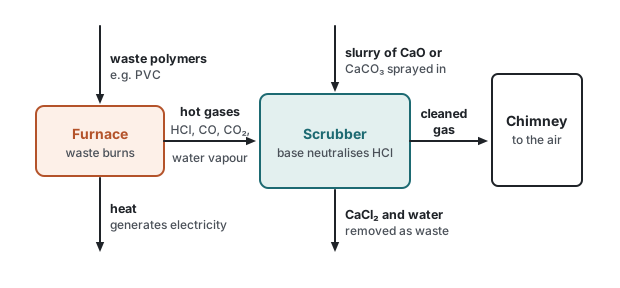
Addition polymers are unreactive and do not rot. Chemists develop biodegradable polymers, and remove the toxic gases from incineration by passing them through a base in a scrubber.
Read first: From monomer to repeat unit, and back
Why waste polymers are a problem 5.8
Poly(ethene), poly(propene) and PVC are saturated chains. Their C–C and C–H bonds are strong and almost non-polar, so the polymers are chemically unreactive. Microorganisms cannot break them down, so they are non-biodegradable. Waste stays in landfill or as litter for hundreds of years.
Chemists limit the problem in two ways, both of which you need to know.
Biodegradable polymers 5.85.8(i)
Chemists develop biodegradable polymers, for example polymers made from starch or other plant materials. Microorganisms can break these chains down, so the waste does not build up in landfill or as litter.
Incineration and toxic gases 5.85.8(ii)
Burning waste polymers, incineration, reduces the volume sent to landfill and the heat released can be used to generate electricity. But burning can release toxic gases:
- hydrogen chloride, HCl, from polymers that contain chlorine, such as PVC;
- carbon monoxide, CO, from incomplete combustion.
The waste gases are passed through scrubbers that contain a base, such as calcium oxide or calcium carbonate. The base neutralises the acidic gas.
The products of the first reaction are a salt and water. The second also makes carbon dioxide gas.
Worked exampleScrubbing the HCl from burning PVC
1.00 kg of PVC burns completely and all of its chlorine leaves as HCl. What mass of calcium oxide is needed to neutralise it? (: H 1.0, C 12.0, O 16.0, Cl 35.5, Ca 40.1)
- The repeat unit of PVC is C₂H₃Cl: = 2 × 12.0 + 3 × 1.0 + 35.5 = 62.5.
- Amount of repeat units = 1000 ÷ 62.5 = 16.0 mol. Each contains one Cl, so 16.0 mol of HCl are made.
- CaO + 2HCl → CaCl₂ + H₂O, so the amount of CaO = 16.0 ÷ 2 = 8.00 mol.
- of CaO = 40.1 + 16.0 = 56.1. Mass = 8.00 × 56.1 = 449 g.
With calcium carbonate (the same 2 : 1 ratio, = 40.1 + 12.0 + 3 × 16.0 = 100.1), the mass is 8.00 × 100.1 = 801 g.
Check yourself
- Explain why poly(ethene) is not biodegradable.
- Describe how chemists limit the problem of polymer disposal by developing biodegradable polymers.
- Burning PVC releases hydrogen chloride. Explain why PVC gives this gas but poly(ethene) does not.
- State how hydrogen chloride is removed from the waste gases of an incinerator, and give an equation.
- Name one advantage and one problem of disposing of waste polymers by incineration.
- 500 g of PVC is burned and all its chlorine is released as HCl. Calculate the mass of calcium carbonate needed to neutralise it. (: H 1.0, C 12.0, O 16.0, Cl 35.5, Ca 40.1)
Answers cover these until you have tried the questions
- Poly(ethene) is saturated, with strong, almost non-polar C–C and C–H bonds, so it is unreactive. Microorganisms cannot break it down, so it is non-biodegradable.
- Chemists make polymers, for example from starch or other plant material, that microorganisms can break down into simple substances such as CO₂ and water. The waste does not stay in landfill or as litter for hundreds of years.
- PVC is a polymer of chloroethene, so each repeat unit contains a chlorine atom. Burning releases it as hydrogen chloride. Poly(ethene) contains only carbon and hydrogen, so there is no chlorine to make HCl.
- Pass the gases through a scrubber that contains a base, such as calcium oxide. It neutralises the acidic HCl: CaO + 2HCl → CaCl₂ + H₂O. (Calcium carbonate also works: CaCO₃ + 2HCl → CaCl₂ + H₂O + CO₂.)
- Advantage: it reduces landfill (or: the heat can generate electricity). Problem: it can release toxic gases such as hydrogen chloride or carbon monoxide. (It also releases carbon dioxide.)
- Amount of PVC repeat units = 500 ÷ 62.5 = 8.00 mol, so 8.00 mol of HCl are made. CaCO₃ + 2HCl → CaCl₂ + H₂O + CO₂, so the amount of CaCO₃ = 8.00 ÷ 2 = 4.00 mol. Mass = 4.00 × 100.1 = 400 g (400.4 g, 3 significant figures: 400 g).