Topic 5 · page 11 of 15
Carbocation stability
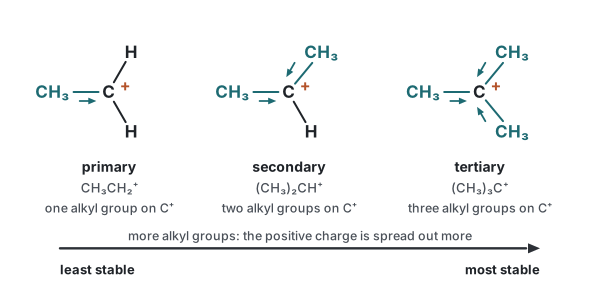
Carbocations are primary, secondary or tertiary according to the number of alkyl groups on the positive carbon. Alkyl groups release electrons, so tertiary is the most stable and primary the least.
Read first: The mechanism for ethene and hydrogen bromide
Primary, secondary and tertiary carbocations 5.6
When an unsymmetrical alkene such as propene reacts, the carbocation can form in more than one way. To decide which is made more easily, you need to compare the carbocations. They are named by the number of alkyl groups bonded to the positive carbon. An alkyl group is a chain of carbon and hydrogen atoms attached by a single bond: CH₃, C₂H₅ and so on.
| Type | Alkyl groups on C⁺ | Example |
|---|---|---|
| primary | 1 | CH₃CH₂⁺ |
| secondary | 2 | (CH₃)₂CH⁺ |
| tertiary | 3 | (CH₃)₃C⁺ |
Count the alkyl groups on the positive carbon, not the total number of carbon atoms in the ion. The ethyl cation, CH₃CH₂⁺, has two carbons but only one alkyl group (the CH₃) on the C⁺, so it is primary.
Why tertiary is the most stable 5.6
Alkyl groups are electron-releasing: they push some of their electron density towards the carbon they are bonded to. A positive carbon is short of electrons, so the more alkyl groups push electrons towards it, the more the positive charge is spread out over the ion. Spreading a charge makes an ion more stable.
Using it to predict a major product 5.6
MethodFinding the major product of H–X addition
- Draw the alkene and decide which carbon of the C=C gets the H.
- For each choice, draw the carbocation that remains (the other carbon is C⁺).
- Classify each carbocation: primary, secondary or tertiary.
- The more stable carbocation is the one that leads to the major product. The halide ion then adds to the C⁺ of that carbocation.
| Alkene | Carbocation if H adds to … | Type | More stable? | Major product |
|---|---|---|---|---|
| propene, CH₃CH=CH₂ | CH₂ end: (CH₃)₂CH⁺ | secondary | yes | 2-bromopropane |
| middle carbon: CH₃CH₂CH₂⁺ | primary | no | ||
| but-1-ene, CH₃CH₂CH=CH₂ | CH₂ end: CH₃CH₂CH⁺CH₃ | secondary | yes | 2-bromobutane |
| C2: CH₃CH₂CH₂CH₂⁺ | primary | no | ||
| 2-methylpropene, (CH₃)₂C=CH₂ | CH₂ end: (CH₃)₃C⁺ | tertiary | yes | 2-bromo-2-methylpropane |
| middle carbon: (CH₃)₂CHCH₂⁺ | primary | no | ||
| 2-methylbut-2-ene, (CH₃)₂C=CHCH₃ | CH end: (CH₃)₂C⁺CH₂CH₃ | tertiary | yes | 2-bromo-2-methylbutane |
| C2: (CH₃)₂CHCH⁺CH₃ | secondary | no |
Worked example2-methylbut-2-ene and hydrogen bromide
Name the major product of the reaction of 2-methylbut-2-ene with HBr.
- 2-methylbut-2-ene: (CH₃)₂C=CHCH₃. The C=C is between C2 and C3.
- If H adds to C3 (the CH carbon), C2 becomes C⁺. Its three bonds go to CH₃, CH₃ and CH₂CH₃: three alkyl groups, a tertiary carbocation.
- If H adds to C2, C3 becomes C⁺. Its three bonds go to H, CH₃ and CH(CH₃)₂: two alkyl groups, a secondary carbocation.
- The tertiary carbocation is more stable, so the major product has Br on C2: 2-bromo-2-methylbutane, (CH₃)₂CBrCH₂CH₃.
Check yourself
- Define a tertiary carbocation.
- Classify each as primary, secondary or tertiary: (a) CH₃CH₂CH₂⁺, (b) (CH₃)₂CH⁺, (c) (CH₃)₃C⁺, (d) CH₃CH₂CH⁺CH₂CH₃.
- Explain why a tertiary carbocation is more stable than a primary one.
- Name the major product of the reaction of but-1-ene with hydrogen bromide, and name the type of carbocation it forms through.
- 2-methylpropene reacts with hydrogen chloride. Give the structural formula of both carbocations that could form and say which one leads to the major product.
- State which of these alkenes give only one possible carbocation in their reaction with HBr, and which give two: ethene, propene, but-2-ene.
Answers cover these until you have tried the questions
- A tertiary carbocation is a carbocation in which the positive carbon is bonded to three alkyl groups.
- (a) primary: one alkyl group (CH₂CH₃) on C⁺. (b) secondary: two CH₃ on C⁺. (c) tertiary: three CH₃ on C⁺. (d) secondary: two C₂H₅ groups on C⁺.
- Alkyl groups are electron-releasing. A tertiary carbocation has three, which push electron density towards the positive carbon and spread out the charge; a primary carbocation has only one. The more the charge is spread out, the more stable the ion.
- 2-bromobutane (CH₃CH₂CHBrCH₃). It forms through the secondary carbocation CH₃CH₂CH⁺CH₃, which is more stable than the primary carbocation that would give 1-bromobutane.
- (CH₃)₃C⁺ is tertiary: H adds to the CH₂ end. (CH₃)₂CHCH₂⁺ is primary: H adds to the middle carbon. The tertiary carbocation is more stable and leads to the major product, (CH₃)₃CCl, 2-chloro-2-methylpropane.
- Ethene (primary CH₃CH₂⁺ either way) and but-2-ene (secondary CH₃CH⁺CH₂CH₃ either way) are both symmetrical, so each gives only one type. Propene can give a primary or a secondary carbocation.