Topic 5 · page 14 of 15
From monomer to repeat unit, and back
Draw the repeat unit by turning the C=C into C–C and keeping the side groups in place. Work backwards by finding the two carbons of one unit and putting the C=C back.
Read first: Addition polymerisation
From monomer to repeat unit 5.7
The rules from the last page are the same for every alkene monomer. The side groups stay on the carbon they were on, and the two carbons become the main chain.
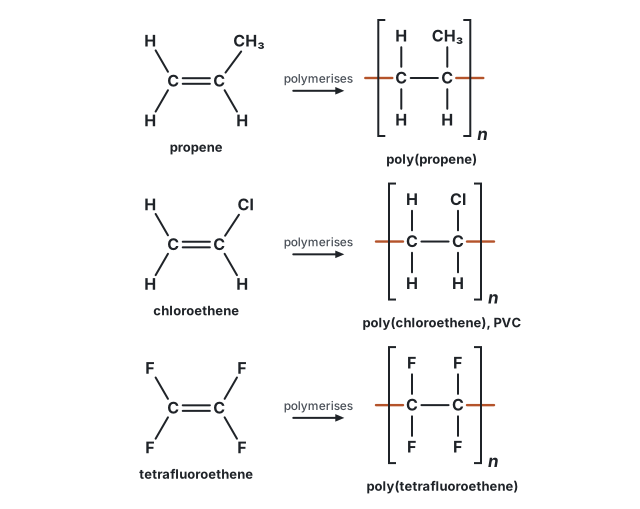
| Monomer | Formula | Polymer | Repeat unit |
|---|---|---|---|
| ethene | CH₂=CH₂ | poly(ethene) | –CH₂–CH₂– |
| propene | CH₂=CHCH₃ | poly(propene) | –CH₂–CH(CH₃)– |
| chloroethene | CH₂=CHCl | poly(chloroethene), PVC | –CH₂–CHCl– |
| tetrafluoroethene | CF₂=CF₂ | poly(tetrafluoroethene) | –CF₂–CF₂– |
In poly(propene) the CH₃ is a side group: it hangs off the carbon chain. The main chain of the repeat unit has only two carbons, even though the monomer has three. The same is true of chloroethene: the Cl is on a main-chain carbon.
Worked examplePoly(but-1-ene)
Draw the repeat unit of poly(but-1-ene).
- But-1-ene is CH₂=CHCH₂CH₃. The C=C is at the end, so the ethyl group, C₂H₅, is the side group.
- Make the C=C into C–C: the two chain carbons are CH₂ and CH.
- Keep C₂H₅ on the CH carbon: –CH₂–CH(C₂H₅)–.
- Put brackets round it so the extension bonds cross them, and write n outside.
From repeat unit to monomer 5.7
Going backwards, you are given a section of a polymer chain, or its repeat unit, and must name the monomer.

MethodFinding the monomer
- Find the two carbons that make one repeat unit. They are two neighbouring main-chain carbons. Their side groups are the ones that stay.
- Take away the extension bonds.
- Put a C=C back between the two carbons.
- Name the alkene.
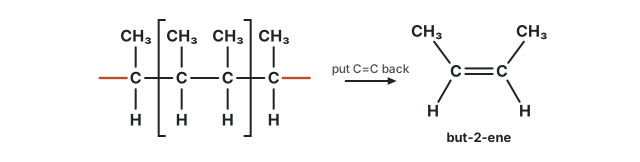
Worked exampleThe monomer of this chain
- Each main-chain carbon has a CH₃ and an H. A repeat unit is two carbons: –CH(CH₃)–CH(CH₃)–.
- Put the C=C back: CH₃CH=CHCH₃.
- The monomer is but-2-ene.
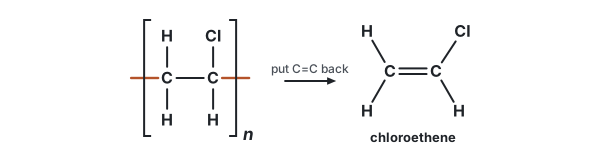
Check yourself
- Draw the repeat unit of poly(propene).
- A polymer has the repeat unit –CH₂–CHCl–. Name and draw its monomer.
- Give the repeat unit of poly(tetrafluoroethene) and the formula of its monomer.
- Draw the repeat unit of poly(2-methylpropene).
- A section of a polymer chain is –CH₂–CH(CH₃)–CH₂–CH(CH₃)–. Name the monomer.
- A student draws the repeat unit of poly(propene) as –CH₂–CH₂–CH₂–. Give two errors.
Answers cover these until you have tried the questions
- –CH₂–CH(CH₃)–, in square brackets, with the extension bonds crossing the brackets and n outside: [–CH₂–CH(CH₃)–]ₙ. The CH₃ is a side group on the second carbon.
- Put the C=C back between the two carbons: CH₂=CHCl, chloroethene.
- –CF₂–CF₂–. The monomer is CF₂=CF₂, tetrafluoroethene.
- 2-methylpropene is (CH₃)₂C=CH₂. The two carbons of the C=C become the main chain, and both CH₃ groups stay on the same carbon: –CH₂–C(CH₃)₂–.
- The repeat unit is –CH₂–CH(CH₃)– (two main-chain carbons, with CH₃ on one). Put the C=C back: CH₂=CH(CH₃) = propene.
- (1) The repeat unit has three main-chain carbons: the CH₃ carbon has been put into the main chain. A monomer with one C=C gives a repeat unit with two main-chain carbons, and the CH₃ must be a side group: –CH₂–CH(CH₃)–. (2) Brackets and extension bonds are missing.