Topic 5 · page 2 of 15
Restricted rotation around C=C
Groups can spin around a C–C single bond but not around a C=C double bond, because twisting would break the π bond. This locks the groups in place and gives geometric isomers.
Read first: Alkenes and the double bond
Rotation around single and double bonds 5.2
In ethane, the two CH₃ groups can spin freely relative to each other. The σ bond between the carbons is a head-on overlap, and head-on overlap is the same at every angle of twist. The molecule changes shape all the time, and these shapes are not different substances.
A C=C is different. Its π bond needs the two p orbitals to be parallel, so that they overlap sideways. If one end of the double bond is twisted, the two p orbitals are turned out of line and the overlap falls.
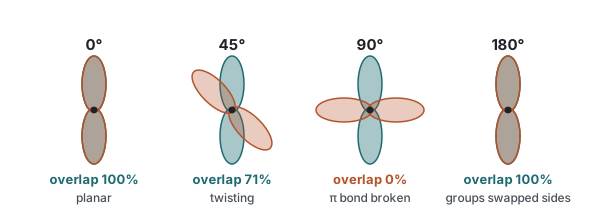
At a twist of 90° the p orbitals no longer overlap at all and the π bond is broken. That takes a large amount of energy, far more than molecules have at room temperature. So at room temperature there is no rotation around a C=C. The four groups attached to the two carbons stay where they are: those on one carbon stay on their own side of the double bond.
The same formula, two different molecules 5.2
Because the groups cannot swap sides, a C=C with the right groups can exist in two forms. But-2-ene, CH₃CH=CHCH₃, is the standard example. Both molecules have the same structural formula and the same atoms joined in the same order. They differ in whether the two CH₃ groups are on the same side of the double bond or on opposite sides.
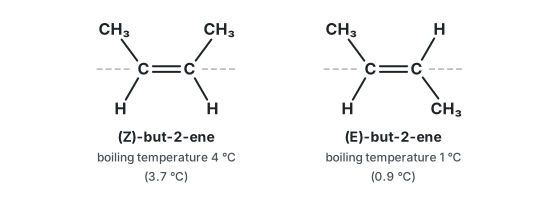
The letters Z and E are explained in E–Z naming. For now, read Z as "same side" and E as "opposite sides".
These are two separate substances, and you can tell by their properties. For example, the boiling temperature of the Z form is about 4 °C and that of the E form is about 1 °C (textbook values 3.7 °C and 0.9 °C). They do not change into each other at room temperature, because that would need the π bond to break.
Geometric isomerism is a kind of stereoisomerism: the atoms are joined in the same order, but are arranged differently in space. This is different from the structural isomerism of Topic 4, where the atoms are joined in a different order.
Check yourself
- Explain why the CH₃ groups in ethane can rotate but the groups in ethene cannot.
- State what is meant by the term geometric isomers.
- At what angle of twist is the overlap of the two p orbitals zero? Give the overlap at 45° as a percentage of the full overlap.
- Explain why (Z)-but-2-ene does not turn into (E)-but-2-ene when it is stored at room temperature.
- Two students look at drawings of but-2-ene. One says that the isomers are the same molecule drawn from different angles. Explain why she is wrong.
Answers cover these until you have tried the questions
- In ethane the carbons are joined by a single σ bond, with head-on overlap that is the same at every angle, so the groups rotate freely. In ethene the carbons are joined by a σ bond and a π bond. Twisting one end turns the p orbitals out of line and the π bond would break, which needs a lot of energy, so rotation is restricted.
- Geometric isomers have the same structural formula but a different arrangement of groups in space, because of restricted rotation around a C=C double bond.
- 90°. At 45° the overlap is cos 45° = 0.707, which is about 71% of the full overlap.
- To change from one to the other the molecule would have to rotate about the C=C. That requires the π bond to break, which needs much more energy than the molecules have at room temperature. So the groups stay locked in place and the two forms stay separate.
- In one isomer the two CH₃ groups are on the same side of the C=C and in the other they are on opposite sides. Turning the molecule over or round does not change which groups are on the same side. The molecules can only be converted by breaking the π bond, so they are different molecules.