Topic 5 · page 12 of 15
The mechanism for propene and hydrogen bromide
Propene can form a secondary or a primary carbocation with HBr. The secondary carbocation is more stable, so 2-bromopropane is the major product and 1-bromopropane the minor product.
Read first: The mechanism for ethene and hydrogen bromide, Carbocation stability
Two routes from one alkene 5.65.6(ii)
Propene, CH₃CH=CH₂, is unsymmetrical. In step 1 the hydrogen of HBr can bond to either carbon of the C=C, so there are two possible carbocations:
- H adds to the CH₂ carbon: the other carbon becomes C⁺ with two alkyl groups, a secondary carbocation, (CH₃)₂CH⁺.
- H adds to the middle carbon: the CH₂ carbon becomes C⁺ with one alkyl group, a primary carbocation, CH₃CH₂CH₂⁺.
Both routes follow the pattern you drew for ethene. Each has two steps.
The major route
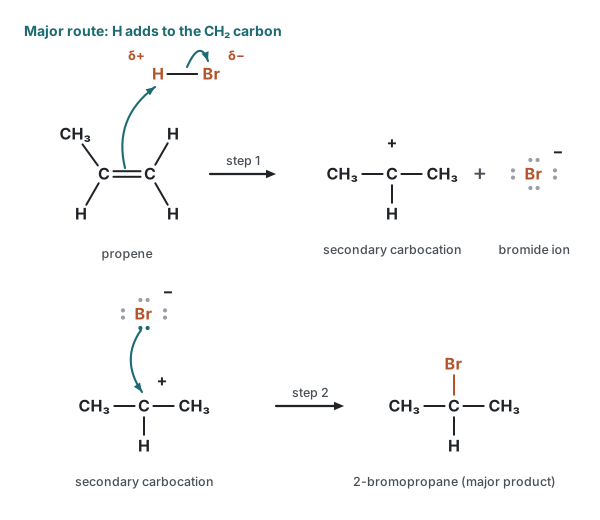
In step 1 the H bonds to the CH₂ carbon, and the carbocation is secondary. In step 2 the lone pair on Br⁻ attacks the C⁺, and the product is 2-bromopropane.
The minor route
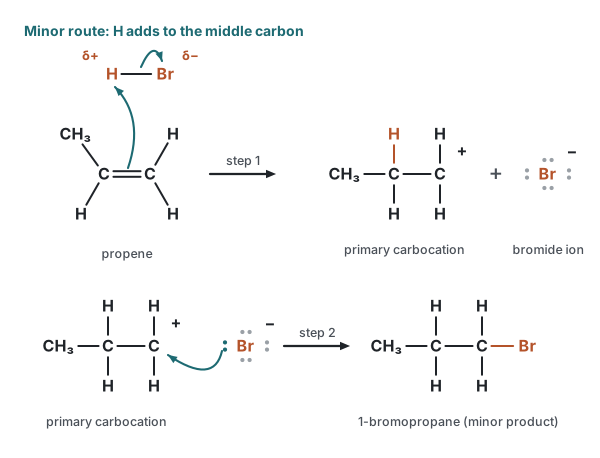
In step 1 the H bonds to the middle carbon, and the carbocation is primary. In step 2 the product is 1-bromopropane.
Which route wins 5.65.6(ii)
The secondary carbocation has two electron-releasing alkyl groups; the primary has only one. The secondary carbocation is more stable, so it forms more easily and more of the reaction goes through it. So 2-bromopropane is the major product and 1-bromopropane is the minor product.
The same reasoning explains the products of propene with steam (propan-2-ol is major, via the secondary carbocation) and with other hydrogen halides. Whenever an unsymmetrical alkene adds H–X, the halogen goes on the carbon that gives the more stable carbocation.
Worked example2-methylpropene and hydrogen bromide
Describe the mechanism for 2-methylpropene with HBr and name the major product.
- 2-methylpropene: (CH₃)₂C=CH₂. H–Br is polar: Hδ+–Brδ−.
- Arrow 1: from the middle of the C=C to Hδ+. The H bonds to the CH₂ carbon.
- Arrow 2: from the H–Br bond to Br, giving Br⁻ with a lone pair.
- The carbocation is (CH₃)₃C⁺. The C⁺ carries three CH₃ groups: tertiary, the most stable type. (The alternative, H bonding to the middle carbon, would give the primary (CH₃)₂CHCH₂⁺.)
- Arrow 3: from a lone pair on Br⁻ to the C⁺. The product is (CH₃)₃CBr, 2-bromo-2-methylpropane, the major product.
Check yourself
- Explain why propene gives two possible carbocations with hydrogen bromide.
- Name the major product of propene and HBr and name the carbocation intermediate on its route.
- Draw the mechanism for the minor route, showing curly arrows, dipoles, charges and lone pairs.
- Explain why the secondary carbocation is more stable than the primary one.
- Name the major organic product of the reaction of 2-methylpropene with hydrogen chloride and name the type of carbocation formed.
- Propene reacts with steam in the presence of an acid catalyst. Use your knowledge of carbocation stability to say which alcohol is the major product.
Answers cover these until you have tried the questions
- Propene is unsymmetrical, so the H of HBr can bond to either carbon of the C=C. H on the CH₂ carbon leaves C⁺ on the middle carbon (secondary); H on the middle carbon leaves C⁺ on the end carbon (primary).
- 2-bromopropane, through the secondary carbocation (CH₃)₂CH⁺.
- Hδ+–Brδ− above propene. Arrow 1: from the middle of the C=C to H, so that H bonds to the middle carbon. Arrow 2: from the H–Br bond to Br. This gives CH₃CH₂CH₂⁺ (primary, + on the end carbon) and Br⁻ with a lone pair. Arrow 3: from a lone pair on Br⁻ to the C⁺. Product: 1-bromopropane. (The minor-route figure on this page shows it.)
- The secondary carbocation has two alkyl groups releasing electrons towards the positive carbon; the primary has one. The more electron-releasing groups, the more the charge is spread out, so the secondary carbocation is more stable.
- 2-chloro-2-methylpropane, (CH₃)₃CCl, through the tertiary carbocation (CH₃)₃C⁺.
- The major product is propan-2-ol. In the mechanism the electrophile (H⁺ from the acid) adds to the CH₂ carbon, giving the secondary carbocation, which is more stable than the primary one; water then attacks the C⁺ on the middle carbon.