Topic 5 · page 8 of 15
Electrophiles and curly arrows
The π bond is a region of high electron density, so it attracts electrophiles. Before drawing any mechanism, you need the rules for curly arrows and for how a bromine molecule can act as an electrophile.
Read first: Alkenes and the double bond, Adding hydrogen and halogens
Why alkenes attract electrophiles 5.6
A mechanism shows, step by step, how the bonds in a reaction break and form. The mechanisms for the reactions of alkenes follow from one fact: the C=C contains a π bond, and the π electrons form a region of high electron density above and below the molecule.
So an electrophile is attracted to the π bond of an alkene. The alkene donates its π electrons, and the π bond breaks. The overall type of reaction is electrophilic addition: an electrophile starts the reaction, and two atoms are added across the C=C.
Electrophiles are usually positive ions or the δ+ end of a polar molecule. Two cases matter here.
Hydrogen bromide is polar, because bromine is more electronegative than hydrogen: Hδ+–Brδ−. The Hδ+ end is the electrophile.
Bromine, Br₂, is non-polar, because the two atoms are identical. So how can it be an electrophile? When a Br₂ molecule approaches the C=C, the π electrons repel the electrons in the Br–Br bond. The bonding pair is pushed towards the far Br atom. The nearer Br atom becomes δ+ and the far one δ−. The alkene has induced a dipole in the bromine molecule. The Brδ+ end is then the electrophile.
Once the electrophile has taken a pair of electrons, the other end of the X–Y bond is left with a pair of electrons of its own. The X–Y bond breaks heterolytically: both electrons of the bond go to Y, which becomes a negative ion (Br⁻ from HBr or Br₂). This is heterolytic fission, as in Topic 4.
Curly arrows 5.6
Curly arrows show the movement of a pair of electrons.
| Rule | What it means |
|---|---|
| The arrow shows a pair of electrons moving | it has a full head (two barbs). Half-arrows, with one barb, are for single electrons in radical reactions. |
| It starts at a bond or a lone pair | never at an atom symbol, never at a + charge |
| It ends at the atom that receives the pair, or in the space where a new bond forms | the arrowhead touches the atom or the gap between atoms |
| Charges and bonds must balance afterwards | the carbon that lost a pair of π electrons is left with a + charge |
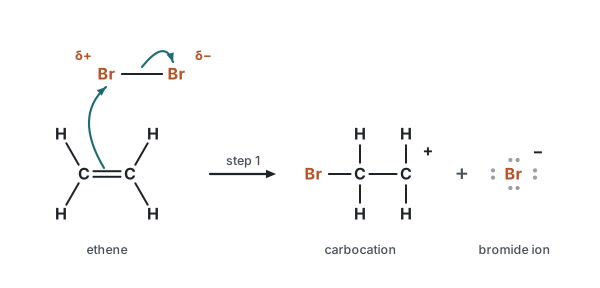
In the first step of every mechanism in this topic, the first arrow starts from the middle of the C=C, because that is where the π electrons are.
Once the π pair has gone to the electrophile, one of the two carbons of the old C=C has lost its share of the π electrons. It has only three bonds and no electrons to spare, so it is left with a positive charge. A species with a positively charged carbon is a carbocation. It is an intermediate: it forms in the first step and is used up in the second.
Check yourself
- Define the term electrophile.
- Explain why alkenes are attacked by electrophiles.
- Hydrogen bromide and bromine are both electrophiles towards ethene. Explain how each one is able to act in this way.
- State where a curly arrow must start and where it must end.
- Explain what the + charge on the carbocation intermediate shows about the electrons in the C=C.
- A student draws a curly arrow from the minus sign on Br⁻ to the carbocation. Explain what is wrong and how to correct it.
Answers cover these until you have tried the questions
- An electrophile is an electron-pair acceptor.
- The C=C contains a π bond, a region of high electron density above and below the molecule. An electrophile is attracted to this region and accepts a pair of electrons from it.
- HBr has a permanent dipole: Br is more electronegative than H, so H is δ+ and is the electrophile. Br₂ is non-polar, but as it approaches the C=C the π electrons repel the electrons of the Br–Br bond, so a dipole is induced: the nearer Br becomes δ+ and acts as the electrophile.
- It must start at a bond or at a lone pair of electrons, and end at the atom that receives the pair of electrons (or at the point where the new bond is formed).
- The two π electrons were donated to the electrophile to make a new bond. The carbon that did not receive a new bond is left one electron pair short, so it has only three bonds and a positive charge.
- A curly arrow must start at a lone pair (or a bond), not at a charge. Draw the lone pair on the Br⁻ ion as a pair of dots and start the arrow at that lone pair, ending on the C⁺.