Topic 5 · page 7 of 15
Oxidation to a diol and the bromine test
Acidified potassium manganate(VII) oxidises a C=C to a diol and turns from purple to colourless. Bromine water is decolourised by a C=C, which makes it the test for an alkene.
Read first: Adding hydrogen and halogens
Oxidation by acidified manganate(VII) 5.45.4(v)
Acidified potassium manganate(VII) is a strong oxidising agent. Shaken with an alkene at room temperature, it oxidises the C=C. The π bond breaks, and an –OH group is added to each carbon of the C=C. The product is a diol: a compound with two –OH groups.
PracticalOxidising an alkene
- Put a few drops of the alkene (or a small volume of its solution) in a test tube.
- Add a few drops of dilute potassium manganate(VII) solution, acidified with dilute sulfuric acid.
- Shake at room temperature and watch the colour.
[O] stands for oxygen supplied by the oxidising agent. The product from ethene is ethane-1,2-diol. In general, an –OH group is added to each of the two carbons that were joined by the C=C.
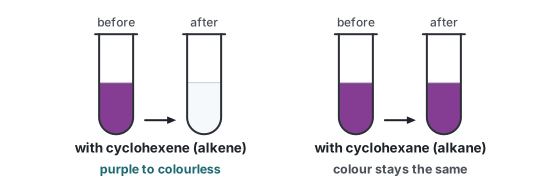
Observation: the purple solution turns colourless. Explanation: manganate(VII) oxidises the C=C to a diol, and in doing so it is itself reduced, so its purple colour disappears.
Worked exampleBalancing with [O]
Write a balanced equation for the oxidation of propene to propane-1,2-diol.
- Propene: CH₃CH=CH₂. Add one O atom from [O] and one H₂O.
- Atoms on the left: C 3, H 6 + 2 = 8, O 1 + 1 = 2.
- Propane-1,2-diol, CH₂(OH)CH(OH)CH₃, is C₃H₈O₂: C 3, H 8, O 2. It balances.
- CH₃CH=CH₂ + [O] + H₂O → CH₂(OH)CH(OH)CH₃
The test for a C=C: bromine water 5.5
To test whether a compound contains a C=C double bond, add bromine water. This is a test you must be able to describe.
PracticalTesting for a C=C double bond
- Put about 2 cm³ of the liquid to be tested in a test tube.
- Add a few drops of bromine water. (Bromine water is harmful: use a dilute solution and small volumes, and wear eye protection.)
- Shake the tube and observe the colour.
| Sample | Observation |
|---|---|
| alkene (contains C=C) | bromine water turns from orange to colourless at once |
| alkane (no C=C) | bromine water stays orange |
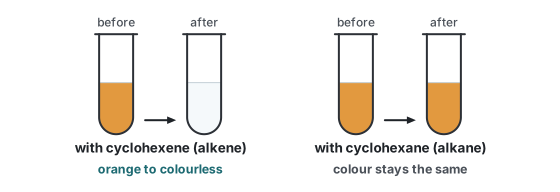
Explanation: the bromine adds across the C=C (see Adding hydrogen and halogens). The products are colourless, so the orange colour of bromine disappears. In bromine water some of the product is a bromo-alcohol, as you will see in Ethene and bromine; the colour change is the same.
| Bromine water | Acidified manganate(VII) | |
|---|---|---|
| Alkene | orange to colourless | purple to colourless |
| Alkane | stays orange | stays purple |
| Reaction with the alkene | electrophilic addition of bromine | oxidation of the C=C to a diol |
Check yourself
- Describe a test to tell cyclohexane from cyclohexene, and give the observation with each.
- Ethene is shaken with acidified potassium manganate(VII). Give the colour change and the name of the organic product.
- Write an equation, using [O], for the oxidation of but-2-ene to a diol, and name the diol.
- Explain why the bromine water test can distinguish an alkene from an alkane.
- A liquid has molecular formula C₆H₁₂ and does not decolourise bromine water. Suggest what it could be, and say why the formula alone could not tell you.
- Name the reagents and the conditions for the oxidation of ethene to ethane-1,2-diol.
Answers cover these until you have tried the questions
- Shake each with bromine water. Cyclohexene turns the bromine water from orange to colourless. Cyclohexane leaves it orange.
- Purple to colourless. The product is ethane-1,2-diol.
- CH₃CH=CHCH₃ + [O] + H₂O → CH₃CH(OH)CH(OH)CH₃. Balance check: left C 4, H 8 + 2 = 10, O 2; right C₄H₁₀O₂: C 4, H 10, O 2. The diol is butane-2,3-diol.
- Bromine adds across the C=C of an alkene, using up the bromine, and the product is colourless, so the orange colour disappears. An alkane has no C=C to add to, so there is no reaction and the colour stays.
- It could be cyclohexane, C₆H₁₂, which has no C=C. The formula C₆H₁₂ also fits an alkene (hexene), so the formula alone cannot decide; the test (no decolourisation) shows there is no C=C.
- Acidified potassium manganate(VII) (dilute sulfuric acid) at room temperature.