Topic 4 · page 17 of 17
Further substitution and its limits
A chlorine radical can attack the product as well as the alkane, so the reaction goes on to make a mixture. A mixture means a low yield of any one product, which is why free radical substitution is of limited use in synthesis.
Read first: Free radical substitution: the mechanism
The reaction does not stop at one substitution 4.184.18(iv)
In the mechanism for methane, a chlorine radical attacks CH₄ and makes chloromethane. But chloromethane still has three C–H bonds, and the chlorine radicals in the mixture cannot tell chloromethane from methane. If a Cl• meets a CH₃Cl molecule, it can take a hydrogen from it too.
The product, dichloromethane, can go on to be substituted again. The process can continue until every hydrogen is replaced.
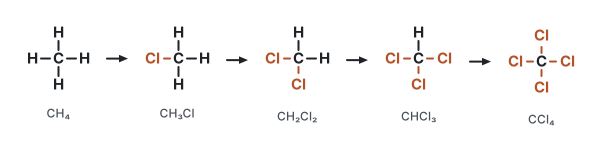
| Product | Name | Overall equation |
|---|---|---|
| CH₃Cl | chloromethane | |
| CH₂Cl₂ | dichloromethane | |
| CHCl₃ | trichloromethane | |
| CCl₄ | tetrachloromethane |
This is further substitution. Each step uses another molecule of chlorine and releases another HCl.
Other reasons for a mixture 4.18(iv)
- With a longer alkane the halogen can replace hydrogen on different carbons. Propane gives both 1-chloropropane and 2-chloropropane. These are position isomers (Structural isomerism).
- Termination steps make other products, such as ethane from two methyl radicals, or butane in the reaction of ethane with bromine.
Worked exampleHow many monosubstituted products?
Count the possible monochloro products when each of these alkanes reacts with chlorine, replacing one hydrogen.
- Ethane. All six hydrogens are equivalent (two CH₃ groups): one product, chloroethane.
- Propane. Hydrogens on an end carbon (CH₃) or on the middle carbon (CH₂): two products, 1-chloropropane and 2-chloropropane.
- Butane. The hydrogens on carbons 1 and 4 are equivalent, and those on carbons 2 and 3 are equivalent: two products, 1-chlorobutane and 2-chlorobutane.
- 2-methylpropane. There are hydrogens on the three CH₃ groups and one on the central carbon: two products, 1-chloro-2-methylpropane and 2-chloro-2-methylpropane.
Getting the monosubstituted product
If you want chloromethane, you can use a large excess of methane. Then a Cl• is much more likely to meet a CH₄ molecule than a CH₃Cl molecule, so most of the product is the monosubstituted one. Even so, a mixture is still formed, and the chloromethane has to be separated from the unreacted methane and from the other products.
Atom economy
Even the desired step wastes atoms: every substitution makes a hydrogen halide as well as the halogenoalkane.
For , the desired product is CH₃Cl, with = 12.0 + 3 × 1.0 + 35.5 = 50.5. The by-product HCl has = 1.0 + 35.5 = 36.5, so the products total 87.0.
The other 42.0% of the mass leaves as HCl. This is before counting the extra products from further substitution.
Check yourself
- Write the equation for the formation of dichloromethane from chloromethane and chlorine in UV light.
- Explain why a large excess of methane is used to make chloromethane.
- Name all the monochloro products formed when propane reacts with chlorine.
- Explain why the reaction of ethane with bromine gives a mixture of products. Name one organic by-product other than a bromoethane.
- Calculate the atom economy for making chloroethane by C₂H₆ + Cl₂ → C₂H₅Cl + HCl.
- Explain why free radical substitution has limited use in synthesis.
Answers cover these until you have tried the questions
- CH₃Cl + Cl₂ → CH₂Cl₂ + HCl (UV light over the arrow). The mechanism has the propagation steps CH₃Cl + Cl• → CH₂Cl• + HCl, then CH₂Cl• + Cl₂ → CH₂Cl₂ + Cl•.
- With a large excess of methane, a chlorine radical is much more likely to collide with CH₄ than with CH₃Cl. Further substitution is therefore less likely, and more of the product is chloromethane.
- 1-chloropropane and 2-chloropropane. (Further substitution then gives dichloropropanes and more.)
- The bromine radical can attack the bromoethane, so further substitution forms dibromoethanes. Termination can join two ethyl radicals to give butane. Either one is an acceptable by-product. A mixture results.
- (C₂H₅Cl) = 2 × 12.0 + 5 × 1.0 + 35.5 = 64.5. The other product is HCl, 36.5, so the products total 64.5 + 36.5 = 101.0 (the same as the reactants, C₂H₆ = 30.0 plus Cl₂ = 71.0). Atom economy = 64.5 ÷ 101.0 × 100 = 63.9%.
- The reaction makes a mixture of products, because of further substitution, substitution at different carbons and termination steps. The yield of the one wanted is low and the products have to be separated, so it is not a good method of making a pure halogenoalkane.