Topic 4 · page 10 of 17
Crude oil and fractional distillation
Crude oil is a mixture of hydrocarbons, mostly alkanes. Fractional distillation separates it into fractions by boiling temperature, and the fractions are the fuels we burn.
Read first: Homologous series and functional groups
Alkanes as fuels 4.12
Alkanes burn in oxygen and release a lot of energy, so they are used as fuels: bottled gas, petrol, diesel and aviation fuel are all mixtures of alkanes. The source is crude oil, a fossil fuel formed over millions of years from the remains of marine organisms.
Crude oil is a mixture of hydrocarbons, mostly alkanes with chains of many different lengths. A mixture of this kind is not directly useful. It must first be separated, and this is done by fractional distillation.
Fractional distillation 4.12
Fractional distillation separates liquids by their boiling temperatures. For crude oil it is done in a tall fractionating column at an oil refinery.
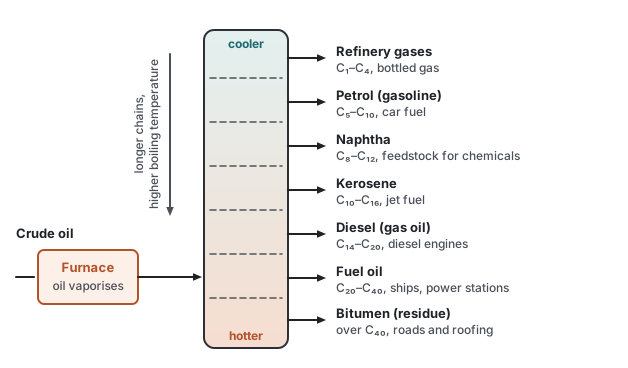
MethodWhat happens in the column
- Crude oil is heated in a furnace until most of it vaporises.
- The hot vapour enters the bottom of the column. The column is hot at the bottom and cooler at the top.
- Vapours rise. Each one condenses at the height where the temperature falls below its boiling temperature.
- Each fraction is drawn off at its own level. It is a mixture of alkanes with similar chain lengths and similar boiling temperatures.
- The gases that do not condense leave at the top. The liquid with the highest boiling temperatures stays at the bottom as the residue.
The trend down the column follows from the boiling temperatures of the alkanes (Homologous series). Longer chains have more electrons, stronger London forces between molecules and higher boiling temperatures, so they condense lower down.
| Fraction | Typical carbons | Main use |
|---|---|---|
| Refinery gases | C₁–C₄ | bottled gas |
| Petrol (gasoline) | C₅–C₁₀ | car fuel |
| Naphtha | C₈–C₁₂ | feedstock for the chemical industry |
| Kerosene | C₁₀–C₁₆ | jet fuel |
| Diesel (gas oil) | C₁₄–C₂₀ | diesel engines |
| Fuel oil | C₂₀–C₄₀ | ships and power stations |
| Bitumen (residue) | over C₄₀ | roads and roofing |
The ranges overlap because the fractions are not pure, and different books quote slightly different ranges. Learn the order and the trend rather than the exact numbers.
Going down the column, the molecules are larger. The fractions have higher boiling temperatures, are less volatile, are more viscous (they flow less easily) and are harder to ignite.
The supply of the fractions does not match the demand. A barrel of crude oil gives a lot of the long-chain fractions, but there is more demand for petrol and for short alkenes. The extra long-chain molecules are converted by cracking, and the quality of petrol is improved by reforming (Cracking and reforming).
Check yourself
- State what crude oil is.
- Describe how the temperature varies in a fractionating column, and why the vapour condenses at different heights.
- Explain why bitumen leaves at the bottom of the column and refinery gases at the top.
- Explain why a fraction is not a pure compound.
- A student writes an equation for the fractional distillation of C₁₀H₂₂. Explain why this is wrong.
- Name two fractions and state a use for each.
Answers cover these until you have tried the questions
- A mixture of hydrocarbons, mostly alkanes of many different chain lengths, formed from the remains of marine organisms over millions of years.
- The column is hot at the bottom and cooler at the top. Each vapour rises until the temperature falls below its boiling temperature, and it then condenses and is drawn off there.
- Bitumen has very long chains. Its molecules have many electrons, strong London forces and a very high boiling temperature, so it does not vaporise easily and stays at the bottom. Refinery gases have the shortest chains and the lowest boiling temperatures, so they stay as gas until the top.
- Each fraction contains many different alkanes with similar chain lengths and similar boiling temperatures, so it is a mixture.
- Fractional distillation is a physical change. Molecules are separated by boiling temperature, with no bonds broken and no new substance formed, so no equation is needed.
- Any two, for example: petrol, car fuel; kerosene, jet fuel; diesel, diesel engines; refinery gases, bottled gas; bitumen, roads.