Topic 4 · page 6 of 17
Bond breaking, free radicals and electrophiles
A covalent bond is a shared pair of electrons. It can break evenly, one electron to each atom, to make free radicals, or unevenly, both electrons to one atom, to make ions.
Read first: Types of organic reaction
Two ways to break a covalent bond 4.7
A covalent bond is a shared pair of electrons. When the bond breaks, those two electrons have to go somewhere. There are two possibilities, and they give different kinds of particle.
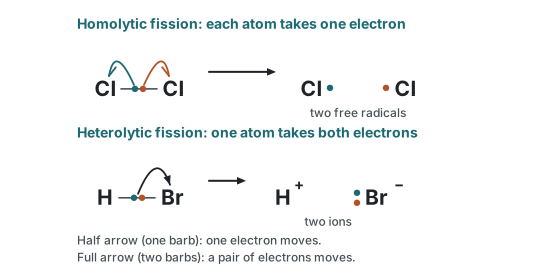
Homolytic fission 4.7(i)
In homolytic fission the bond breaks evenly. Each atom takes one electron from the shared pair, so each atom is left with one unpaired electron. The two particles are free radicals.
This happens when energy is supplied, for example from ultraviolet light, to a bond between two atoms of the same element or of similar electronegativity.
Heterolytic fission 4.7(ii)
In heterolytic fission the bond breaks unevenly. One atom takes both electrons from the shared pair. That atom becomes a negative ion, and the other, which has lost its share of the pair, becomes a positive ion.
The atom that takes the pair is usually the more electronegative one. Bromine is more electronegative than hydrogen, so Br⁻ takes both electrons (Topic 3, electronegativity).
Curly arrows
Arrows show where electrons go. They start at the bond (where the electrons are) and finish at the atom that receives them.
| Arrow | Looks like | Shows the movement of |
|---|---|---|
| Curly half-arrow (fish-hook) | a curve with a single barb | one electron |
| Curly arrow | a curve with a full double-barbed head | a pair of electrons |
Free radicals and electrophiles 4.8
A radical is shown with a single dot for the unpaired electron: Cl•, Br•, CH₃•. Radicals are very reactive, because the unpaired electron strongly tends to pair up.
Examples are H⁺ and the δ+ end of a polar molecule. The word means "electron-loving". Free radicals are the reactive species in the alkane reactions in this topic. Electrophiles appear later, for example in the reactions of alkenes.
Check yourself
- Explain the difference between homolytic and heterolytic fission.
- Write an equation for the homolytic fission of a bromine molecule and name the particles formed.
- State how many electrons each curly half-arrow represents, and how many a full curly arrow represents.
- In the heterolytic fission of H–Br, explain why the bromine atom takes both electrons.
- Define the terms free radical and electrophile.
- A student writes "Cl• has a negative charge because it has an extra electron". Explain the error.
Answers cover these until you have tried the questions
- In homolytic fission each atom takes one electron of the bonding pair, forming two free radicals. In heterolytic fission one atom takes both electrons, forming a positive ion and a negative ion.
- Br₂ → 2Br•. The particles are bromine free radicals (bromine atoms, each with one unpaired electron).
- A half-arrow shows the movement of one electron. A full curly arrow shows the movement of a pair of electrons (two electrons).
- Bromine is more electronegative than hydrogen, so it attracts the bonding pair more strongly. It takes both electrons and becomes Br⁻; hydrogen becomes H⁺.
- A free radical is a species with an unpaired electron. An electrophile is an electron-pair acceptor.
- Cl• is a chlorine atom with seven outer electrons, one of them unpaired. It has no charge. An ion such as Cl⁻ has a full outer shell and no unpaired electron. A radical is not an ion.