Topic 4 · page 16 of 17
Free radical substitution: the mechanism
The reaction of an alkane with a halogen is a chain reaction in three stages. Initiation makes radicals, propagation regenerates them as the product forms, and termination removes them.
Read first: Bond breaking, free radicals and electrophiles, Alkanes and halogens
Radicals and the three stages 4.184.18(i)
A mechanism shows, step by step, how a reaction happens. The reaction of methane with chlorine in UV light is a free radical substitution. It goes through three stages, and the particles that carry the reaction are free radicals: species with an unpaired electron, written with a single dot.
| Stage | What happens | Radicals |
|---|---|---|
| Initiation | a halogen molecule splits into two radicals | made |
| Propagation | a radical reacts with a molecule and makes a new radical | used and made again |
| Termination | two radicals join to make a molecule | removed |
The radicals in this reaction are the chlorine radical, Cl•, and the methyl radical, CH₃•. Write the dot on every radical, in every step.
Initiation 4.184.18(ii)
Ultraviolet light supplies the energy to break the Cl–Cl bond. The bond breaks by homolytic fission: each chlorine atom takes one of the two bonding electrons, giving two chlorine free radicals.

The curly half-arrows start in the middle of the bond and go one to each Cl atom. Each half-arrow carries one electron.
Propagation 4.184.18(iii)
Propagation has two steps. In each step one radical is used and another is made. The second step makes the radical that began the first, so the sequence repeats: this is a chain reaction.
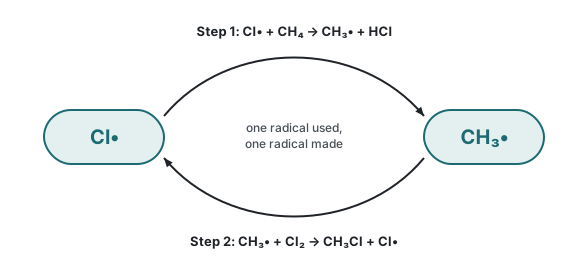
Add the two propagation steps and cancel what appears on both sides (CH₃• and Cl•). What remains is the overall equation:
One initiation step can lead to thousands of cycles, because the chlorine radical is never used up in propagation.
Termination 4.184.18(iii)
The chain stops when two radicals meet and join. Each such step makes a molecule, and no radical is left, so the number of radicals falls.
Ethane forms in the third step. Ethane was never added to the mixture, which is evidence that radicals combine in this way.
MethodWriting the mechanism for any alkane and halogen
- Initiation: halogen molecule → 2 halogen radicals, with UV light.
- Propagation 1: alkane + halogen radical → alkyl radical + hydrogen halide.
- Propagation 2: alkyl radical + halogen molecule → halogenoalkane + halogen radical.
- Termination: any two radicals from the mixture combine into one molecule. Write at least one that makes the halogen molecule, one that makes the halogenoalkane, and one that joins two alkyl radicals.
Worked exampleEthane and bromine
Write the mechanism for the reaction of ethane with bromine in UV light.
- Initiation:
- Propagation: then
- Termination (three possibilities): ; ; .
- Overall: . The termination step that joins two ethyl radicals gives butane, an unwanted by-product.
Check yourself
- Write the equation for the initiation step of the reaction of methane with bromine, and name the type of bond fission.
- Write the two propagation steps for the reaction of methane with bromine.
- Write a termination step that makes ethane.
- Explain why the second propagation step is described as a chain reaction.
- Write a termination step that forms butane when ethane reacts with bromine.
- A student writes the first propagation step as CH₄ + Cl• → CH₃Cl + H•. Explain what is wrong.
Answers cover these until you have tried the questions
- Br₂ → 2Br• with UV light; homolytic fission, because each bromine atom takes one of the two bonding electrons.
- CH₄ + Br• → CH₃• + HBr, then CH₃• + Br₂ → CH₃Br + Br•.
- CH₃• + CH₃• → C₂H₆.
- The second step makes a bromine radical, which is the radical that started the first step. The sequence therefore repeats over and over, so one initiation can produce many molecules of product.
- C₂H₅• + C₂H₅• → C₄H₁₀ (butane).
- The chlorine radical takes a hydrogen atom from methane to form HCl, and leaves a methyl radical. It does not form a C–Cl bond in this step, and no H• radical is made in the mechanism. The chloromethane forms in the second propagation step, from CH₃• and Cl₂. The correct first step is CH₄ + Cl• → CH₃• + HCl.