Topic 4 · page 13 of 17
Pollutants from burning fuels
Burning alkane fuels releases carbon monoxide, carbon particulates, unburned hydrocarbons, oxides of nitrogen and sulfur dioxide. Carbon monoxide is toxic because it binds to haemoglobin, and the oxides of nitrogen and sulfur make acid rain.
Read first: Combustion of alkanes
The pollutants and where they come from 4.13
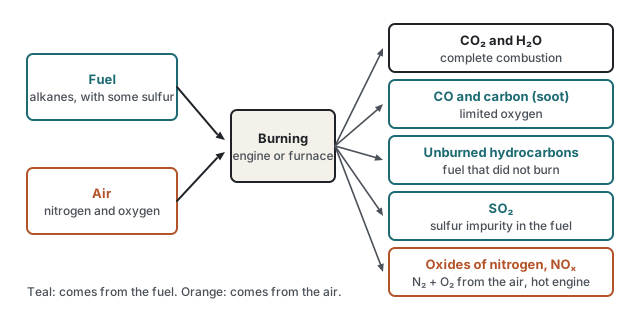
In a perfect engine an alkane fuel would give only carbon dioxide and water. Real engines are not perfect, and the fuel is not pure. A pollutant is a substance that harms the environment or living things. The five that you must know are in the table.
| Pollutant | How it forms |
|---|---|
| Carbon monoxide, CO | incomplete combustion, when the oxygen supply is limited |
| Carbon particulates (soot), C | incomplete combustion |
| Unburned hydrocarbons | some fuel passes through the engine without burning |
| Oxides of nitrogen, NOₓ | nitrogen and oxygen from the air react at the high temperature and pressure inside the engine |
| Sulfur dioxide, SO₂ | sulfur impurities in the fuel burn |
The oxides of nitrogen are made in two steps. Nitrogen monoxide forms first, and it is then oxidised to nitrogen dioxide.
Crude oil contains small amounts of sulfur compounds. When the fuel burns, the sulfur burns too.
Carbon monoxide: why it is toxic 4.14
Carbon monoxide is colourless and odourless, so people cannot tell that they are breathing it in. It is toxic because of what it does in the blood.
- Red blood cells contain haemoglobin, which carries oxygen from the lungs round the body.
- Carbon monoxide binds to haemoglobin much more strongly than oxygen does.
- With the haemoglobin taken up by carbon monoxide, less oxygen can be carried to the cells.
- The cells are starved of oxygen, which causes headaches and drowsiness, and at high concentrations, death.
Acid rain from oxides of nitrogen and sulfur 4.14
Sulfur dioxide and nitrogen dioxide are acidic. They dissolve in rain water to make acids, and the rain becomes acid rain.
Sulfurous acid is slowly oxidised in the air to sulfuric acid, which is the main acid in acid rain.
Acid rain damages the stonework of buildings (limestone and marble, which are mainly calcium carbonate), harms trees and makes lakes too acidic for fish. It also corrodes metals.
Check yourself
- Name five pollutants emitted when an alkane fuel burns.
- Explain how nitrogen monoxide forms in a petrol engine, with an equation.
- State where the sulfur dioxide in exhaust gases comes from.
- Explain why carbon monoxide is toxic.
- Write an equation for the formation of nitric acid in acid rain, starting from nitrogen dioxide.
- State one effect of acid rain on buildings and give an equation for it.
Answers cover these until you have tried the questions
- Carbon monoxide, carbon particulates (soot), unburned hydrocarbons, oxides of nitrogen and sulfur dioxide.
- At the high temperature inside the engine, nitrogen and oxygen from the air react: N₂ + O₂ → 2NO.
- From sulfur impurities in the fuel. The sulfur burns: S + O₂ → SO₂.
- CO binds to haemoglobin in red blood cells, more strongly than oxygen does. Less haemoglobin is free to carry oxygen, so less oxygen reaches the cells.
- 4NO₂ + O₂ + 2H₂O → 4HNO₃. Check: N 4 = 4; H 4 = 4; O 8 + 2 + 2 = 12 on the left and 12 on the right.
- Acid rain damages limestone or marble buildings, because calcium carbonate reacts with the acid. For example, CaCO₃ + H₂SO₄ → CaSO₄ + H₂O + CO₂.