Topic 4 · page 9 of 17
Isomers of alkanes and cycloalkanes
A method for finding every structural isomer of an alkane or cycloalkane up to six carbons, by starting with the longest chain and shortening it one carbon at a time. The answers to learn are 2 for C₄H₁₀, 3 for C₅H₁₂ and 5 for C₆H₁₄.
Read first: Structural isomerism
Isomers of alkanes 4.11
Alkanes with one, two or three carbons have only one structure each. Isomers begin at four carbons.
| Alkane | Number of isomers |
|---|---|
| CH₄, C₂H₆, C₃H₈ | 1 each |
| C₄H₁₀ | 2 |
| C₅H₁₂ | 3 |
| C₆H₁₄ | 5 |
C₄H₁₀ and C₅H₁₂
For C₄H₁₀: the four-carbon chain is butane. Shorten it to a three-carbon chain and the spare carbon is a methyl branch on carbon 2: methylpropane. A methyl on carbon 1 would only lengthen the chain again.
For C₅H₁₂ there are three isomers.
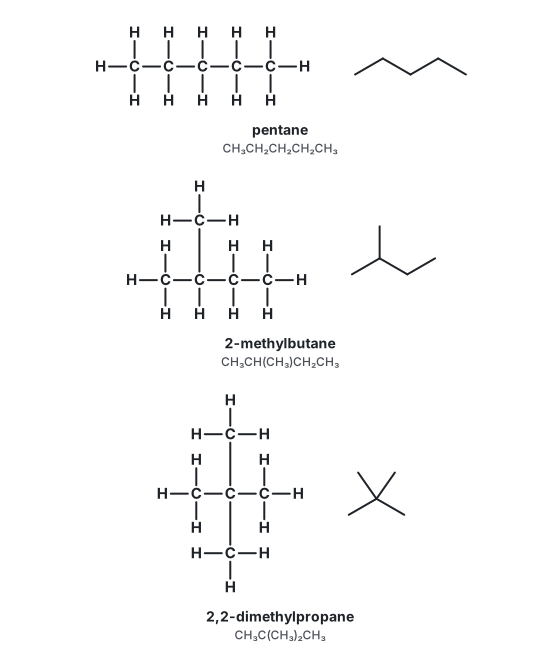
Worked exampleFinding the isomers of C₅H₁₂
- Five-carbon chain: pentane.
- Four-carbon chain, one carbon left over: the spare carbon is a methyl branch. On carbon 1 it just makes pentane again. On carbon 2 it gives 2-methylbutane. On carbon 3 it gives the same molecule as on carbon 2, numbered from the other end. So there is one isomer here.
- Three-carbon chain, two carbons left over: the middle carbon can take both methyls: 2,2-dimethylpropane. Two methyls on different carbons would create a longer chain.
- Total: three isomers.
The five isomers of C₆H₁₄
Shorten the chain one carbon at a time and place the branches.
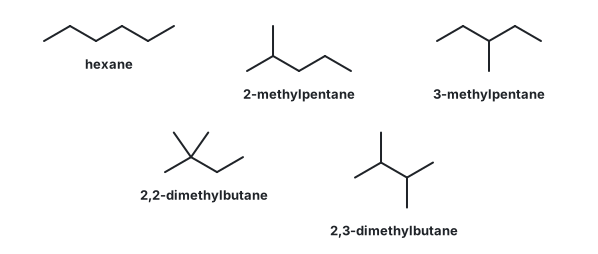
| Longest chain | Branches | Isomers |
|---|---|---|
| 6 carbons | none | hexane |
| 5 carbons | one methyl on carbon 2 or on carbon 3 | 2-methylpentane, 3-methylpentane |
| 4 carbons | two methyls: both on carbon 2, or one on each of carbons 2 and 3 | 2,2-dimethylbutane, 2,3-dimethylbutane |
| 3 carbons | not possible | the middle carbon of a three-carbon chain can carry at most two branches, which gives C₅H₁₂ at most |
Other apparent isomers are the same as one of these: 3,3-dimethylbutane is 2,2-dimethylbutane numbered from the wrong end, and an ethyl branch on carbon 2 of a four-carbon chain makes a five-carbon chain, which is 3-methylpentane.
Isomers of cycloalkanes 4.11
The method is the same. Start with the largest ring, then make the ring one carbon smaller and attach the spare carbons as branches. Number the ring so that the branches get the lowest numbers.
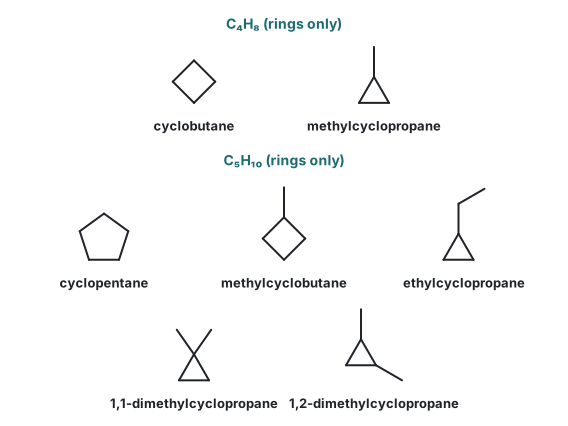
| Formula | Ring isomers | Number |
|---|---|---|
| C₃H₆ | cyclopropane | 1 |
| C₄H₈ | cyclobutane, methylcyclopropane | 2 |
| C₅H₁₀ | cyclopentane, methylcyclobutane, ethylcyclopropane, 1,1-dimethylcyclopropane, 1,2-dimethylcyclopropane | 5 |
| C₆H₁₂ | listed below | 12 |
For C₆H₁₂ the ring isomers, grouped by the size of the ring, are:
| Ring | Isomers |
|---|---|
| 6-membered | cyclohexane |
| 5-membered | methylcyclopentane |
| 4-membered | ethylcyclobutane, 1,1-dimethylcyclobutane, 1,2-dimethylcyclobutane, 1,3-dimethylcyclobutane |
| 3-membered | propylcyclopropane, (1-methylethyl)cyclopropane, 1-ethyl-1-methylcyclopropane, 1-ethyl-2-methylcyclopropane, 1,1,2-trimethylcyclopropane, 1,2,3-trimethylcyclopropane |
You are unlikely to be asked for all twelve. The method is what matters: biggest ring first, then smaller rings with branches, and name each structure to remove duplicates.
Check yourself
- Draw and name the two isomers of C₄H₁₀.
- Explain why "3-methylbutane" is not the name of a new isomer of C₅H₁₂.
- State the number of isomers of C₅H₁₂ and C₆H₁₄, and give the names of the isomers of C₆H₁₄ that have a four-carbon main chain.
- Explain why there is no isomer of C₆H₁₄ with a three-carbon main chain.
- Draw and name the two cycloalkane isomers of C₄H₈.
- Draw and name the five cycloalkanes with the molecular formula C₅H₁₀.
Answers cover these until you have tried the questions
- Butane, a four-carbon zigzag, and methylpropane, a three-carbon chain with a methyl on carbon 2 (both are drawn in Structural isomerism). Both are C₄H₁₀.
- A methyl on carbon 3 of a four-carbon chain is the same as a methyl on carbon 2, numbered from the other end. The correct name has the lowest number, so it is 2-methylbutane, which is already one of the three isomers.
- C₅H₁₂ has 3 isomers and C₆H₁₄ has 5. The two with a four-carbon main chain are 2,2-dimethylbutane and 2,3-dimethylbutane.
- A three-carbon chain would need three more carbons as branches, with the middle carbon only able to hold two branches (it already has two bonds to the chain). A branch on an end carbon would extend the chain. So any attempt makes a longer main chain.
- Cyclobutane (a four-membered ring) and methylcyclopropane (a three-membered ring with a methyl group).
- Cyclopentane; methylcyclobutane; ethylcyclopropane; 1,1-dimethylcyclopropane; 1,2-dimethylcyclopropane (all five are drawn in the ring figure on this page). Check each: five carbons and ten hydrogens.