Topic 4 · page 3 of 17
Ways of writing a formula
Molecular, structural, displayed and skeletal formulae show different amounts of detail. You must be able to write one from another and know what each one shows.
Four formulae for one molecule 4.54.5(ii)
A molecular formula tells you how many atoms there are, but not how they are joined. Organic chemistry needs more, because the same atoms can be joined in different ways. Four kinds of formula show different amounts of detail.
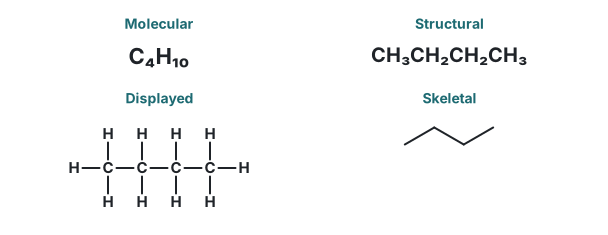
| Formula | What it shows | Butane |
|---|---|---|
| Molecular | the number of atoms of each element | C₄H₁₀ |
| Structural | the atoms in order, carbon by carbon, with no bonds drawn | CH₃CH₂CH₂CH₃ |
| Displayed | every atom and every bond | all four carbons, ten hydrogens, and all 13 bonds |
| Skeletal | only the carbon skeleton and the functional groups | a zigzag line |
A fifth kind, the general formula, such as CₙH₂ₙ₊₂ for alkanes, describes a whole series (Homologous series).
Structural formulae 4.5(ii)
Write the carbons in order and put each carbon's hydrogens after it. A branch goes in brackets straight after the carbon it is attached to.
| Compound | Structural formula |
|---|---|
| butane | CH₃CH₂CH₂CH₃ |
| 2-methylbutane | CH₃CH(CH₃)CH₂CH₃ |
| 2,2-dimethylpropane | CH₃C(CH₃)₂CH₃ |
| 1-chloropropane | CH₂ClCH₂CH₃ or CH₃CH₂CH₂Cl |
| propan-2-ol | CH₃CH(OH)CH₃ |
Displayed formulae 4.5(ii)
A displayed formula shows every bond, including C–H and O–H. Each line is one shared pair of electrons.
Skeletal formulae 4.5(ii)
A skeletal formula is the quickest to draw, and it is the one that exam papers use most for larger molecules. The rules are:
- Each corner and each end of a line is a carbon atom.
- Each line is a C–C bond.
- Hydrogen atoms bonded to carbon are not shown. You work them out: each carbon has four bonds, so it has enough hydrogens to make four.
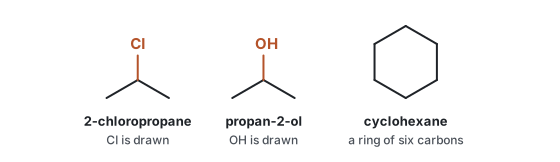
- Functional groups are drawn in full, with their atoms written: Cl, Br, OH. The hydrogen of an OH group is shown.
- A ring is drawn as a polygon.
Worked exampleFrom displayed to skeletal
Convert the displayed formula of 2-methylbutane to a skeletal formula, and find its molecular formula.
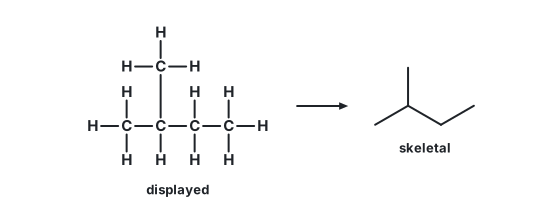
- Find the longest carbon chain: four carbons. Draw it as a zigzag of four points.
- The branch is a single carbon on the second carbon of the chain. Draw a short line up from the second point.
- Count carbons: the 4 in the chain and 1 in the branch, so 5 carbons.
- Count hydrogens. The two end carbons and the branch carbon are each CH₃ (3 × 3 = 9). The second carbon is CH (1). The third carbon is CH₂ (2). Total H = 9 + 1 + 2 = 12.
- The molecular formula is C₅H₁₂.
Check yourself
- Write the molecular formula and the structural formula of butane.
- How many hydrogen atoms are on each carbon of a skeletal zigzag that has a CH₃ at each end and two corners between them? Give the molecular formula.
- Write the structural formula of 2-methylbutane and state its molecular formula.
- Describe how a skeletal formula shows the following: (a) a carbon atom; (b) a chlorine atom; (c) a hydrogen atom bonded to carbon.
- Draw the displayed formula of ethanol, C₂H₅OH.
- A skeletal formula has a six-membered ring with no other lines. Name the compound and give its molecular formula.
Answers cover these until you have tried the questions
- Molecular formula C₄H₁₀. Structural formula CH₃CH₂CH₂CH₃.
- A zigzag with two ends and two corners has four carbon atoms. The ends are CH₃ (3 H each) and the corners are CH₂ (2 H each). Total H = 3 + 2 + 2 + 3 = 10, so the formula is C₄H₁₀ (butane).
- CH₃CH(CH₃)CH₂CH₃, molecular formula C₅H₁₂ (5 carbons, and 2 × 5 + 2 = 12 hydrogens).
- (a) A carbon atom is each corner or end of a line. (b) A chlorine atom is written in full as Cl at the end of a bond. (c) A hydrogen atom bonded to carbon is not shown; you count it from the four bonds that each carbon makes.
- H–C(H)(H)–C(H)(H)–O–H, with every bond drawn: the two carbons joined by a single bond, three H on the first carbon, two H on the second carbon, and the OH group on the second carbon with an O–H bond shown. The second carbon has four bonds (one to C, two to H, one to O).
- Cyclohexane. There are six carbons at the corners, and each carbon is CH₂, so 6 × 2 = 12 hydrogens: C₆H₁₂.