Topic 3 · page 15 of 15
Metallic bonding
Metals are lattices of positive ions in a sea of delocalised electrons. The attraction between them is the bond. The model explains why metals conduct when solid, why melting temperatures are high, and why a metal bends where an ionic crystal shatters.
Read first: Giant covalent structures and carbon
The metallic model 3.203.21
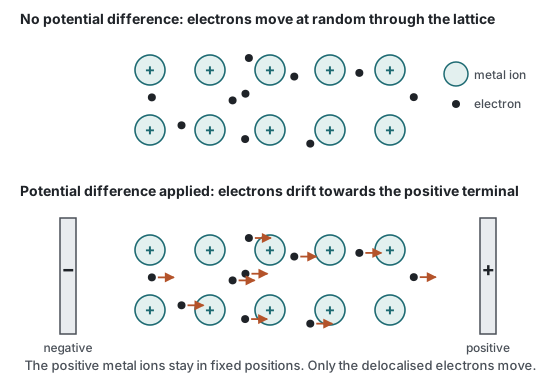
Metals are giant lattices of positive metal ions, with the outer electrons of each atom delocalised. Delocalised electrons are free to move through the whole structure. The collection of these electrons is often called a sea of electrons.
Compare the three definitions of strong bonding:
| Ionic | Covalent | Metallic | |
|---|---|---|---|
| Attraction between | oppositely charged ions | two nuclei and a shared pair of electrons | metal ions and delocalised electrons |
Each metal atom has lost its outer electron or electrons to the sea, so the particles in the lattice are ions, not atoms. The number of delocalised electrons per ion is 1 for sodium (Na⁺), 2 for magnesium (Mg²⁺) and 3 for aluminium (Al³⁺).
Using the model 3.22
Electrical conductivity. When a potential difference is applied, the delocalised electrons move through the lattice towards the positive terminal, carrying charge. The electrons are free in the solid as well as in the liquid, so metals conduct in both. This is the difference from an ionic compound. In sodium chloride the charge carriers are ions, and they can move only when the compound is molten or dissolved (see evidence for ions).
High melting temperature. Melting needs a lot of energy to overcome the strong attraction between the metal ions and the delocalised electrons.
Malleable, not brittle. If a force moves one layer of ions over the next, the ions are still surrounded by the same sea of electrons, so the attraction continues and the metal bends instead of breaking. In an ionic crystal a shift of one layer brings ions of the same charge together, and the crystal shatters (see evidence for ions).
| Metal | Ion | Delocalised electrons per ion | Ionic radius / pm | Melting temperature / °C |
|---|---|---|---|---|
| Na | Na⁺ | 1 | 102 | 98 |
| Mg | Mg²⁺ | 2 | 72 | 650 |
| Al | Al³⁺ | 3 | 53 | 660 |
Magnesium melts much higher than sodium. Its ions have a higher charge and are smaller, and there are more delocalised electrons per ion. All three make the attraction between the ions and the electrons stronger, so more energy is needed to overcome it.
Three types of strong bonding 3.53.103.21
| Ionic | Covalent | Metallic | |
|---|---|---|---|
| Particles | positive and negative ions | atoms sharing pairs of electrons | metal ions and delocalised electrons |
| Attraction | between oppositely charged ions | between two nuclei and a shared pair | between metal ions and delocalised electrons |
| Examples | NaCl, MgO | Cl₂, H₂O; diamond, graphite | Na, Mg, Cu |
| Conducts? | only when molten or dissolved (ions move) | usually no. Graphite and graphene do | yes, solid and liquid (electrons move) |
Worked exampleSame bonds, different conduction
Sodium chloride, diamond and copper all have high melting temperatures. Copper conducts when solid, sodium chloride does not, and diamond never does. Explain.
All three are giant structures held together by strong bonds: ionic bonds between ions in NaCl, covalent bonds between atoms in diamond and metallic bonds in copper. A lot of energy is needed to overcome them.
Conduction depends on whether charged particles can move. Copper has delocalised electrons that move, so it conducts as a solid. NaCl has ions fixed in the lattice, so it conducts only when the ions are free (molten or dissolved). Diamond uses all four outer electrons of each carbon in bonds and has no mobile charged particles, so it never conducts.
Check yourself
- State what is meant by metallic bonding.
- Explain why copper conducts electricity when solid but sodium chloride does not.
- Explain why the melting temperature of magnesium (650 °C) is much higher than that of sodium (98 °C).
- Explain why a metal can be hammered into shape but an ionic crystal shatters.
- Name the particles that carry the charge in (a) a metal, (b) molten sodium chloride and (c) graphite.
- A student writes: "metallic bonding is the attraction between metal atoms, and metals conduct because the ions move". Correct both parts.
Answers cover these until you have tried the questions
- Metallic bonding is the strong electrostatic attraction between metal ions and the delocalised electrons.
- Copper has delocalised electrons that are free to move through the lattice, so they carry charge, even in the solid. In solid sodium chloride the ions are fixed in position, so there are no mobile charged particles.
- Mg²⁺ has a higher charge and a smaller radius than Na⁺, and magnesium has 2 delocalised electrons per ion against 1 for sodium. The electrostatic attraction between the ions and the delocalised electrons is stronger, so more energy is needed to overcome it.
- In a metal, when layers of ions slide, the ions remain surrounded by the delocalised electrons, so the attraction is maintained and the metal bends. In an ionic crystal, sliding a layer brings ions of the same charge next to each other, and they repel, so the crystal splits.
- (a) Delocalised electrons. (b) Ions (Na⁺ and Cl⁻). (c) Delocalised electrons, along the layers.
- (1) Metallic bonding is the attraction between metal ions and delocalised electrons, not between metal atoms. (2) Metals conduct because the delocalised electrons move, not the ions.