Topic 3 · page 7 of 15
Covalent bonds and dot-and-cross diagrams
A covalent bond is the electrostatic attraction between two nuclei and the shared pair between them. Learn the definition, the electron density map that supports it, and how to draw single, double and triple bonds.
Read first: Polarisation
What a covalent bond is 3.103.10(ii)
In ionic bonding the attraction is between ions. Covalent bonding needs a different definition, and the wording matters.
Look at what attracts what. The two nuclei are positive. The shared pair of electrons between them is negative. Both nuclei are attracted to the pair in the middle, and that attraction holds the atoms together. The bond is the attraction, not just the sharing.
The specification asks for two kinds of evidence that covalent bonds are strong and that the electrons are shared between nuclei.
- Physical properties of giant atomic structures. Diamond and silicon dioxide have very high melting temperatures and are very hard. This is on the page about giant carbon structures.
- Electron density maps for simple molecules. This is on this page.
Electron density map of hydrogen 3.103.10(ii)
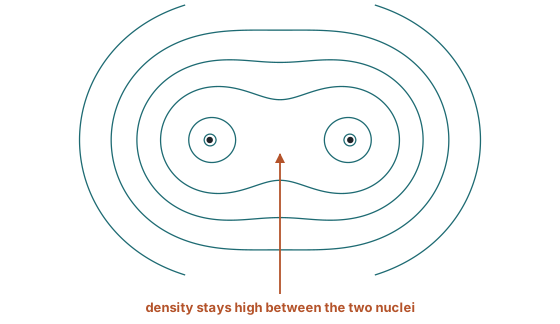
In the hydrogen map the contours enclose both nuclei. The electron density stays high between the nuclei, because the shared pair is concentrated there. This is what holds the nuclei together.
Compare it with the sodium chloride map on the evidence page:
| Ionic (NaCl) | Covalent (H₂) | |
|---|---|---|
| Contours | separate rings round each ion | one set of contours round both nuclei |
| Density between the particles | falls to almost zero | high |
Dot-and-cross diagrams: single bonds 3.113.11(i)
A dot-and-cross diagram shows only the outer shell electrons. Use dots for the electrons of one atom and crosses for those of the other, so that you can see where each electron came from. The shared pair goes where the two outer shells overlap.
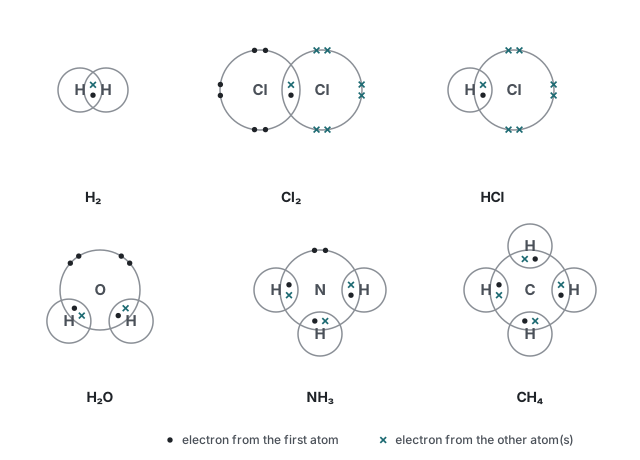
Count the electrons around each atom:
- Hydrogen has 2. Its shell is full with two.
- Each other atom here has 8, counting both the shared pairs and its own lone pairs.
A lone pair is a pair of outer electrons that is not used in bonding. Draw them. The lone pairs on oxygen and nitrogen decide the shapes of H₂O and NH₃ (see lone pairs and new shapes).
Dot-and-cross diagrams: double and triple bonds 3.113.11(i)
A double bond is two shared pairs, which is four electrons. A triple bond is three shared pairs, which is six electrons.
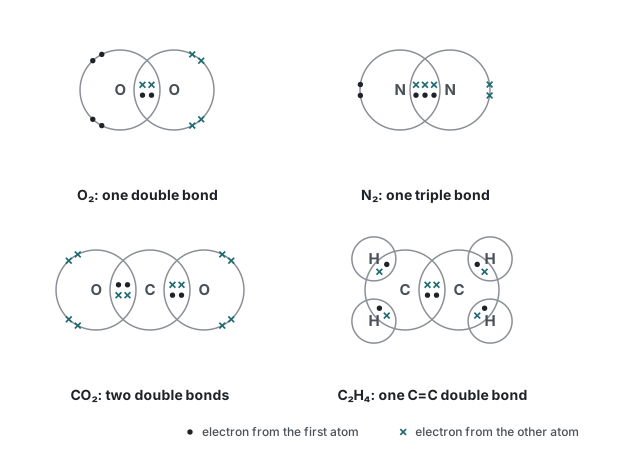
- O₂: one double bond, and two lone pairs on each oxygen.
- N₂: one triple bond, and one lone pair on each nitrogen.
- CO₂: carbon has four outer electrons and each oxygen needs two more, so carbon forms a double bond with each oxygen. There are two double bonds in total.
- C₂H₄: each carbon forms two single bonds to hydrogen and shares two pairs with the other carbon. There is one C=C double bond.
MethodDrawing a covalent dot-and-cross diagram
- Draw the outer-shell electrons of each atom, with dots for one atom and crosses for the other.
- Decide how many electrons each atom needs to complete its shell: 1 for hydrogen, and 8 minus its outer electrons for the others.
- Overlap the shells so that each atom shares the right number of pairs. The shared pairs go in the overlap.
- Add lone pairs until every atom is full.
- Count: hydrogen 2, the others 8. Check the total number of electrons against the outer electrons of the atoms in the formula.
Use the electron count in step 5 as your check:
| Molecule | Total outer electrons | Pairs | Bonding pairs | Lone pairs |
|---|---|---|---|---|
| H₂ | 2 | 1 | 1 | 0 |
| Cl₂ | 14 | 7 | 1 | 6 |
| HCl | 8 | 4 | 1 | 3 |
| H₂O | 8 | 4 | 2 | 2 |
| NH₃ | 8 | 4 | 3 | 1 |
| CH₄ | 8 | 4 | 4 | 0 |
| O₂ | 12 | 6 | 2 | 4 |
| N₂ | 10 | 5 | 3 | 2 |
| CO₂ | 16 | 8 | 4 | 4 |
| C₂H₄ | 12 | 6 | 6 | 0 |
For H₂O: oxygen has 6 outer electrons and each hydrogen has 1, so the total is 6 + 1 + 1 = 8, which is 4 pairs. Two pairs are shared with hydrogen and two are lone pairs on oxygen. For CO₂: 4 + 6 + 6 = 16, which is 8 pairs. Four are bonding pairs (two double bonds) and four are lone pairs.
Check yourself
- State what is meant by a covalent bond.
- Describe what the electron density map of hydrogen shows, and say why it is evidence for a covalent bond.
- Describe the dot-and-cross diagram for HCl. State the number of bonding pairs, the number of lone pairs, and the number of electrons around each atom.
- Calculate the total number of outer electrons in NH₃, and use it to state the number of bonding pairs and lone pairs.
- Describe the dot-and-cross diagram for CO₂, and give the number of electrons in each overlap region.
- A student writes "a double bond is two electrons" and "a covalent bond is a shared pair". Correct both statements.
Answers cover these until you have tried the questions
- A covalent bond is the strong electrostatic attraction between two nuclei and the shared pair of electrons between them.
- The contours enclose both nuclei, and the electron density between the nuclei stays high. The shared pair is concentrated between the nuclei, so both nuclei are attracted to it. This is the evidence that electrons are shared in a covalent bond. In an ionic compound the density between the ions would fall to almost zero.
- One shared pair between H and Cl (1 bonding pair), and 3 lone pairs on Cl. Hydrogen has 2 electrons around it (the shared pair). Chlorine has 8: the shared pair and three lone pairs.
- Nitrogen has 5 outer electrons and each of three hydrogens has 1, so the total is 5 + 3 = 8 electrons, which is 4 pairs. Three pairs are bonding pairs (N–H) and one is a lone pair on nitrogen.
- The carbon atom is in the centre with an oxygen on each side. There are two shared pairs between the carbon and each oxygen, which is four electrons in each overlap region. Each oxygen has two lone pairs. Every atom has 8 electrons around it. The total is 4 + 6 + 6 = 16 electrons.
- A double bond is two shared pairs, which is four electrons. A covalent bond is the electrostatic attraction between the nuclei and the shared pair of electrons, so sharing alone is not the whole definition.