Topic 3 · page 10 of 15
Electronegativity and bond polarity
Electronegativity is the pull an atom has on the bonding pair in a covalent bond. Equal pull gives a non-polar bond, unequal pull gives a polar bond, and a very large difference gives ionic bonding. Ionic and covalent are the two ends of one scale.
Read first: Covalent bonds and dot-and-cross diagrams, Polarisation
Electronegativity 3.13
The values are on the Pauling scale. A larger number means a stronger pull on the bonding pair.
| Element | H | C | N | O | F |
|---|---|---|---|---|---|
| Electronegativity | 2.1 | 2.5 | 3.0 | 3.5 | 4.0 |
| Element | Na | Mg | Al | Cl | Br | I |
|---|---|---|---|---|---|---|
| Electronegativity | 0.9 | 1.2 | 1.5 | 3.0 | 2.8 | 2.5 |
Two trends can be read from these values:
- Across a period electronegativity increases (Na 0.9 to Cl 3.0). The nuclear charge rises while the number of shells stays the same, so the nucleus pulls on the bonding pair more strongly.
- Down a group electronegativity decreases (Cl 3.0, Br 2.8, I 2.5). There are more shells, so the bonding pair is further from the nucleus and is more shielded.
Fluorine is the most electronegative element, with a value of 4.0.
A continuum from covalent to ionic 3.14
Bonds are not simply ionic or covalent. They lie on a scale, and the difference in electronegativity between the two atoms shows where.
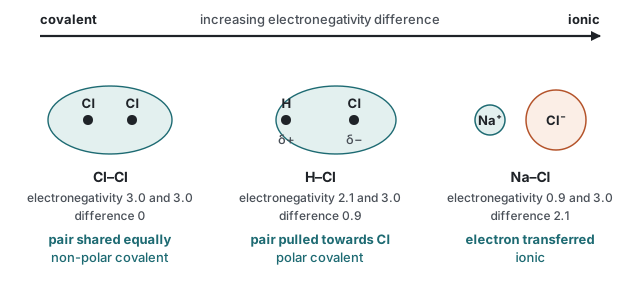
| Bond | Electronegativities | Difference | What happens to the pair | Type |
|---|---|---|---|---|
| Cl–Cl | 3.0 and 3.0 | 0 | shared equally | non-polar covalent |
| H–Cl | 2.1 and 3.0 | 0.9 | pulled towards Cl | polar covalent |
| Na–Cl | 0.9 and 3.0 | 2.1 | effectively transferred | ionic |
- Equal electronegativity: the pair is shared equally. The electron density is symmetrical between the nuclei, and the bond is non-polar.
- Different electronegativity: the pair is pulled towards the more electronegative atom. That atom is slightly negative and the other is slightly positive. The bond is polar, written .
- A large enough difference: the pair is so far from one atom that an electron has in effect been transferred, and the bonding is ionic.
The slightly positive and negative ends are shown with δ+ and δ−. The δ+ is on the less electronegative atom, and the δ− is on the more electronegative atom.
Worked examplePolarity of X–H bonds
Which end of each bond is δ+? Put the bonds in order of increasing polarity.
Bonds: C–H, N–H, O–H, F–H. Use the values H 2.1, C 2.5, N 3.0, O 3.5, F 4.0.
| Bond | Difference | δ+ atom | δ− atom |
|---|---|---|---|
| C–H | 2.5 − 2.1 = 0.4 | H | C |
| N–H | 3.0 − 2.1 = 0.9 | H | N |
| O–H | 3.5 − 2.1 = 1.4 | H | O |
| F–H | 4.0 − 2.1 = 1.9 | H | F |
In each bond the hydrogen is δ+, because it is the less electronegative atom. The order of increasing polarity is C–H < N–H < O–H < F–H, the same as the order of the difference.
Check yourself
- Define electronegativity.
- State the trend in electronegativity across Period 3 from Na to Cl, and give the values at the two ends.
- Explain the trend in electronegativity down Group 7.
- Calculate the electronegativity difference for C–O and for C–H, and state which bond is more polar and which atom carries the δ+ in each.
- Describe what happens to the bonding pair in Cl–Cl, H–Cl and Na–Cl, and name the type of bond in each.
- A student writes "electronegativity is the ability of an atom to gain electrons" and "HCl is ionic because chlorine is more electronegative". Correct both statements.
Answers cover these until you have tried the questions
- Electronegativity is the ability of an atom to attract the bonding pair of electrons in a covalent bond.
- It increases across the period, from 0.9 for sodium to 3.0 for chlorine. (The nuclear charge rises, the number of shells is the same, and the pull on the bonding pair increases.)
- It decreases down the group (F 4.0, Cl 3.0, Br 2.8, I 2.5). The atoms have more shells, so the bonding pair is further from the nucleus and is more shielded, so the pull on it is weaker.
- C–O: 3.5 − 2.5 = 1.0. C–H: 2.5 − 2.1 = 0.4. C–O is more polar. In C–O the carbon is δ+ (less electronegative than oxygen). In C–H the hydrogen is δ+ (2.1 is less than 2.5).
- In Cl–Cl the pair is shared equally: a non-polar covalent bond. In H–Cl the pair is pulled towards chlorine, so it is a polar covalent bond with and . In Na–Cl the difference is large and the electron is effectively transferred, so the bond is ionic.
- (1) Electronegativity is the ability of an atom to attract the bonding pair in a covalent bond. Gaining an electron to form an ion is a different idea. (2) HCl is a polar covalent bond. The pair is shared, but unequally, and the difference of 0.9 is not large enough to transfer the electron.