Topic 3 · page 2 of 15
Giant ionic lattices and ionic bonding
Ions do not pair up. They pack into a giant lattice, held by the net electrostatic attraction between oppositely charged ions in every direction.
Read first: Ions and electron transfer
Ionic crystals are giant lattices 3.4
Once ions have formed, they do not stay in pairs. Each positive ion attracts every negative ion around it, and each negative ion attracts every positive ion. The ions build up into a regular three-dimensional arrangement with a very large number of ions, called a giant lattice.
In sodium chloride, each Na⁺ ion is surrounded by six Cl⁻ ions, and each Cl⁻ ion is surrounded by six Na⁺ ions. The number of nearest neighbours is called the coordination number, so the coordination number is 6 for both ions.
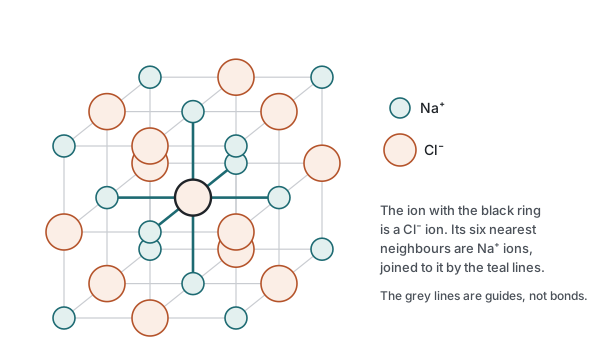
The lattice continues in all directions, so there are no separate NaCl molecules. The formula NaCl gives only the ratio of ions, 1 : 1. In magnesium chloride the ratio is one Mg²⁺ to two Cl⁻, which is why the formula is MgCl₂.
Ionic bonding 3.5
Each part of the definition has a job.
- Electrostatic attraction. The force comes from opposite charges, not from sharing electrons.
- Oppositely charged ions. The particles are ions, not atoms and not molecules.
- Net. In a lattice, every ion is attracted to ions of the opposite charge but also repelled by ions of the same charge. The oppositely charged ions are on average closer, so the attractions outweigh the repulsions. The net effect is a strong attraction.
The attraction acts in all directions, not just towards one partner. This is why the ions build a giant lattice and not a pair.
Check yourself
- State what is meant by ionic bonding.
- Explain why the definition of ionic bonding includes the word "net".
- In sodium chloride, state how many chloride ions surround each sodium ion, and how many sodium ions surround each chloride ion.
- Explain why it is wrong to refer to a "molecule of sodium chloride".
- A student writes "ionic bonding is the attraction between a metal and a non-metal". Give two errors.
- A crystal contains 1.00 mol of MgCl₂. State the amount of each ion, and calculate the total number of ions. The Avogadro constant is 6.02 × 10²³ mol⁻¹.
Answers cover these until you have tried the questions
- The strong net electrostatic attraction between oppositely charged ions.
- Every ion is attracted to neighbouring ions of the opposite charge but is also repelled by ions of the same charge. The attractions are greater than the repulsions, because the oppositely charged ions are closer together. The overall (net) force is attractive.
- Six chloride ions around each sodium ion, and six sodium ions around each chloride ion.
- Sodium chloride is a giant lattice of ions that continues in all directions, with no separate groups of ions. The formula NaCl only gives the ratio of Na⁺ to Cl⁻ ions, 1 : 1.
- Two from: the attraction is between ions, not between a metal and a non-metal (atoms); the attraction is electrostatic (the word is missing); it is strong and net (these words are missing).
- MgCl₂ gives one Mg²⁺ and two Cl⁻, so there is 1.00 mol of Mg²⁺ and 2.00 mol of Cl⁻. The total is 3.00 mol of ions, and 3.00 × 6.02 × 10²³ = 1.806 × 10²⁴, which is 1.81 × 10²⁴ ions.