Topic 3 · page 1 of 15
Ions and electron transfer
Metals lose electrons to become positive ions, non-metals gain electrons to become negative ions, and a dot-and-cross diagram shows where every electron has gone.
How ions form 3.2
An atom is neutral because it has as many electrons as protons. It becomes an ion when it loses or gains electrons. The nucleus never changes. Only electrons move.
- Metals lose their outer electrons and become positive ions, called cations.
- Non-metals gain electrons and become negative ions, called anions.
Sodium has the configuration 1s² 2s² 2p⁶ 3s¹. It loses the 3s electron and is left with 1s² 2s² 2p⁶, the configuration of neon. Chlorine is 1s² 2s² 2p⁶ 3s² 3p⁵. It gains one electron into the 3p sub-shell and reaches 1s² 2s² 2p⁶ 3s² 3p⁶, the configuration of argon.
An electron appears as a product when an atom loses it, and as a reactant when an atom gains it. Check that the total charge is the same on both sides of every equation.
| Group | 1 | 2 | 3 | 5 | 6 | 7 |
|---|---|---|---|---|---|---|
| Ion charge | 1+ | 2+ | 3+ | 3− | 2− | 1− |
| Example | Na⁺ | Mg²⁺ | Al³⁺ | N³⁻ | O²⁻ | Cl⁻ |
Many d-block metals do not follow this pattern. Iron forms Fe²⁺ and Fe³⁺, and copper forms Cu²⁺, so you must learn or be given their charges (see the d-block ions in Topic 2).
Worked exampleEquations for four ions
Write equations for the formation of Mg²⁺, O²⁻, Al³⁺ and N³⁻ from their atoms.
- Magnesium is in Group 2, so it loses 2 electrons:
- Oxygen is in Group 6, so it gains 2 electrons:
- Aluminium is in Group 3, so it loses 3 electrons:
- Nitrogen is in Group 5, so it gains 3 electrons:
- Check the charge on each side. In 1 the left side is 0 and the right side is 2+ plus 2−, which is 0. The other three balance in the same way.
Dot-and-cross diagrams for ions 3.3
A dot-and-cross diagram shows the outer-shell electrons of each particle. Dots are the electrons from one atom and crosses are the electrons from the other. The symbols let you see where each electron started.
- Draw the outer shell of each ion only, as a circle around the symbol.
- Use dots for the electrons that came from one atom and crosses for the other.
- Put each ion in square brackets, with its charge outside the bracket, at the top right.
- Do not draw any line or shared pair between the ions. No electrons are shared in an ionic compound.
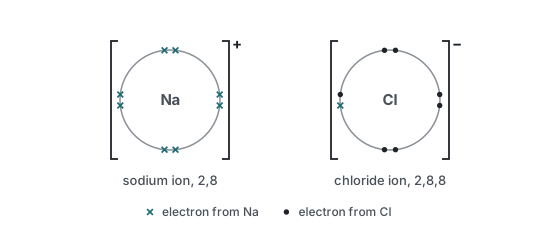
Look at what has happened to the sodium ion. Its old outer shell, the third, is gone. The second shell is now the outer shell, and it is full with eight electrons, so you draw eight crosses. Some mark schemes also accept Na⁺ drawn as an empty bracket with the charge, but eight crosses is the safe choice. The chloride ion has its own seven electrons plus the one from sodium, which makes eight.
Magnesium has two outer electrons, so it loses two.
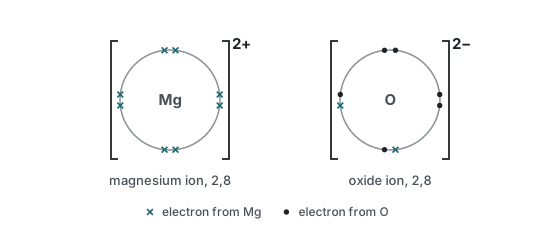
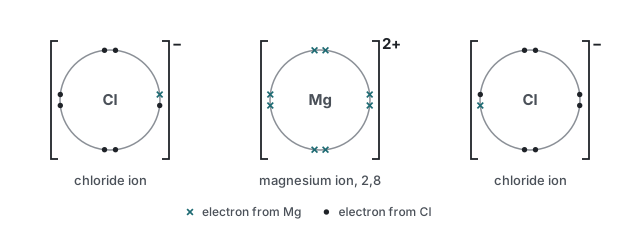
In magnesium chloride each chlorine atom needs only one electron, so the two electrons go to two different chlorine atoms.
Check yourself
- Write equations, with electrons, for the formation of Ca²⁺ and S²⁻ from their atoms.
- Write the electronic configuration of Al³⁺ and of N³⁻, and name the noble gas that each matches.
- Describe the dot-and-cross diagram for lithium oxide, Li₂O. Outer shells only.
- Describe the dot-and-cross diagram for calcium fluoride, CaF₂.
- Deduce the formula of aluminium oxide from the charges on its ions.
- A student draws magnesium chloride with one Mg²⁺ ion and one Cl⁻ ion. Explain what is wrong.
Answers cover these until you have tried the questions
- (calcium is in Group 2) and (sulfur is in Group 6).
- Al is 1s² 2s² 2p⁶ 3s² 3p¹. It loses three electrons, so Al³⁺ is 1s² 2s² 2p⁶, the same as neon. N is 1s² 2s² 2p³. It gains three electrons, so N³⁻ is 1s² 2s² 2p⁶, also the same as neon.
- Two lithium atoms each lose one electron, and one oxygen atom gains two. Draw two [Li]⁺ ions, each showing its first shell of two crosses, with the charge outside the bracket. Draw one [O]²⁻ ion with eight electrons: six dots from oxygen and two crosses, one from each lithium atom. The charge is 2− outside the bracket.
- One calcium atom loses two electrons, and each of two fluorine atoms gains one. Draw one [Ca]²⁺ ion with eight crosses (its full third shell) and two [F]⁻ ions, each with seven dots and one cross. The charges are 2+ and 1− each, outside the brackets.
- Al³⁺ and O²⁻. The smallest equal total charge is 6, which needs two Al³⁺ (2 × 3) and three O²⁻ (3 × 2). The formula is Al₂O₃.
- Magnesium loses two electrons, but a chlorine atom accepts only one. With one Cl⁻ ion, one electron has nowhere to go and the charges do not balance (2+ against 1−). A second chloride ion is needed: one Mg²⁺ and two Cl⁻, which gives MgCl₂ with a total charge of zero.