Topic 3 · page 5 of 15
Ionic radius and bond strength
Charge and radius decide how strongly ions attract each other. Radii follow two trends, shells down a group and nuclear charge across a set of isoelectronic ions. Count the electrons first, and the right argument follows.
Read first: Giant ionic lattices and ionic bonding
What makes ionic bonding stronger 3.6
Ionic bonding is the strong electrostatic attraction between oppositely charged ions in the lattice (see giant ionic lattices). Two things change the size of that attraction:
- A higher ionic charge gives a stronger attraction.
- A smaller ionic radius puts the ions closer together, which gives a stronger attraction.
A stronger attraction means more energy is needed to separate the ions, so the melting temperature is higher.
| Compound | Ions | Melting temperature / °C |
|---|---|---|
| NaF | Na⁺ F⁻ | 993 |
| NaCl | Na⁺ Cl⁻ | 801 |
| NaBr | Na⁺ Br⁻ | 747 |
| NaI | Na⁺ I⁻ | 661 |
| MgO | Mg²⁺ O²⁻ | 2852 |
Read the table one factor at a time:
- NaF to NaI: the charges are the same, 1+ and 1−. Only the anion changes, and it gets bigger from F⁻ to I⁻. The ions are further apart, the attraction is weaker, and the melting temperature falls. This isolates the radius effect.
- NaCl to MgO: the charges rise from 1+ and 1− to 2+ and 2−, and the ions are also smaller. The attraction is much stronger, and the melting temperature is much higher. This shows the charge effect.
Ionic radius down a group 3.7
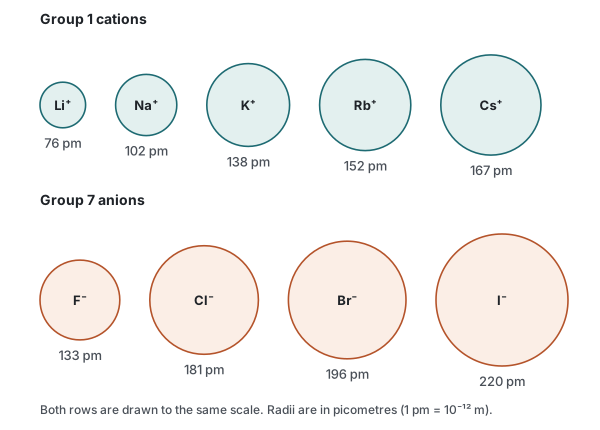
Going down a group the ions have more electron shells. The outer electrons are further from the nucleus, so the ionic radius increases. The nuclear charge also increases, but the extra inner shells shield it, and the extra shell has the larger effect.
Positive and negative ions follow the same trend down a group.
Isoelectronic ions 3.7
Isoelectronic ions have the same number of electrons. The ions N³⁻, O²⁻, F⁻, Na⁺, Mg²⁺ and Al³⁺ all have 10 electrons, with the arrangement 1s² 2s² 2p⁶. They also have the same two shells.
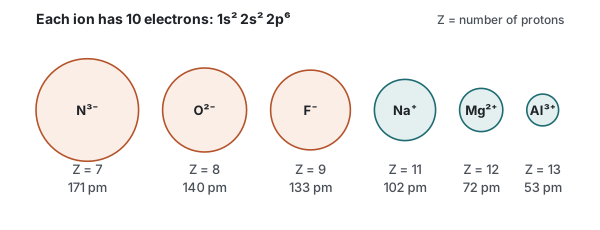
| Ion | N³⁻ | O²⁻ | F⁻ | Na⁺ | Mg²⁺ | Al³⁺ |
|---|---|---|---|---|---|---|
| Protons | 7 | 8 | 9 | 11 | 12 | 13 |
| Electrons | 10 | 10 | 10 | 10 | 10 | 10 |
| Radius / pm | 171 | 140 | 133 | 102 | 72 | 53 |
From N³⁻ to Al³⁺ the nuclear charge increases from 7 to 13 protons while the electron arrangement stays the same. The same ten electrons are pulled closer to the nucleus, so the radius decreases.
MethodChoosing the argument for a radius
- Count the electrons in each ion (atomic number, plus the charge of an anion or minus the charge of a cation).
- If the ions have different numbers of shells (for example Na⁺ is 2,8 and K⁺ is 2,8,8), argue from shells and distance.
- If the ions have the same number of electrons (isoelectronic), argue from nuclear charge: more protons pull the same electrons closer.
Worked exampleCl⁻ and Na⁺
Why is Cl⁻ bigger than Na⁺, although both are in Period 3?
Na⁺ has 10 electrons, arranged 2,8, in two shells. Cl⁻ has 18 electrons, arranged 2,8,8, in three shells. Cl⁻ has the extra shell, so its outer electrons are further from the nucleus. The radius of Cl⁻ is larger. (The values are 181 pm and 102 pm.)
Check yourself
- Explain why K⁺ is larger than Na⁺.
- S²⁻, Cl⁻, K⁺ and Ca²⁺ each have 18 electrons. Put them in order of size, largest first, and explain the order.
- Predict which has the higher melting temperature, NaF or MgF₂, and explain.
- Explain why the melting temperature of sodium iodide (661 °C) is lower than that of sodium chloride (801 °C).
- Put O²⁻, F⁻, Na⁺ and Mg²⁺ in order of ionic radius, largest first, and explain.
- A student explains that the radius of Al³⁺ is smaller than that of N³⁻ "because aluminium has more shells". Find the error and write the correct explanation.
Answers cover these until you have tried the questions
- K⁺ has the electron arrangement 2,8,8 and Na⁺ has 2,8. K⁺ has one more electron shell, so its outer electrons are further from the nucleus and its radius is larger.
- Order: S²⁻ > Cl⁻ > K⁺ > Ca²⁺. Each ion has 18 electrons, so they have the same arrangement and the same number of shells. The nuclear charge increases from 16 protons (S) to 17 (Cl), 19 (K) and 20 (Ca). The same 18 electrons are pulled closer to a more highly charged nucleus, so the radius decreases along the series.
- MgF₂ has the higher melting temperature. Mg²⁺ has a higher charge (2+ against 1+) and a smaller radius than Na⁺. The electrostatic attraction between the ions is stronger, so more energy is needed to separate them.
- Both compounds have the same ion charges, 1+ and 1−. I⁻ has more shells than Cl⁻, so it is larger. The ions in NaI are further apart, so the attraction between the ions is weaker and less energy is needed to overcome it. The melting temperature is lower.
- Each ion has 10 electrons, so they are isoelectronic. Protons: O 8, F 9, Na 11, Mg 12. Order: O²⁻ > F⁻ > Na⁺ > Mg²⁺. The nuclear charge increases along the series and the electrons are pulled closer, so the radius decreases.
- N³⁻ and Al³⁺ both have 10 electrons in two shells, so Al³⁺ does not have more shells. The correct explanation is that Al has 13 protons against 7 in N. The same 10 electrons are pulled closer to the more highly charged nucleus, so Al³⁺ is smaller.