Topic 3 · page 8 of 15
Dative covalent bonds
In a dative bond both electrons of the shared pair come from the same atom. The ammonium ion and Al2Cl6 are the two examples you must be able to draw. Look for an atom with a lone pair next to an atom that is short of electrons.
Read first: Covalent bonds and dot-and-cross diagrams
What a dative bond is 3.113.11(ii)
Once it has formed, a dative bond is still a covalent bond. It is the attraction between two nuclei and a shared pair, as before. The only difference is where the pair came from.
Two conditions must be met:
- one atom has a lone pair to give (the donor),
- the other atom has an empty space in its outer shell to receive it (the acceptor).
In a displayed formula a dative bond is drawn as an arrow that points from the donor to the acceptor.
The ammonium ion 3.113.11(ii)
Ammonia has a lone pair on the nitrogen atom. A hydrogen ion, H⁺, has no electrons: it is just a proton, with an empty 1s orbital. The lone pair on nitrogen is shared with H⁺:
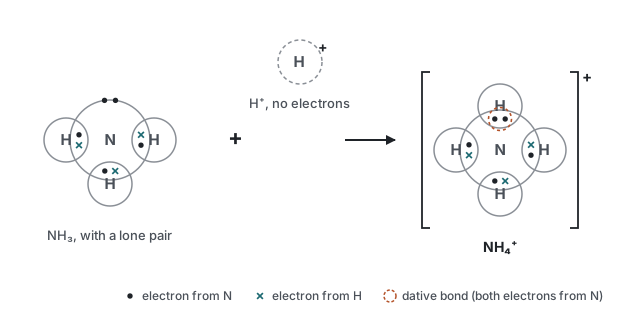
In the diagram, the overlap for the dative bond has two electrons of the same symbol, because both came from nitrogen. In the finished ion, all four N–H bonds are identical. You cannot tell which one was the dative bond, because they have the same length and the same strength.
Drawing rules for NH₄⁺:
- the charge belongs to the whole ion, so draw a square bracket round all five atoms and put the + outside at the top right,
- nitrogen has 8 electrons around it and each hydrogen has 2,
- the total is 5 (N) + 4 (H) − 1 (for the + charge) = 8 electrons, which is 4 bonding pairs.
Al₂Cl₆ 3.113.11(ii)
Aluminium chloride is the second example. Start with the molecule AlCl₃.
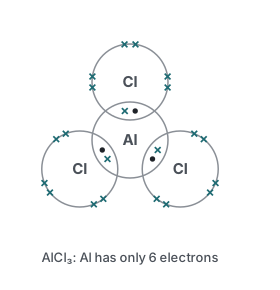
Count the electrons around aluminium: it has three bonding pairs and no lone pairs, so only 6. Aluminium is electron-deficient. Its outer shell has room for two more electrons.
Two AlCl₃ molecules join to make Al₂Cl₆. A lone pair on a chlorine atom of each molecule forms a dative bond to the aluminium of the other molecule.
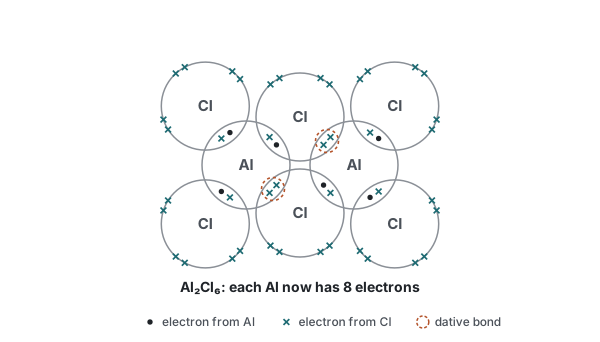
Now each aluminium atom has 8 electrons, and each bridging chlorine atom still has 8.
Worked exampleElectron count for Al₂Cl₆
Check the electron count for Al₂Cl₆.
Outer electrons: 2 × 3 (Al) + 6 × 7 (Cl) = 6 + 42 = 48, which is 24 pairs.
Bonding pairs: each Al has four pairs shared (two to terminal Cl and two to bridging Cl). 2 × 4 = 8 bonding pairs.
Lone pairs: four terminal Cl atoms with 3 lone pairs each = 12. Two bridging Cl atoms with 2 lone pairs each = 4. That gives 16 lone pairs.
8 + 16 = 24 pairs. The total matches, so the diagram is consistent.
Other examples built the same way, which you may meet in a question:
- the oxonium ion, H₃O⁺: a lone pair on oxygen in H₂O bonds to H⁺,
- NH₃ with BF₃: boron in BF₃ has 6 electrons around it, and the lone pair on nitrogen fills the gap.
Check yourself
- Define a dative covalent bond.
- Explain how an ammonia molecule bonds to a hydrogen ion, and state which atom donates the pair.
- Describe how you can tell, from the finished NH₄⁺ ion, which N–H bond was the dative bond.
- Explain why AlCl₃ is said to be electron-deficient, and state how two molecules of it combine.
- A water molecule bonds to H⁺ to form H₃O⁺. State the number of bonding pairs and lone pairs on oxygen in H₃O⁺, and say which atom donates.
- A student draws the displayed formula of NH₄⁺ with the arrow pointing from H to N and without brackets. Give two corrections.
Answers cover these until you have tried the questions
- A dative covalent bond is a shared pair of electrons in which both electrons come from the same atom.
- The nitrogen atom has a lone pair. H⁺ has an empty orbital and no electrons. The lone pair on nitrogen is shared with H⁺ to make a new N–H bond, giving NH₄⁺. Nitrogen donates the pair.
- You cannot. All four N–H bonds in NH₄⁺ are identical in length and strength. Once formed, the dative bond is the same as the other three.
- In AlCl₃ aluminium has three bonding pairs and no lone pair, so it has only 6 electrons in its outer shell, with room for two more. Two AlCl₃ molecules join to make Al₂Cl₆: a lone pair on a chlorine atom of each molecule forms a dative bond to the aluminium of the other. Each aluminium then has 8 electrons.
- Oxygen in H₃O⁺ has 3 bonding pairs and 1 lone pair. It had two bonding pairs and two lone pairs in H₂O, and it uses one lone pair to bond to H⁺. Oxygen donates the pair. (Total outer electrons: 6 + 3 − 1 = 8, which is 4 pairs.)
- (1) The arrow should point from N to H, from the donor to the acceptor. (2) The ion needs square brackets with the + charge outside at the top right, because the charge belongs to the whole ion.