Topic 14 · page 18 of 18
Core Practical 11: finding the Ka of a weak acid
Find the equivalence volume by titration, then add exactly half of it to fresh acid and measure the pH. At that point pH = pKa, so Ka = 10 to the power minus pH.
Read first: Buffers on the titration curve
Aim and idea 14.2314.21(ii)
To find the acid dissociation constant, , of a weak acid, here ethanoic acid, using a pH meter and a titration.
The idea comes from page 16. When exactly half of a weak acid has been neutralised, [HA] = [A⁻], so pH = . You therefore need two things: the volume of NaOH that neutralises all the acid (), and the pH when half that volume has been added.
Method 14.23
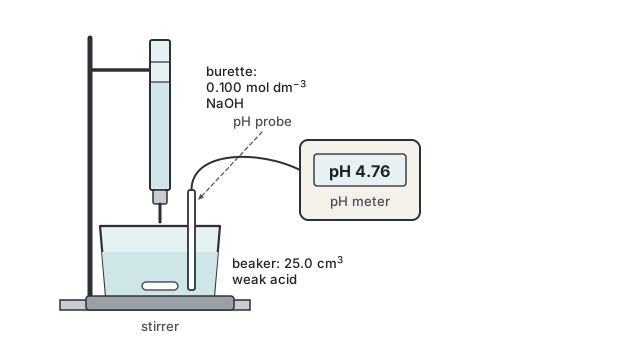
PracticalFinding Ka
- Calibrate the pH meter with buffer solutions of known pH (for example pH 4.00 and pH 7.00, which bracket the pH you expect). Rinse the probe with deionised water.
- Find the equivalence volume. Pipette 25.0 cm³ of the ethanoic acid into a conical flask, add a few drops of phenolphthalein, and titrate with 0.100 mol dm⁻³ NaOH. Do one rough titration, then repeat until two titres agree within 0.10 cm³. Calculate the mean, .
- Half-neutralise. Pipette a fresh 25.0 cm³ of the same acid into a beaker. From the burette add exactly of the NaOH. Stir, and put in the probe.
- Measure the pH when the reading is steady, and record it. This is the .
- Calculate = .
A variation records the whole curve instead. Place the probe in 25.0 cm³ of acid, add NaOH in 1.0 cm³ portions (0.1 to 0.5 cm³ near equivalence), record the pH after each, plot pH against volume, find from the middle of the vertical section and read the pH at .
| Step | Why |
|---|---|
| Calibrate and rinse the probe | The pH reading is only as good as the calibration, and depends on it directly |
| Use the same pipette and the same NaOH for both parts | The ratio of acid to alkali is then exact, so the half-neutralisation is exactly half |
| Stir before reading | The pH near the probe must match the rest of the solution |
| Wait for a steady reading | The meter needs a few seconds to settle |
| Keep the temperature the same | changes with temperature |
Results and processing 14.23
The results below are illustrative, calculated from the equilibrium model, not measured data.
| Titration | Volume of NaOH / cm³ |
|---|---|
| 1 (rough) | 25.60 |
| 2 | 25.05 |
| 3 | 24.95 |
| 4 | 25.00 |
The concordant titres (2, 3 and 4) have a mean of 25.00 cm³, so = 25.00 cm³ and the half-neutralisation volume is 12.50 cm³.
If you recorded the whole curve, you have data like this.
| Volume of NaOH / cm³ | pH |
|---|---|
| 0 | 2.88 |
| 5.0 | 4.16 |
| 10.0 | 4.58 |
| 12.5 | 4.76 |
| 15.0 | 4.94 |
| 20.0 | 5.36 |
| 24.0 | 6.14 |
| 24.5 | 6.45 |
| 25.0 | 8.73 |
| 25.5 | 11.00 |
| 26.0 | 11.29 |
| 30.0 | 11.96 |
| 40.0 | 12.36 |
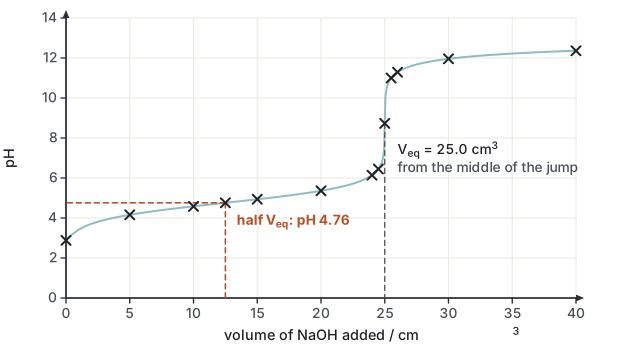
| Observation | Explanation |
|---|---|
| The start is at pH 2.88, not 1 | ethanoic acid is weak, so it is only partly dissociated |
| The pH rises slowly up to about 24 cm³ | HA and A⁻ are both present: a buffer |
| A sharp rise at 25.0 cm³ | equivalence: all the HA has been used |
| pH 4.76 at 12.5 cm³ | [HA] = [A⁻], so pH = |
There is a cross-check from the start of the curve. A pH of 2.88 for 0.100 mol dm⁻³ acid gives, by the method of page 6, = ()² ÷ 0.100 = 1.7 × 10⁻⁵. The two methods agree.
Evaluation 14.23
| Source of error | Effect | Improvement |
|---|---|---|
| Meter badly calibrated | every pH shifts by the same amount, so is wrong | calibrate with two buffers that bracket the pH |
| Equivalence volume read from a curve | is less exact, so half of it is too | take readings every 0.1 cm³ near the jump, or use concordant titrations |
| NaOH has absorbed CO₂ from the air | its true concentration is lower than stated | use the same NaOH for both parts, as the method does |
| Temperature different from the data-book value | changes with temperature | record the temperature and compare with a value at that temperature |
| Assumes [HA] = [A⁻] exactly at the half point | a small error, because some of the HA also dissociates | negligible here, as [H⁺] is far smaller than [HA] and [A⁻] |
Two points about the size of the errors.
- A pH uncertainty of ±0.01 gives a uncertainty of about 2.3%, because = . On page 6 it was doubled to about 5% because [H⁺] was squared. Here there is no squaring.
- The curve is almost flat at 12.5 cm³ (about 0.07 pH units per cm³), so a burette error of ±0.05 cm³ changes the pH by less than 0.004. The result is not sensitive to small errors in the volume.
Check yourself
- Explain why the pH meter is calibrated with buffers at pH 4.00 and pH 7.00 for this experiment.
- The mean equivalence volume is 21.40 cm³. What volume of NaOH is added to a fresh 25.0 cm³ of acid in the second part?
- The pH at half-neutralisation is 4.62. Calculate and .
- Explain why the pH at half-neutralisation equals the .
- A student's result is = 1.55 × 10⁻⁵ mol dm⁻³ and the data-book value is 1.74 × 10⁻⁵. Calculate the percentage difference, and the error in the pH reading that would explain it.
- The pH reading is uncertain by ±0.02. Calculate the percentage uncertainty in .
Answers cover these until you have tried the questions
- The expected pH of the half-neutralised acid is about 4.8. Buffers at pH 4.00 and pH 7.00 bracket that value, so the meter reads accurately across the range used.
- Half of 21.40 = 10.70 cm³ of NaOH, added to 25.0 cm³ of the same acid.
- = 4.62. = = 2.40 × 10⁻⁵, so 2.4 × 10⁻⁵ mol dm⁻³.
- At half-neutralisation half the acid has been converted to its conjugate base, so [HA] = [A⁻]. In = [H⁺][A⁻] ÷ [HA] these cancel, so = [H⁺], and pH = .
- Percentage difference = (1.74 − 1.55) ÷ 1.74 × 100 = 10.9% low. for 1.55 × 10⁻⁵ = 4.81, against 4.76, so a pH reading 0.05 units too high would explain it (for example from imperfect calibration).
- = , so the factor is = 1.047, an uncertainty of about 4.7% in .