Topic 14 · page 12 of 18
Choosing an indicator
An indicator changes colour over a range of pH. It gives a sharp end point only if that range lies inside the vertical section of the titration curve.
Read first: Four monoprotic curves
How an indicator works 14.16
An acid-base indicator is itself a weak acid, written HIn, whose acid form and base form have different colours:
In an acidic solution the equilibrium lies to the left and you see the colour of HIn. In an alkaline solution it lies to the right and you see the colour of In⁻. In between, both are present and the colour is a mixture. The colour does not flip at one exact pH. It changes gradually over a range of about two pH units.
Only a few drops are added. The indicator is itself a weak acid, and more than that would react with the solution being titrated and spoil the result.
| Indicator | pH range | Colour in acid | Colour in alkali |
|---|---|---|---|
| Methyl orange | 3.1 to 4.4 | red | yellow |
| Methyl red | 4.2 to 6.3 | red | yellow |
| Bromothymol blue | 6.0 to 7.6 | yellow | blue |
| Phenolphthalein | 8.3 to 10.0 | colourless | pink |
The rule 14.16
If the range is outside the vertical section, the colour changes gradually over several cm³ of titrant, well before or well after the equivalence point, so the end point is not sharp.
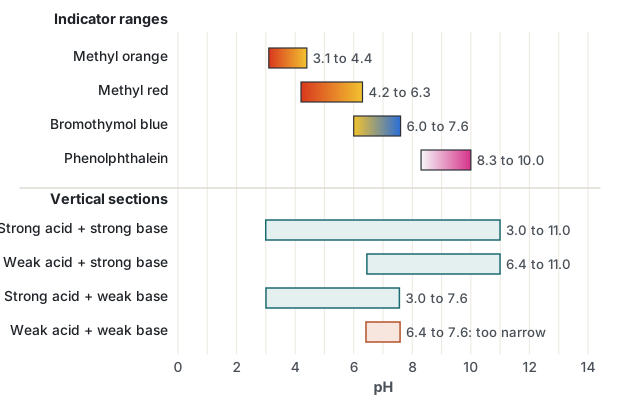
Read down the figure for each titration. An indicator whose bar sits inside the vertical bar is suitable.
| Titration | Vertical section | Suitable | Not suitable |
|---|---|---|---|
| strong acid + strong base | about 3 to 11 | any of the four | none |
| weak acid + strong base | about 6.5 to 11 | phenolphthalein | methyl orange, methyl red, bromothymol blue |
| strong acid + weak base | about 3 to 7.6 | methyl orange, methyl red | phenolphthalein, bromothymol blue |
| weak acid + weak base | none | none: use a pH meter | all |
Bromothymol blue just misses the strong acid with weak base titration, because its range reaches pH 7.6 and the vertical section stops at about 7.6. Treat it as unsuitable.
Choosing from the curve 14.16
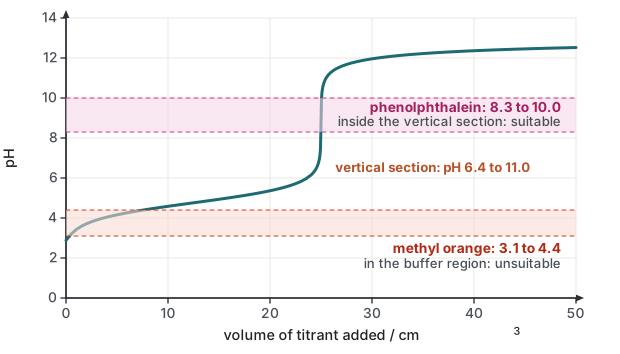
Methyl orange starts to change colour after less than 1 cm³ of alkali, because the pH is already close to 3 at the start. It has finished changing by about 7.6 cm³, less than a third of the way to equivalence, and then the colour stays yellow for the remaining 17 cm³ or so. Phenolphthalein stays colourless until the vertical section and turns pink as the last drops of alkali go in.
Worked exampleStrong acid with weak base
Choose an indicator for the titration of 0.100 mol dm⁻³ ammonia with 0.100 mol dm⁻³ hydrochloric acid. The vertical section runs from about pH 7.6 to pH 3.0 and the equivalence point is at pH 5.28.
- The indicator range must lie inside pH 3.0 to 7.6.
- Methyl orange (3.1 to 4.4) lies inside, and so does methyl red (4.2 to 6.3).
- Phenolphthalein (8.3 to 10.0) is above the vertical section, so it would change colour before any acid was added.
- A suitable choice is methyl orange, which changes from yellow to orange as acid is added.
Check yourself
- Explain why the colour-change range of an indicator must lie inside the vertical section of the curve.
- Name a suitable indicator for the titration of ethanoic acid with sodium hydroxide, and justify your choice.
- Name a suitable indicator for the titration of hydrochloric acid with ammonia, and justify your choice.
- Explain why methyl orange is not suitable for the titration of ethanoic acid with sodium hydroxide.
- A titration has a vertical section from pH 3.5 to pH 10.5. Which of methyl orange, methyl red, bromothymol blue and phenolphthalein are suitable?
- Why is no indicator suitable for the titration of ethanoic acid with ammonia, and how would you find the equivalence volume instead?
Answers cover these until you have tried the questions
- A drop of titrant near equivalence changes the pH across the whole vertical section. If the indicator range is inside it, the indicator changes colour completely with one drop, giving a sharp end point at the equivalence point.
- Phenolphthalein (range 8.3 to 10.0). The vertical section is about pH 6.5 to 11, and the range lies inside it. The equivalence point is at pH 8.73.
- Methyl orange (range 3.1 to 4.4), or methyl red (4.2 to 6.3). The vertical section is about pH 7.6 to 3.0 and these ranges lie inside it. The equivalence point is at pH 5.28.
- Methyl orange changes colour at pH 3.1 to 4.4. That is in the gradually rising buffer region, far below the vertical section (about 6.5 to 11). The colour change would be gradual and would finish well before the equivalence point.
- The indicator range must lie within pH 3.5 to 10.5. Methyl orange (3.1 to 4.4) starts below 3.5, so it is not suitable. Methyl red (4.2 to 6.3), bromothymol blue (6.0 to 7.6) and phenolphthalein (8.3 to 10.0) all lie inside, so they are suitable.
- With both a weak acid and a weak base there is no vertical section, so the pH changes smoothly and every indicator changes colour gradually. Use a pH meter, plot pH against volume, and read the equivalence volume from the middle of the steepest part of the curve.