Topic 14 · page 13 of 18
What a buffer is and how it works
A buffer holds a large reserve of a weak acid and its conjugate base. Added H⁺ is absorbed by the base, added OH⁻ by the acid, so the pH hardly moves.
Read first: The acid dissociation constant
What a buffer is 14.17
Add 1 cm³ of 1 mol dm⁻³ hydrochloric acid to a litre of pure water and the pH drops from 7 to 3. Add the same acid to a litre of blood and the pH hardly changes. Something in the blood absorbs the acid. Anything that does this job is a buffer.
Acidic and basic buffers 14.17
Every buffer is built from the two members of a conjugate pair that are both present in good amounts.
| Type | Made from | Example | pH |
|---|---|---|---|
| Acidic buffer | a weak acid and its conjugate base (usually as a sodium salt) | ethanoic acid + sodium ethanoate | below 7 |
| Acidic buffer, made another way | a weak acid part-neutralised by a strong base, leaving some acid | excess ethanoic acid + some NaOH | below 7 |
| Basic buffer | a weak base and its conjugate acid (as a salt) | ammonia + ammonium chloride | above 7 |
In the second row the NaOH reacts with some of the acid to make the sodium salt in the flask. You then have the acid and its salt together, just as if you had weighed out both.
How an acidic buffer works 14.18
Take ethanoic acid with sodium ethanoate. The salt is fully dissociated, so it supplies a large reserve of CH₃COO⁻. The acid is only slightly dissociated, so it supplies a large reserve of undissociated CH₃COOH. The equilibrium is:
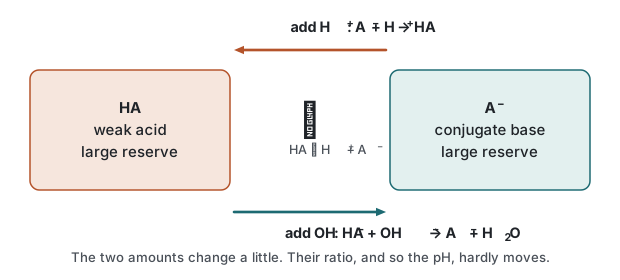
When a little acid is added, the extra H⁺ is removed by the ethanoate ions:
The equilibrium shifts to the left. The reserve of CH₃COO⁻ falls a little, the CH₃COOH rises a little, and [H⁺] stays almost where it was.
When a little alkali is added, the OH⁻ reacts with H⁺ to make water:
This takes H⁺ out of the equilibrium, which shifts to the right. CH₃COOH dissociates to replace the H⁺ that was lost, so the pH hardly changes.
The ratio [CH₃COO⁻] ÷ [CH₃COOH] decides [H⁺] (page 14). Each addition changes that ratio only slightly, because both amounts are large, and so the pH hardly moves.
A basic buffer 14.18
A mixture of ammonia and ammonium chloride works the same way with the roles swapped. NH₃ is the base that removes added acid, and NH₄⁺ is the acid that removes added alkali.
Check yourself
- State what is meant by a buffer solution.
- Explain how a mixture of ethanoic acid and sodium ethanoate acts as a buffer when a small amount of hydrochloric acid is added.
- Explain how the same mixture responds when a small amount of sodium hydroxide is added.
- Explain how a mixture of ammonia and ammonium chloride responds when a small amount of acid is added.
- Explain why a mixture of hydrochloric acid and sodium chloride is not a buffer.
- 25.0 cm³ of 0.200 mol dm⁻³ ethanoic acid is mixed with 10.0 cm³ of 0.200 mol dm⁻³ sodium hydroxide. Show that the mixture is a buffer.
Answers cover these until you have tried the questions
- A solution that resists changes in pH when small amounts of acid or alkali are added.
- The mixture holds a large reserve of CH₃COOH and CH₃COO⁻. The added H⁺ reacts with CH₃COO⁻: . The equilibrium shifts to the left, so the H⁺ is removed. The ratio [CH₃COO⁻] ÷ [CH₃COOH] changes only slightly, so [H⁺] and the pH hardly change.
- The added OH⁻ reacts with H⁺: . This removes H⁺, so the equilibrium shifts to the right and CH₃COOH dissociates to replace the H⁺. The ratio changes only slightly, so the pH hardly changes.
- NH₃ is a base and accepts the added H⁺: . The amount of NH₃ falls slightly and NH₄⁺ rises slightly. Both are large reserves, so the ratio and the pH hardly change.
- HCl is a strong acid and NaCl is a salt of a strong acid, so the mixture contains no weak acid and conjugate base pair. Cl⁻ cannot accept H⁺ from solution, so nothing removes added H⁺, and nothing replaces H⁺ when alkali is added.
- Moles of CH₃COOH = 0.200 × 0.0250 = 5.00 × 10⁻³ mol. Moles of NaOH = 0.200 × 0.0100 = 2.00 × 10⁻³ mol. The NaOH reacts with some of the acid: moles of CH₃COOH left = 3.00 × 10⁻³ mol and moles of CH₃COO⁻ made = 2.00 × 10⁻³ mol. Both members of the conjugate pair are present in comparable amounts, so the mixture is a buffer.