Topic 14 · page 8 of 18
Measuring pH and dilution
Two experiments test the ideas so far. Equimolar solutions show how strength and salts change pH, and dilution by ten, a hundred and a thousand times tells a strong acid from a weak one.
Read first: pH of a weak acid, Water and strong bases
Measuring pH 14.13(i)
There are two ways to measure pH in the laboratory.
- A pH meter. Calibrate it with buffer solutions of known pH (for example pH 4 and pH 7 or 10), rinse the probe with deionised water between solutions, and wait for the reading to settle. It reads to 0.01 or 0.1 pH units.
- Universal indicator (paper or solution). Compare the colour with a chart. It is quick, but it is only accurate to about one pH unit.
Use a meter whenever a number matters, such as for or a titration curve.
Equimolar solutions 14.13(i)
"Equimolar" means the same concentration. Fixing the concentration at 0.100 mol dm⁻³ means any difference in pH is down to the substance itself. Typical results at 298 K are:
| Solution | Type | pH |
|---|---|---|
| Hydrochloric acid | strong acid | 1.00 |
| Ethanoic acid | weak acid | 2.88 |
| Ammonium chloride | salt of a weak base | 5.13 |
| Sodium chloride | salt of a strong acid and a strong base | 7.00 |
| Sodium ethanoate | salt of a weak acid | 8.88 |
| Ammonia | weak base | 11.12 |
| Sodium hydroxide | strong base | 13.00 |
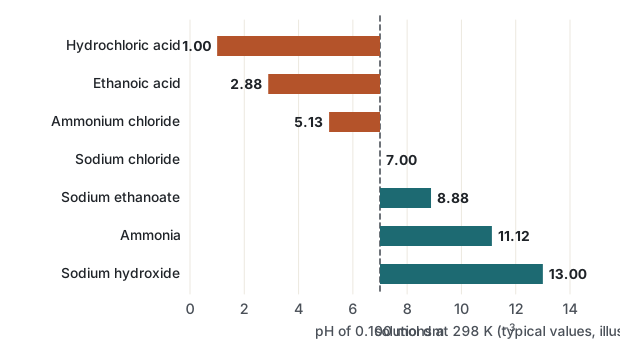
Read the table as a set of rules.
- A strong acid or base is fully dissociated, so its pH is furthest from 7.
- A weak acid or base is only partly dissociated, so its pH is closer to 7 than the strong one at the same concentration.
- A salt can be acidic, neutral or alkaline. It depends on its ions.
Why salts are not all neutral 14.13(i)
A salt dissolves into its ions, and each ion may or may not react with water. Ask of each ion: is it the conjugate base of a weak acid, or the conjugate acid of a weak base? Only those ions change the pH.
Sodium chloride is neutral. Na⁺ and Cl⁻ come from a strong base and a strong acid. Chloride is the conjugate base of a strong acid, so it is far too weak a base to take a proton from water, and Na⁺ does not react either.
Ammonium chloride is acidic. NH₄⁺ is the conjugate acid of the weak base ammonia, so it is a weak acid and donates a proton to water:
Sodium ethanoate is alkaline. CH₃COO⁻ is the conjugate base of a weak acid, so it is a weak base and takes a proton from water:
Dilution by 10, 100 and 1000 14.13(ii)14.6
The second experiment compares a strong and a weak acid as they are diluted. Start with 0.100 mol dm⁻³ hydrochloric acid and 0.100 mol dm⁻³ ethanoic acid, measure the pH of each, then dilute each solution by a factor of 10 and measure again. Repeat for ×100 and ×1000.
To dilute ten times accurately, pipette 25.0 cm³ of the solution into a 250 cm³ volumetric flask, fill to the mark with deionised water and mix. For ×100, dilute that solution by ten again.
| Dilution | Concentration / mol dm⁻³ | pH of HCl | pH of ethanoic acid | Ethanoic acid dissociated |
|---|---|---|---|---|
| none | 0.100 | 1.00 | 2.88 | 1.3% |
| ×10 | 0.0100 | 2.00 | 3.39 | 4.1% |
| ×100 | 0.00100 | 3.00 | 3.91 | 12% |
| ×1000 | 0.000100 | 4.00 | 4.47 | 34% |
The ethanoic acid values are model values from the full equilibrium expression, not laboratory readings.
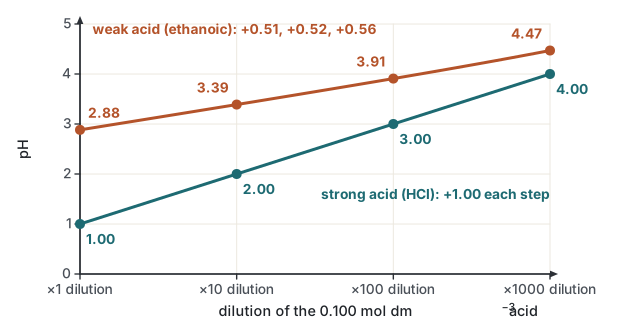
Strong acid. [H⁺] equals the concentration, and each tenfold dilution divides it by ten. The pH rises by exactly 1 every time.
Weak acid. The pH rises by less than 1 each time, about 0.5 at first (+0.51, +0.52, +0.56 in the table). The two assumptions of the weak-acid calculation say [H⁺] = √( × c). A tenfold fall in c then divides [H⁺] by only √10 = 3.2, which is 0.5 of a pH unit.
The reason is the equilibrium. Dilution lowers all the concentrations, so the equilibrium shifts to the right and more of the acid dissociates. The degree of dissociation rises (1.3%, 4.1%, 12%, 34%), and the extra H⁺ partly makes up for the dilution.
Check yourself
- 0.100 mol dm⁻³ solutions P, Q, R and S have pH 1.00, 7.00, 11.12 and 5.13. Suggest what type of substance each is.
- Explain, with an equation, why a solution of sodium ethanoate is alkaline.
- Explain why sodium chloride solution is neutral.
- Two acids, X and Y, are each 0.0500 mol dm⁻³. X has pH 1.30 and Y has pH 3.03. Each is diluted by ten, and the pH values become 2.30 and 3.54. Say which is strong and which is weak, and give the change in pH for each.
- Predict the pH when 0.100 mol dm⁻³ hydrochloric acid and 0.100 mol dm⁻³ ethanoic acid ( = 1.74 × 10⁻⁵ mol dm⁻³) are each diluted 100 times.
- Describe how you would prepare the ×100 dilution of an acid accurately and why the pH probe is rinsed between solutions.
Answers cover these until you have tried the questions
- P: a strong acid (such as HCl). Q: the salt of a strong acid and a strong base (such as NaCl). R: a weak base (such as ammonia), pH well above 7 but below 13. S: a salt of a weak base (such as NH₄Cl), because it is slightly acidic.
- CH₃COO⁻ is the conjugate base of a weak acid, so it accepts a proton from water: . This makes OH⁻, so [OH⁻] > [H⁺] and the solution is alkaline.
- Na⁺ and Cl⁻ come from a strong base and a strong acid. Neither ion reacts with water to make H⁺ or OH⁻, so [H⁺] = [OH⁻] and the solution is neutral.
- X: the pH rises by 2.30 − 1.30 = 1.00, exactly 1 for a tenfold dilution, so X is a strong acid. Y: the pH rises by 3.54 − 3.03 = 0.51, less than 1, so Y is a weak acid. When Y is diluted its degree of dissociation increases, so [H⁺] falls by less than a factor of ten.
- HCl is strong: the concentration is 0.100 ÷ 100 = 1.00 × 10⁻³ mol dm⁻³, so pH = 3.00. Ethanoic acid: [H⁺] = √(1.74 × 10⁻⁵ × 1.00 × 10⁻³) = 1.32 × 10⁻⁴ mol dm⁻³, so pH = 3.88 (the full equilibrium calculation gives 3.91).
- Pipette 25.0 cm³ of the acid into a 250 cm³ volumetric flask, fill to the mark with deionised water and mix. Pipette 25.0 cm³ of that solution into a second 250 cm³ volumetric flask and repeat. Rinse the probe with deionised water between solutions so that the previous solution does not contaminate the next one and change its pH.