Topic 14 · page 16 of 18
Buffers on the titration curve
The flat part of a weak acid curve is a buffer. Halfway to equivalence the weak acid and its conjugate base are equal, so the pH equals the pKa and gives Ka.
Read first: Four monoprotic curves, pH of a buffer
The flat region is a buffer 14.21(i)
Look again at the curve for ethanoic acid with sodium hydroxide. Before equivalence the flask contains both ethanoic acid (the part not yet reacted) and ethanoate ions (made by the reaction). That is exactly a weak acid and its conjugate base, an acidic buffer, made in the flask as you titrate.
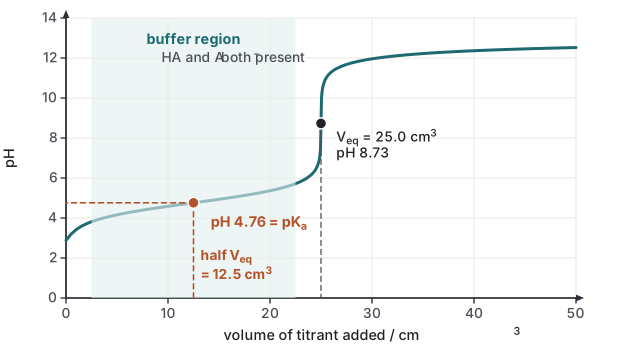
The evidence is the shape. Over the first 22.5 cm³, 90% of the alkali, the pH rises by only 1.9 units. Over the last 0.2 cm³ around equivalence it rises by 6.6.
| Volume of NaOH / cm³ | 0 | 2.5 | 5.0 | 10.0 | 12.5 | 15.0 | 20.0 | 22.5 | 24.9 | 25.1 |
|---|---|---|---|---|---|---|---|---|---|---|
| pH | 2.88 | 3.81 | 4.16 | 4.58 | 4.76 | 4.94 | 5.36 | 5.71 | 7.16 | 10.30 |
The buffer is at its best around the middle, where the two amounts are about equal. It works until the acid is used up. At equivalence there is no CH₃COOH left to remove added OH⁻, so the buffer stops working and the curve shoots upwards. The same idea applies to a strong acid with a weak base: a buffer of NH₃ and NH₄⁺ forms before equivalence.
pH = pKa at half-neutralisation 14.21(ii)
At the point where half of the acid has been neutralised, half has become A⁻ and half is still HA. So [HA] = [A⁻].
This is the buffer equation with a ratio of 1. It means a titration curve measures .
MethodKa from a titration curve
- Find the equivalence volume from the middle of the vertical section.
- Halve it: is the half-neutralisation point.
- Read the pH at that volume. That is the .
- .
Worked exampleEthanoic acid from the curve
On the curve above the vertical section is centred on 25.0 cm³, so = 25.0 cm³.
- Half of 25.0 cm³ is 12.5 cm³.
- The pH at 12.5 cm³ is 4.76, so = 4.76.
- = = 1.7 × 10⁻⁵ mol dm⁻³.
Worked exampleA table of data
25.0 cm³ of a weak acid HX is titrated with 0.100 mol dm⁻³ NaOH. The results below are illustrative. Find .
| Volume of NaOH / cm³ | 0 | 5.0 | 10.0 | 12.5 | 15.0 | 20.0 | 24.0 | 24.5 | 25.0 | 25.5 | 26.0 | 30.0 |
|---|---|---|---|---|---|---|---|---|---|---|---|---|
| pH | 2.41 | 3.22 | 3.63 | 3.80 | 3.98 | 4.40 | 5.18 | 5.49 | 8.25 | 11.00 | 11.29 | 11.96 |
- The pH jumps from 5.49 to 11.00 between 24.5 and 25.5 cm³, so the vertical section is centred on = 25.0 cm³.
- Half of that is 12.5 cm³, where the pH is 3.80. So = 3.80.
- = = 1.6 × 10⁻⁴ mol dm⁻³.
For a strong acid with a weak base the same method gives the of the conjugate acid of the base. For ammonia titrated with hydrochloric acid, the pH at half-neutralisation is 9.25, the of NH₄⁺.
If you are given the equivalence-point pH 14.21(ii)
The specification line reads "half the acid is neutralised/equivalence point". The half-neutralisation method above is the one used in Core Practical 11. A question could also give the pH at the equivalence point of a weak acid with a strong base. The flask then holds only the salt, whose anion is a weak base, and you can work backwards to .
Worked exampleKa from the equivalence point
25.0 cm³ of 0.100 mol dm⁻³ weak acid HA is titrated with 0.100 mol dm⁻³ NaOH. The pH at equivalence is 8.60. Find . = 1.00 × 10⁻¹⁴.
- At equivalence the volume is 50.0 cm³, so [A⁻] = 2.50 × 10⁻³ ÷ 0.0500 = 0.0500 mol dm⁻³.
- [H⁺] = = 2.51 × 10⁻⁹, so [OH⁻] = 1.00 × 10⁻¹⁴ ÷ 2.51 × 10⁻⁹ = 3.98 × 10⁻⁶ mol dm⁻³.
- A⁻ + H₂O ⇌ HA + OH⁻, with [HA] = [OH⁻]. = (3.98 × 10⁻⁶)² ÷ 0.0500 = 3.17 × 10⁻¹⁰ mol dm⁻³.
- = ÷ = 1.00 × 10⁻¹⁴ ÷ 3.17 × 10⁻¹⁰ = 3.2 × 10⁻⁵ mol dm⁻³.
The half-neutralisation route is quicker and does not depend on knowing the concentration exactly, so it is the one to learn first.
Check yourself
- Explain why the flat region of the curve for a weak acid with a strong base shows buffer action.
- 25.0 cm³ of a weak acid HX is titrated with 0.100 mol dm⁻³ NaOH. The pH is 3.40 at 0 cm³, 4.48 at 11.0 cm³ and rises steeply between 21.5 and 22.5 cm³. Find the equivalence volume and (assume the pH reading at 11.0 cm³ is the half-neutralisation value).
- Show that pH = when half of a weak acid has been neutralised.
- Explain why the buffering stops working at the equivalence point.
- Ammonia is titrated with hydrochloric acid and the pH at half-neutralisation is 9.25. State what this value is and calculate the of the conjugate acid.
- A weak acid HA (25.0 cm³, 0.100 mol dm⁻³) is titrated with 0.100 mol dm⁻³ NaOH, and the pH at equivalence is 8.60. A student reads the pH at 12.5 cm³ as 4.50. Calculate from each reading and comment on the two answers.
Answers cover these until you have tried the questions
- Before equivalence the flask contains the weak acid HA (not yet reacted) and its conjugate base A⁻ (made by the reaction). Added alkali is removed by HA and the ratio [A⁻] ÷ [HA] changes only slowly, so the pH rises only slowly. The flat region is a buffer.
- The jump is centred on 22.0 cm³, so = 22.0 cm³ and half of it is 11.0 cm³. The pH at 11.0 cm³ is 4.48, so = 4.48 and = = 3.3 × 10⁻⁵ mol dm⁻³.
- At half-neutralisation half the HA has become A⁻, so [HA] = [A⁻]. Then , so pH = −lg = .
- At equivalence all the weak acid has been used up. There is no HA left to remove added OH⁻, so the pH is no longer held steady, and the curve rises almost vertically.
- It is the of NH₄⁺, the conjugate acid of ammonia. = = 5.6 × 10⁻¹⁰ mol dm⁻³.
- From the half-neutralisation reading: = = 3.2 × 10⁻⁵ mol dm⁻³. From the equivalence pH: = 3.2 × 10⁻⁵ mol dm⁻³ (the worked example above). The two agree, which supports both the readings and the assumptions in each method.