Topic 14 · page 3 of 18
Strong and weak acids
A strong acid is completely dissociated and a weak acid only partly, so strength is not concentration. For a strong acid the pH comes straight from the concentration.
Read first: pH and hydrogen ion concentration
Strength is not concentration 14.6
0.100 mol dm⁻³ hydrochloric acid has pH 1.00. 0.100 mol dm⁻³ ethanoic acid has pH 2.88. The same number of moles of each, in the same volume, neutralises the same amount of sodium hydroxide. So why are the pH values so different?
The answer is that pH counts the H⁺ that is actually in the solution, not the H⁺ the acid could release. In hydrochloric acid every HCl molecule has given up its proton. In ethanoic acid almost none has.
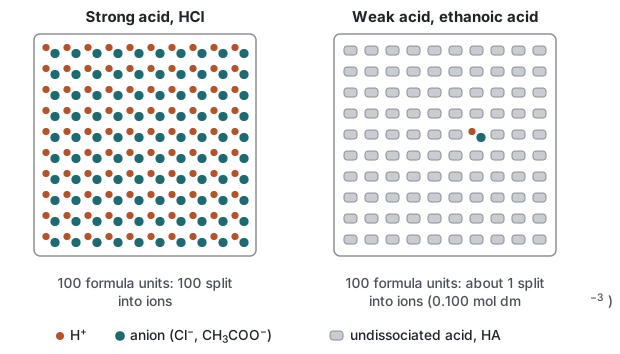
The single arrow means the reaction goes to completion. The equilibrium arrow means the acid and its ions are both present, and the reaction runs in both directions.
Degree of dissociation 14.6
For a monoprotic acid HA, the degree of dissociation is the fraction that has dissociated:
where c is the concentration of acid you started with. Multiply by 100 for a percentage.
| Acid | Concentration / mol dm⁻³ | [H⁺] / mol dm⁻³ | Degree of dissociation |
|---|---|---|---|
| HCl (strong) | 0.100 | 0.100 | 1, or 100% |
| CH₃COOH (weak) | 0.100 | 1.3 × 10⁻³ | 0.013, or 1.3% |
Common strong acids at this level are HCl, HBr, HI, HNO₃ and H₂SO₄. Common weak acids are ethanoic acid and the other carboxylic acids, HF, H₂CO₃ and HCN.
Equal moles of each acid still need equal moles of NaOH. Neutralising the first few H⁺ removes them from the weak acid's equilibrium, so more of it dissociates to replace them. This repeats until all the acid has reacted. Neutralisation counts all the acid, not just the part that is dissociated at the start.
The pH of a strong acid 14.7
Because a strong acid is completely dissociated, the H⁺ concentration is fixed by how many H⁺ each formula unit can release.
Then pH = −lg [H⁺].
Worked exampleHydrochloric acid
Calculate the pH of 0.020 mol dm⁻³ HCl.
- HCl is a strong monoprotic acid, so it is fully dissociated: [H⁺] = 0.020 mol dm⁻³.
- pH = −lg (0.020) = 1.70
Worked exampleSulfuric acid
Calculate the pH of 0.0050 mol dm⁻³ H₂SO₄, treating both protons as fully released.
- Each formula unit releases two H⁺, so [H⁺] = 2 × 0.0050 = 0.010 mol dm⁻³.
- pH = −lg (0.010) = 2.00
Worked exampleAfter dilution
25.0 cm³ of 0.200 mol dm⁻³ HCl is made up to 100 cm³ with water. Calculate the pH.
- Moles of HCl = 0.200 × 0.0250 = 5.00 × 10⁻³ mol.
- New concentration = 5.00 × 10⁻³ ÷ 0.100 = 0.0500 mol dm⁻³, so [H⁺] = 0.0500.
- pH = −lg (0.0500) = 1.30
Check yourself
- Define a strong acid and a weak acid in terms of dissociation.
- Calculate the pH of 0.040 mol dm⁻³ nitric acid, HNO₃.
- Calculate the pH of 0.040 mol dm⁻³ sulfuric acid, treating it as fully dissociated.
- 25.0 cm³ of 0.0400 mol dm⁻³ HCl is made up to 1.00 dm³ with water. Calculate the pH.
- A solution of hydrochloric acid has pH 1.30. Calculate its concentration.
- 0.100 mol dm⁻³ ethanoic acid has [H⁺] = 1.3 × 10⁻³ mol dm⁻³. Calculate the percentage of the acid that is dissociated, and explain why the solution has a higher pH than 0.100 mol dm⁻³ HCl.
Answers cover these until you have tried the questions
- A strong acid is completely dissociated in aqueous solution. A weak acid is only partially dissociated, so an equilibrium exists that lies mostly on the left.
- HNO₃ is a strong monoprotic acid, so [H⁺] = 0.040 mol dm⁻³. pH = −lg 0.040 = 1.40
- Two H⁺ per formula unit: [H⁺] = 2 × 0.040 = 0.080 mol dm⁻³. pH = −lg 0.080 = 1.097, so 1.10
- Moles of HCl = 0.0400 × 0.0250 = 1.00 × 10⁻³ mol. New concentration = 1.00 × 10⁻³ ÷ 1.00 = 1.00 × 10⁻³ mol dm⁻³, so [H⁺] = 1.00 × 10⁻³. pH = 3.00
- [H⁺] = = 0.0501. HCl is fully dissociated, so the concentration is 0.050 mol dm⁻³ (5.0 × 10⁻² mol dm⁻³).
- Percentage = 1.3 × 10⁻³ ÷ 0.100 × 100 = 1.3%. Ethanoic acid is only 1.3% dissociated, so its [H⁺] is much smaller than in HCl, which is 100% dissociated. A smaller [H⁺] means a higher pH (2.88 against 1.00).