Topic 13 · page 12 of 12
How far does it go
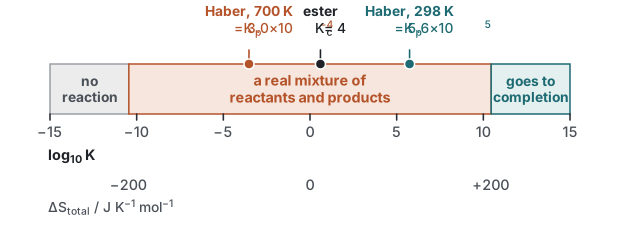
The size of K says how far a reaction goes, not how fast. A large K means mostly products, a small K mostly reactants, and K near 1 a real mixture. The page ends by explaining one tube in three ways.
Read first: Temperature changes K, Entropy and K
What the size of K tells you 13.9
is a ratio of products to reactants at equilibrium, so its size is a direct measure of how far the reaction goes.
| Size of | Equilibrium mixture | In words |
|---|---|---|
| very large (above about 10¹⁰) | practically all products | the reaction goes to completion |
| large | mostly products | products favoured |
| near 1 | significant amounts of both | a true equilibrium mixture |
| small | mostly reactants | reactants favoured |
| very small (below about 10⁻¹⁰) | practically no products | no reaction to speak of |
For the simplest case, with = [B] ÷ [A], the fraction of the mixture that is B follows directly from :
| 0.01 | 0.1 | 1 | 10 | 100 | |
|---|---|---|---|---|---|
| % of B at equilibrium | 1.0 | 9.1 | 50 | 91 | 99 |
Worked exampleEsterification
is about 4 for ethanoic acid and ethanol making ethyl ethanoate and water. Predict the extent of reaction if 1.00 mol of each reactant is mixed.
- Let x mol of ester form. Then acid = ethanol = 1.00 − x, and ester = water = x. The volume cancels.
- Take the square root of both sides: x ÷ (1.00 − x) = 2, so x = 0.667.
- About two thirds of the reactants have been converted. This is a true equilibrium mixture, because is close to 1.
K and the total entropy change 13.9
Since , the total entropy change tells you the same story. A rule of thumb is that above about +200 J K⁻¹ mol⁻¹ means K above about 10¹⁰ (goes to completion), and below about −200 means K below about 10⁻¹⁰ (no reaction). The ±200 is a guide, not a sharp line.
Worked examplePredicting the extent from ΔS total
A reaction has = +350 J K⁻¹ mol⁻¹ at 298 K. Calculate K and predict the extent.
- ln K = 350 ÷ 8.31 = 42.1
- K = e^42.1 = 2 × 10¹⁸
- This is far above 10¹⁰, so the reaction goes to completion.
How far is not how fast 13.9
The Haber process shows the difference. is 5.6 × 10⁵ atm⁻² at 298 K, so at room temperature nitrogen and hydrogen would be almost entirely ammonia at equilibrium. They do not react in the cylinder because the activation energy is very high. Raising the temperature to about 700 K gives a usable rate, but falls to about 3 × 10⁻⁴ atm⁻² (the model value from page 10; measured values are a few times smaller). The equilibrium mixture now has a low ammonia content, so each pass through the reactor gives a low yield, and the unreacted gases are recycled. The plant operates at about 700 K, 200 atm, with an iron catalyst.
- Temperature: a compromise between a larger at lower temperatures and a faster rate at higher ones.
- Pressure: 200 atm does not change . It moves the mixture towards fewer moles of gas, so there is more NH₃, and it also raises the rate.
- Catalyst: changes neither nor the yield. It gives a useful rate at a lower temperature than would be needed without it.
Worked exampleThe Contact process
, = −196 kJ mol⁻¹. Use the model value K = 6.4 × 10⁴ atm⁻¹ at 700 K (page 11). The plant runs at about 700 to 720 K and a pressure of 1 to 2 atm, with a V₂O₅ catalyst.
- is large, so the equilibrium lies well to the right even at this temperature. A high conversion is possible without raising the pressure.
- High pressure would raise the yield a little further, but the cost of strong equipment and compression is not worth it.
- A higher temperature would make the rate faster but smaller, since the reaction is exothermic. The catalyst gives a usable rate at a moderate temperature.
One tube, three changes 13.413.7
Return to the sealed tube of , colourless ⇌ brown, with = +57 kJ mol⁻¹. Three changes show everything in this topic.
| Change | Position | What you see | |
|---|---|---|---|
| In ice water | falls (endothermic) | moves left | pale, mostly N₂O₄ |
| In hot water | rises | moves right | dark brown, more NO₂ |
| Squeeze the tube (syringe) | unchanged | moves left (fewer moles of gas) | darker at once, then fades a little |
On squeezing, the colour darkens at once because the same NO₂ is now more concentrated in a smaller volume. Then the mixture moves left, towards the side with fewer gas molecules, and the colour fades somewhat. It stays darker than before, because the volume is smaller.
Check yourself
- For , describe the equilibrium mixture for K = 1 × 10¹⁵, for K = 1, and for K = 1 × 10⁻¹⁵.
- For , K = 9.0. What percentage of the mixture is B at equilibrium?
- A reaction has = −250 J K⁻¹ mol⁻¹ at 298 K. Calculate K and predict the extent of reaction.
- The Haber process has ≈ 5.6 × 10⁵ atm⁻² at 298 K and about 3 × 10⁻⁴ atm⁻² at 700 K. The plant runs at about 700 K, 200 atm, with an iron catalyst. (a) Why not run it at room temperature? (b) What does the small at 700 K suggest about one pass through the reactor? (c) How does 200 atm help, given that it does not change ?
- A reaction has K = 1 × 10²⁰, but nothing is seen when the reagents are mixed at room temperature. Explain.
- A gas syringe holds an equilibrium mixture of NO₂ and N₂O₄ at constant temperature. The plunger is pushed in. Describe and explain what you see, and state what happens to .
Answers cover these until you have tried the questions
- K = 10¹⁵: practically all B, the reaction goes to completion. K = 1: about half A and half B. K = 10⁻¹⁵: practically all A, almost no reaction.
- Fraction of B = K ÷ (1 + K) = 9.0 ÷ 10.0 = 0.90, so 90%.
- ln K = −250 ÷ 8.31 = −30.1, so K = e^−30.1 = 8.5 × 10⁻¹⁴. This is far below 1, so the equilibrium mixture is almost entirely reactants: practically no reaction.
- (a) At room temperature the rate is far too slow, because the activation energy is high. is large at 298 K, but it gives the extent, not the speed. (b) is small, so the equilibrium mixture is mostly N₂ and H₂, and the yield per pass is low. The unreacted gases are recycled. (c) contains a factor of 1/P², so at high P the mixture must contain more NH₃ for the expression to equal . High pressure also increases the rate.
- K is large, so the equilibrium lies far to the right, but K says nothing about the rate. The reaction must have a high activation energy and be too slow to see.
- The gas darkens at once, because NO₂ is more concentrated in the smaller volume. The mixture then moves towards fewer moles of gas, which is the colourless N₂O₄ side, so the colour fades a little but stays darker than at the start. is unchanged, because only temperature changes it.