Topic 13 · page 8 of 12
What changes K
At one temperature K is a fixed number. Changing a concentration, the pressure or adding a catalyst cannot change it. A change in concentration moves the mixture until the expression equals K again.
Read first: Writing Kc, Calculating Kp
K belongs to a temperature 13.5
The position of equilibrium is the composition of the mixture: how much of the products and how much of the reactants are present. The equilibrium constant is a different thing. It is a single number calculated from that composition.
This sounds odd, because Unit 2 taught that a change in concentration or pressure moves the equilibrium. Both statements are true. A change moves the mixture. The constant does not move, and the mixture moves until it satisfies the same constant again.
The reaction quotient 13.4
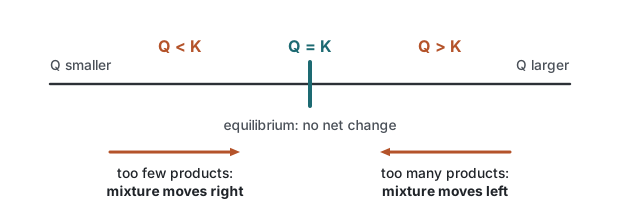
To see why the mixture moves, you need a quantity that has the shape of but can be worked out at any moment. This is the reaction quotient, .
- If , there are too few products compared with equilibrium. The forward reaction is faster than the backward reaction until rises to .
- If , there are too many products. The backward reaction wins until falls to .
You will not be asked to define , but it explains every shift in this topic, and it is the quickest way to get the direction right.
Changing a concentration 13.413.5
Take the mixture from page 1, at a temperature where = 50:
Worked exampleAdding hydrogen to the mixture
(Illustrative data.) At equilibrium [H₂] = [I₂] = 0.0040 mol dm⁻³ and [HI] = 0.0283 mol dm⁻³, so = 50. Extra H₂ is added so that [H₂] is at once 0.0080 mol dm⁻³. The temperature and volume do not change.
- Just after the addition, = 25.
- is less than , so the mixture moves right. HI forms, and H₂ and I₂ are used.
- At the new equilibrium (found by solving for the change): [H₂] = 0.00678, [I₂] = 0.00278 and [HI] = 0.0307 mol dm⁻³.
- Check: = 50, the same .
| [H₂] | [I₂] | [HI] | Q or K | |
|---|---|---|---|---|
| First equilibrium | 0.00400 | 0.00400 | 0.0283 | = 50 |
| Just after adding H₂ | 0.00800 | 0.00400 | 0.0283 | = 25 |
| New equilibrium | 0.00678 | 0.00278 | 0.0307 | = 50 |
The position changed: more HI, less I₂. The constant did not. Removing a substance has the opposite effect to adding it. Remove some HI and falls below , so the mixture moves right again.
Four changes at a glance 13.413.5
| Change | Effect on the position of equilibrium | Effect on K |
|---|---|---|
| Add or remove a reactant or product | Moves to counter the change (shown above) | none |
| Change the pressure | Depends on the moles of gas on each side (page 9) | none |
| Add a catalyst | none (equilibrium is reached sooner) (page 9) | none |
| Change the temperature | Moves, because K changes (pages 10 and 11) | changes |
The last row is the exception, and the next three pages take the rows in turn.
Check yourself
- Extra O₂ is added to an equilibrium mixture for at constant temperature. State the effect on (a) the position of equilibrium and (b) . Say whether is greater or less than just after the addition.
- At a certain temperature = 4.24 × 10⁻³ mol dm⁻³ for . At one moment [N₂O₄] = 0.0200 mol dm⁻³ and [NO₂] = 0.0100 mol dm⁻³. Calculate and say which way the mixture moves.
- In the Haber process, ammonia is removed from the mixture as it forms. State and explain the effect on the position of equilibrium, and on .
- Some HI is removed from the equilibrium mixture in the worked example, so that [HI] is at once 0.0200 mol dm⁻³. Calculate and say which way the mixture moves.
- A student says "I added more reactant, the equilibrium shifted right, so increased". Correct her.
- Which of these can change the value of : adding a reactant, raising the pressure, adding a catalyst, raising the temperature?
Answers cover these until you have tried the questions
- (a) The position moves right, towards more SO₃. (b) is unchanged. The extra O₂ is in the bottom of the expression, so is less than just after the addition, and the mixture moves right until = again.
- = 5.00 × 10⁻³ mol dm⁻³. This is greater than 4.24 × 10⁻³, so there are too many products. The mixture moves left, towards N₂O₄, until falls to .
- Removing NH₃ lowers the top of the expression, so falls below . The mixture moves right, forming more NH₃, until = again. itself is unchanged, because only temperature changes it.
- = 25. This is less than 50, so the mixture moves right, making more HI.
- The shift right is correct, but does not change. Adding reactant made smaller than , and the shift restores to the same . The value of changes only if the temperature changes.
- Only raising the temperature. Adding a reactant, raising the pressure and adding a catalyst leave unchanged.