Topic 13 · page 9 of 12
Pressure and catalysts
Pressure moves the mixture when the moles of gas differ on each side, but it leaves Kp alone. A catalyst changes neither the mixture nor K, only how fast equilibrium is reached. Solids make no difference.
Read first: What changes K
Why pressure moves the mixture 13.4
Write each partial pressure as mole fraction × total pressure, . For :
is fixed, and the expression has a leftover factor of . If is doubled, the mole-fraction term must halve to keep the same. So falls and rises: the mixture moves left, towards the side with fewer moles of gas.
The power of is the moles of gas on the right minus the moles of gas on the left. That gives three cases.
| Gas moles | Example | Power of | Raising moves the mixture |
|---|---|---|---|
| more on the right | +1 | left (fewer moles of gas) | |
| fewer on the right | −2 | right (more NH₃) | |
| equal | 0 | no effect |
For the Haber process the factor is . Doubling the pressure divides that factor by 4, so the mole-fraction term must grow by 4 to keep the same. The mixture contains more NH₃. For hydrogen iodide cancels, so the composition does not depend on it at all.
Worked exampleDoubling the pressure
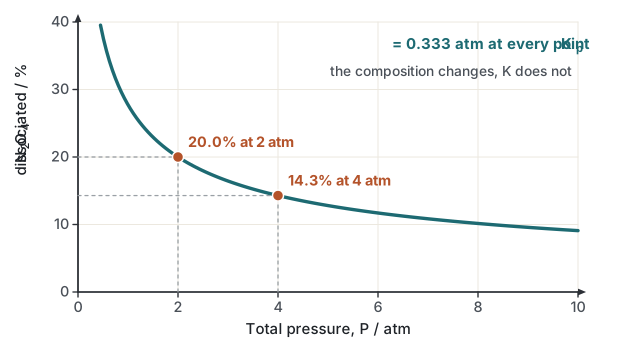
At a certain temperature = 0.333 atm for . At 2.00 atm the mixture is 20.0% dissociated (page 7). The pressure is raised to 4.00 atm at the same temperature.
- At the new equilibrium the mixture is 14.3% dissociated. From 1.00 mol N₂O₄ that is 0.857 mol N₂O₄ and 0.286 mol NO₂, total 1.143 mol.
- = 0.286 ÷ 1.143 = 0.250, and = 0.750.
- = 0.250 × 4.00 = 1.00 atm, and = 0.750 × 4.00 = 3.00 atm.
- = 0.333 atm, the same .
The composition changed (20.0% became 14.3%), and did not.
Adding an inert gas 13.4
Pressure can also rise because an unreactive gas such as argon is pumped into a sealed container. At constant volume the partial pressure of each reacting gas is unchanged, because each gas still has the same number of moles in the same volume. still equals , so there is no shift. Pressure only matters through the partial pressures of the reacting gases.
Catalysts 13.413.5
A catalyst provides an alternative route with a lower activation energy. The same lower route works in both directions, so the catalyst speeds up the forward and the backward reactions by the same factor.
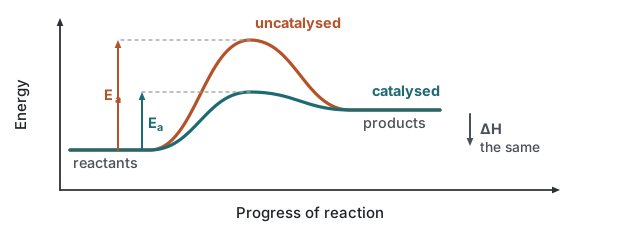
If both rates change by the same factor, the point where they are equal does not move. So:
- the composition at equilibrium is the same, so the yield is the same;
- is the same;
- equilibrium is reached sooner.
Heterogeneous systems 13.4
Now apply all of it to a system with a solid. The equilibrium is in a closed container:
| Change | Effect |
|---|---|
| Add more CaCO₃(s) | None. A solid is not in the expression, so stays equal to . |
| Compress the gas (smaller volume) | rises above . CO₂ reacts with CaO to form CaCO₃ until falls back to the same . More CaCO₃, less CO₂ gas, same pressure. |
| Heat | The reaction is endothermic, so rises (page 10). More CaCO₃ decomposes, and rises. |
| Add a catalyst | None. |
At a fixed temperature, the pressure of CO₂ over the solids is always the same value, , whatever amounts of CaCO₃ and CaO there are, as long as some of each is present. That is a surprising result, and it is a direct consequence of leaving solids out.
Check yourself
- For with = −196 kJ mol⁻¹, the pressure is increased at constant temperature. State the effect on and on the yield of SO₃, with a reason.
- A V₂O₅ catalyst is added to the mixture in question 1. State the effect on and on the composition.
- Explain why changing the pressure does not alter the composition of .
- At a certain temperature = 0.333 atm for . In an equilibrium mixture at a lower total pressure, = 0.500 atm. Calculate and the total pressure, and the mole fraction of NO₂.
- Solid CaCO₃ and CaO are in equilibrium with CO₂ in a closed container. More CaCO₃ is added, then the volume is halved, both at constant temperature. State the effect of each change on at the new equilibrium.
- A student says "adding a catalyst to the Haber process gives more ammonia". Correct her, and say what the catalyst does achieve.
Answers cover these until you have tried the questions
- is unchanged, because only temperature changes it. The yield of SO₃ increases: there are 3 moles of gas on the left and 2 on the right, so raising moves the mixture towards fewer moles of gas, the SO₃ side. In terms of the expression, , so a higher needs a larger mole-fraction term.
- No effect on and none on the composition. The catalyst speeds up the forward and backward reactions equally, so equilibrium is reached sooner.
- There are 2 moles of gas on each side, so the power of is 0 and cancels in . The mole fractions already satisfy at any pressure.
- = 0.500² ÷ 0.333 = 0.751 atm. Total = 0.751 + 0.500 = 1.25 atm. = 0.500 ÷ 1.251 = 0.400. This is higher than the 0.333 at 2.00 atm, as expected at a lower pressure.
- Adding CaCO₃: no effect on , because a solid is not in . Halving the volume: first rises, then CO₂ reacts with CaO until = again. So at the new equilibrium is the same as before, with less CO₂ gas and more CaCO₃.
- The yield is the same with or without the catalyst, because the catalyst changes neither nor the position of equilibrium. It makes equilibrium arrive sooner, so the plant can run at a lower temperature at a useful rate.