Topic 13 · page 2 of 12
Partial pressures and Kp
For gases it is often easier to use pressures than concentrations. Each gas contributes a partial pressure, found from its mole fraction, and Kp has the same shape as Kc with partial pressures in atm.
Read first: Writing Kc
Gases share a pressure 13.2
In a mixture of gases, every gas fills the whole container and contributes part of the total pressure. That part is its partial pressure. The total pressure is the sum of the partial pressures.
To find a partial pressure you need the share of the molecules that belong to that gas. That share is the mole fraction.
The mole fractions of all the gases add up to 1, and the partial pressures add up to . Use both as checks.
Worked examplePartial pressures of a mixture
1.00 mol of N₂ and 3.00 mol of H₂ are mixed at a total pressure of 4.00 atm. Find each partial pressure.
- Total moles of gas = 1.00 + 3.00 = 4.00 mol
- = 1.00 ÷ 4.00 = 0.250, and = 3.00 ÷ 4.00 = 0.750
- = 0.250 × 4.00 = 1.00 atm, and = 0.750 × 4.00 = 3.00 atm
- Check: 1.00 + 3.00 = 4.00 atm, the total pressure.
For gases, the percentage by volume is the percentage by moles, so the mole fraction is the volume percentage ÷ 100. Air at 1.00 atm is about 78% N₂ and 21% O₂ by volume, so ≈ 0.78 atm and ≈ 0.21 atm.
Partial pressures at equilibrium 13.2
At equilibrium you often know the amount of each gas and the total pressure. Work out the total moles of gas first, then each mole fraction.
Worked exampleAn equilibrium mixture of N₂O₄ and NO₂
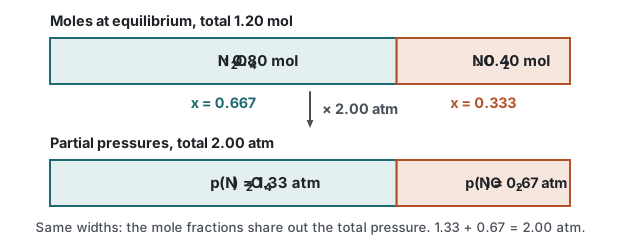
An equilibrium mixture at a total pressure of 2.00 atm contains 0.80 mol of N₂O₄ and 0.40 mol of NO₂ (illustrative amounts).
- Total moles = 0.80 + 0.40 = 1.20 mol
- = 0.80 ÷ 1.20 = 0.667, and = 0.40 ÷ 1.20 = 0.333
- = 0.667 × 2.00 = 1.33 atm, and = 0.333 × 2.00 = 0.667 atm
The expression for Kp 13.2
has exactly the same shape as . Replace each concentration with the equilibrium partial pressure of the gas, and write it as rather than with square brackets.
Worked exampleThree Kp expressions
Check yourself
- A mixture of 0.30 mol CO and 0.70 mol H₂ is at a total pressure of 5.0 atm. Calculate the mole fraction and partial pressure of each gas.
- Dry air is 78.0% N₂, 21.0% O₂ and 1.0% Ar by volume. Give the partial pressure of each gas at a total pressure of 1.00 atm and at 2.00 atm.
- Write the expression for for .
- Write the expression for for .
- At equilibrium, a mixture of 1.20 mol SO₂, 0.60 mol O₂ and 8.20 mol SO₃ is at a total pressure of 2.0 atm. Calculate the partial pressure of each gas.
- A student calculates the partial pressure of a gas as with = 0.25 and = 8.0 atm. She gets 32 atm. Where did the error come from, and what is the correct value?
Answers cover these until you have tried the questions
- Total = 1.00 mol. = 0.30 ÷ 1.00 = 0.30 and = 0.70. = 0.30 × 5.0 = 1.5 atm and = 0.70 × 5.0 = 3.5 atm (sum 5.0 atm).
- At 1.00 atm: N₂ 0.780 atm, O₂ 0.210 atm, Ar 0.010 atm. At 2.00 atm every partial pressure doubles: N₂ 1.56 atm, O₂ 0.420 atm, Ar 0.020 atm.
- Total = 1.20 + 0.60 + 8.20 = 10.00 mol. = (1.20 ÷ 10.00) × 2.0 = 0.24 atm; = (0.60 ÷ 10.00) × 2.0 = 0.12 atm; = (8.20 ÷ 10.00) × 2.0 = 1.64 atm. Check: 0.24 + 0.12 + 1.64 = 2.00 atm.
- She divided by in place of multiplying (8.0 ÷ 0.25 = 32). The correct value is 0.25 × 8.0 = 2.0 atm. A partial pressure can never be bigger than the total pressure.