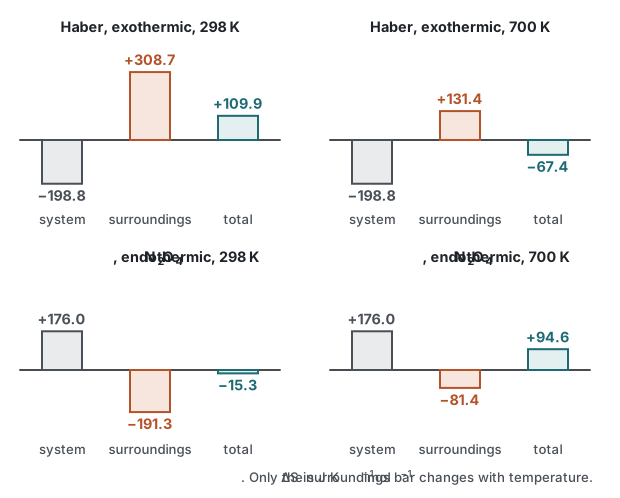
The temperature dependence of K comes from entropy. Only the surroundings term, minus delta H over T, changes with temperature, and ΔS total = R ln K turns that change into a change in K.
Only one term depends on temperature. ΔSsystem is treated as constant, and ΔSsurroundings contains the T. Raising the temperature shrinks the size of ΔH/T, so the surroundings matter less.
Exothermic reaction: ΔH is negative, so −ΔH/T is positive. It gets smaller as T rises, so ΔStotalfalls.
Endothermic reaction: ΔH is positive, so −ΔH/T is negative. Its size shrinks as T rises, so it becomes less negative, and ΔStotalrises.
Worked exampleTotal entropy for the Haber process
NX2(g)+3HX2(g)2NHX3(g), with ΔH = −92 kJ mol⁻¹ and ΔSsystem = −198.8 J K⁻¹ mol⁻¹. Calculate ΔStotal at 298 K and at 700 K.
ΔStotal rose, as expected for an endothermic reaction.
The system bar is the same at both temperatures. The surroundings bar shrinks as T rises, and the total bar follows it.
Total entropy and K 13.8(ii)
The total entropy change is linked to the equilibrium constant by
ΔStotal=RlnK
where R = 8.31 J K⁻¹ mol⁻¹ and K is the equilibrium constant at that temperature, used as a plain number. Rearranged:
lnK=RΔStotalK=eΔStotal/R
Three things follow, with no calculator needed.
ΔStotalpositive means ln K is positive, so K is greater than 1. Products are favoured.
ΔStotalzero means ln K = 0, so K = 1.
ΔStotalnegative means K is less than 1. Reactants are favoured.
Because ln K moves in the same direction as ΔStotal, a bigger ΔStotal means a bigger K. Combine this with the previous section:
MethodCalculating K from the total entropy change
Find ΔStotal in J K⁻¹ mol⁻¹. Convert ΔH from kJ to J before dividing by T.
Divide by R = 8.31 to get ln K.
Take the exponential, K=elnK, using the ex button.
Worked exampleK for the Haber process at two temperatures
Use the ΔStotal values above.
298 K: ln K = +109.9 ÷ 8.31 = 13.23, so K = e^13.23 = 5.6 × 10⁵ (units atm⁻²).
700 K: ln K = −67.4 ÷ 8.31 = −8.11, so K = e^−8.11 = 3.0 × 10⁻⁴ (units atm⁻²).
Worked exampleK for N₂O₄ at two temperatures
298 K: ln K = −15.3 ÷ 8.31 = −1.84, so K = 0.16 (units atm).
700 K: ln K = +94.6 ÷ 8.31 = 11.38, so K = 8.8 × 10⁴ (units atm).
These are the figures in the table on page 10. The units of Kp are put back afterwards, from the expression. The relationship uses K as a number.
The same story in one line 13.8(ii)
Substitute ΔStotal=ΔSsystem−ΔH/T into ΔStotal=RlnK:
lnK=RΔSsystem−RTΔH
For an exothermic reaction (ΔH negative) the last term is positive and shrinks as T rises, so ln K falls. For an endothermic reaction it is negative and shrinks towards zero, so ln K rises. Both are the same argument as before.
When ΔStotal = 0, K = 1. That is the temperature at which the reaction becomes feasible in the entropy topic.
Worked exampleThe temperature at which K = 1
Find the temperature at which K = 1 for NX2OX4(g)2NOX2(g).
K = 1 means ln K = 0, so ΔStotal = 0, so ΔSsystem=ΔH/T.
T = ΔH/ΔSsystem = 57 000 ÷ 176 = 324 K (51 °C).
The reaction is endothermic, so K rises with temperature: above 324 K, K > 1, and below it K < 1. This matches the table: 0.16 at 298 K, 56 at 400 K.
Check yourself
2SOX2(g)+OX2(g)2SOX3(g) has ΔH = −196 kJ mol⁻¹ and ΔSsystem = −188 J K⁻¹ mol⁻¹. Calculate ΔStotal at 298 K and at 700 K, and state the effect of the temperature rise on ΔStotal.
Use your 700 K value from question 1 to calculate K at 700 K.
For CaCOX3(s)CaO(s)+COX2(g), ΔH = +178 kJ mol⁻¹ and ΔSsystem = +160.4 J K⁻¹ mol⁻¹. Calculate ΔStotal and K at 1000 K.
Use ΔStotal = R ln K to explain why K for an endothermic reaction increases with temperature.
A reaction has K = 4.0 × 10⁻³ at one temperature. Calculate ΔStotal and say what it tells you about the position of equilibrium.
Find the temperature at which K = 1 for the Haber process, given ΔH = −92 kJ mol⁻¹ and ΔSsystem = −198.8 J K⁻¹ mol⁻¹. Say whether K is greater or less than 1 at 600 K.
Answers cover these until you have tried the questions
At 298 K: ΔSsurroundings = +196 000 ÷ 298 = +657.7, so ΔStotal = −188 + 657.7 = +469.7 J K⁻¹ mol⁻¹ (+470). At 700 K: ΔSsurroundings = +196 000 ÷ 700 = +280.0, so ΔStotal = −188 + 280.0 = +92.0 J K⁻¹ mol⁻¹. The reaction is exothermic, so ΔStotaldecreases as the temperature rises.
ln K = 92.0 ÷ 8.31 = 11.07, so K = e^11.07 = 6.4 × 10⁴ (atm⁻¹).
The reaction is endothermic, so ΔSsurroundings = −ΔH/T is negative. As T rises its size falls, so it becomes less negative. ΔSsystem is constant, so ΔStotal increases. Since ΔStotal = R ln K, ln K increases, so K increases.
ΔStotal = 8.31 × ln(4.0 × 10⁻³) = 8.31 × (−5.52) = −45.9 J K⁻¹ mol⁻¹. It is negative and K is less than 1, so the equilibrium mixture contains mostly reactants.
ΔStotal = 0, so T = ΔH ÷ ΔSsystem = −92 000 ÷ −198.8 = 463 K (190 °C). The reaction is exothermic, so K falls as T rises. At 600 K, which is above 463 K, K is less than 1 (at 600 K, ΔStotal = −198.8 + 153.3 = −45.5 J K⁻¹ mol⁻¹, so K ≈ 4 × 10⁻³).