Topic 13 · page 10 of 12
Temperature changes K
Heating lowers K for an exothermic reaction and raises it for an endothermic one. The position of equilibrium moves because K has changed, so always explain a temperature effect through K.
Read first: What changes K, Pressure and catalysts
Temperature changes K 13.6
Concentration, pressure and catalysts leave alone. Temperature does not. For a reaction at a different temperature, has a different value.
The table shows two reactions. The Haber process is exothermic. The dissociation of N₂O₄ is endothermic. Both are calculated from the entropy relationship on page 11, with and taken as constant, so they are model values. Measured values differ somewhat, but the trends are real.
| T / K | , = −92 kJ mol⁻¹, / atm⁻² | , = +57 kJ mol⁻¹, / atm |
|---|---|---|
| 298 | 5.6 × 10⁵ | 0.16 |
| 400 | 43 | 56 |
| 500 | 0.17 | 1.7 × 10³ |
| 700 | 3.0 × 10⁻⁴ | 8.8 × 10⁴ |
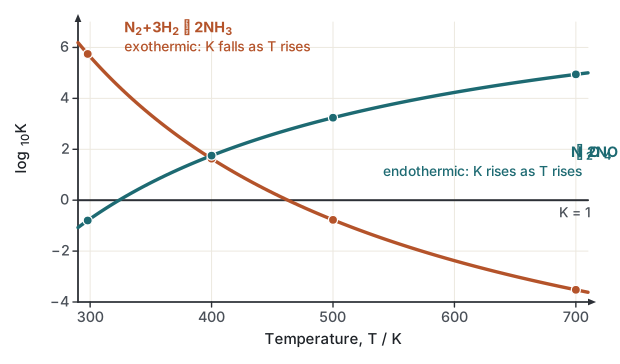
The trend agrees with the Unit 2 rule that heating favours the endothermic direction. The new idea is the reason for it.
The position follows K 13.713.4
Compare with a concentration change. When you add a reactant, stays the same and is knocked away from it. When you change the temperature, the opposite happens: the mixture has not had time to change yet, so is at first the same as before, and is what moves.
Worked exampleHeating the Haber mixture
, = −92 kJ mol⁻¹. The temperature is raised from 500 K to 700 K. Explain the effect on the amount of ammonia.
- The reaction is exothermic, so falls, from 0.17 atm⁻² to 3.0 × 10⁻⁴ atm⁻².
- At that instant the mixture has not changed, so the quotient still has its old value, 0.17 atm⁻². That is larger than the new .
- The quotient is too large, which means too many products. The mixture moves left until falls to the new .
- There is less NH₃ at equilibrium at 700 K.
Worked exampleHeating and cooling N₂O₄
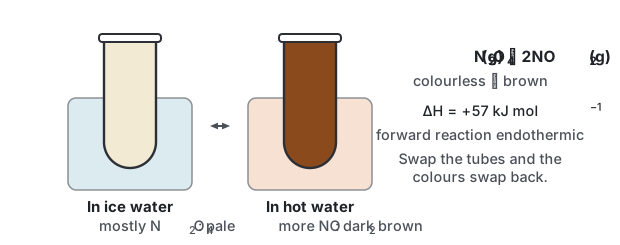
, = +57 kJ mol⁻¹. Colourless N₂O₄ and brown NO₂ share a sealed tube.
- Heat. The reaction is endothermic, so rises. The quotient is now smaller than the new (too few products), so the mixture moves right: more NO₂ and a darker brown.
- Cool in ice. falls. The quotient is now larger than the new , so the mixture moves left: more N₂O₄ and a paler colour.
- Swap the tubes and changes back, and so does the colour.
The reverse reaction behaves in the opposite way. Its constant is , so when a forward reaction is exothermic, the reverse reaction is endothermic, and the constant for the reverse reaction rises with temperature.
Check yourself
- State how changes when the temperature is raised for each reaction. (a) , = −196 kJ mol⁻¹ (b) , = +178 kJ mol⁻¹ (c) , = +180 kJ mol⁻¹
- Explain, in terms of , why the yield of SO₃ falls when the temperature of the equilibrium mixture in 1(a) is raised.
- has = +41 kJ mol⁻¹. State and explain the effect on and on the yield of CO of (a) raising the temperature, and (b) raising the pressure.
- A reaction has = 0.020 at 400 K and 0.31 at 600 K (illustrative). Is it exothermic or endothermic? Explain.
- Explain, in terms of , why the N₂O₄ and NO₂ mixture is paler in ice water than at room temperature.
- The forward reaction is exothermic. What happens to the equilibrium constant for the reverse reaction when the temperature is raised?
Answers cover these until you have tried the questions
- (a) Exothermic, so decreases. (b) Endothermic, so increases. (c) Endothermic, so increases.
- The reaction is exothermic, so decreases when the temperature rises. The quotient is then larger than the new , so the mixture moves left until the quotient falls to the new . There is less SO₃.
- (a) The reaction is endothermic, so increases. The quotient is then smaller than the new , so the mixture moves right and the yield of CO increases. (b) There are 2 moles of gas on each side, so cancels from . Raising the pressure has no effect on or on the yield.
- rises with temperature, so the forward reaction is endothermic. (An exothermic reaction has a that falls as the temperature rises.)
- The forward reaction (N₂O₄ → 2NO₂) is endothermic, so falls when the mixture is cooled. The quotient is then larger than the new , so the mixture moves left towards the colourless N₂O₄, and the brown colour fades.
- The constant for the reverse reaction is for the forward reaction. for the forward (exothermic) reaction falls, so its reciprocal rises: the reverse reaction is endothermic, and its constant increases with temperature.