Topic 8 · page 24 of 29
Colours of the halogens and displacement reactions
A more reactive halogen oxidises the halide ion of a less reactive one and displaces the halogen. Learn the colour of each halogen in water and in a non-polar solvent, so you can read the result of each test.
Read first: Trends in Group 7
Colours of the halogens 8.25
The specification expects you to know the colours of the elements in three settings: as the element at standard conditions, in aqueous solution, and in a non-polar organic solvent such as hexane or cyclohexane.
| Chlorine | Bromine | Iodine | |
|---|---|---|---|
| Element, standard conditions | pale green gas | red-brown liquid | grey-black solid |
| In water | very pale green (almost colourless) | orange (yellow when dilute) | brown |
| In a non-polar solvent | pale green | orange-red | violet (purple) |
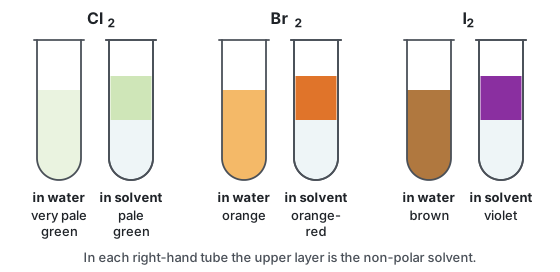
The halogens are more soluble in a non-polar solvent than in water, because they are non-polar molecules, so the colour is stronger in the solvent. The solvent is less dense than water, so it forms the upper layer. When you shake a halogen solution with a solvent, the coloured halogen moves into the upper layer.
Displacement reactions 8.25
A halogen that is a stronger oxidising agent takes electrons from the halide ion of a weaker one. The weaker halogen is displaced.
Chlorine goes 0 → −1 (reduced). Bromide goes −1 → 0 (oxidised). Chlorine is the oxidising agent; bromide is the reducing agent. The half-equations are:
| Chloride, Cl⁻(aq) | Bromide, Br⁻(aq) | Iodide, I⁻(aq) | |
|---|---|---|---|
| Chlorine water, Cl₂(aq) | no reaction | orange: Br₂ formed | brown: I₂ formed |
| Bromine water, Br₂(aq) | no reaction | no reaction | brown: I₂ formed |
| Iodine, I₂(aq) | no reaction | no reaction | no reaction |
The ionic equations are:
PracticalDisplacement reactions
- Put about 1 cm³ of each potassium halide solution (KCl, KBr, KI) into separate test tubes.
- Add about 1 cm³ of chlorine water to each. Record the colour of each solution.
- Add about 1 cm³ of cyclohexane to each, put the stopper in, shake, and let the layers separate. Record the colour of the upper layer.
- Repeat with bromine water in place of chlorine water, and with each halide.
The organic layer makes the result clearer. With chlorine and bromide, the upper layer is orange-red. With chlorine or bromine and iodide, the upper layer is violet. No halogen forms with a halide it cannot displace: the upper layer is the colour of the halogen that was added.
Worked examplePredicting a displacement
Predict what you would see when bromine water is added to potassium chloride, then to potassium iodide, followed by cyclohexane.
- KCl: Br₂ is a weaker oxidising agent than Cl₂, so it cannot take electrons from Cl⁻. No reaction. The upper layer is orange-red (the bromine).
- KI: Br₂ is a stronger oxidising agent than I₂, so it oxidises I⁻: . The aqueous layer turns brown and the upper layer is violet.
Check yourself
- State the colours of chlorine, bromine and iodine dissolved in water.
- State the colour of iodine in cyclohexane, and say which layer it is in.
- Chlorine water is added to potassium iodide solution. State the observation and write the ionic equation.
- Explain, in terms of electrons, why bromine displaces iodide ions from solution but not chloride ions.
- Bromine water is added to potassium chloride solution, and then cyclohexane is added and shaken. Describe what you see in each tube.
- State the changes in oxidation number in and say which species is the reducing agent.
Answers cover these until you have tried the questions
- Chlorine: very pale green. Bromine: orange. Iodine: brown.
- Violet (purple), in the upper layer, because cyclohexane is less dense than water and does not mix with it.
- The solution turns brown (iodine is made).
- Bromine is a stronger oxidising agent than iodine, so it can take electrons from I⁻. It is a weaker oxidising agent than chlorine, so it cannot take electrons from Cl⁻.
- The solution stays orange (no change): there is no reaction. With cyclohexane, the upper layer is orange-red (bromine in cyclohexane); the lower layer is almost colourless.
- Cl: 0 → −1 (reduced). Br: −1 → 0 (oxidised). The reducing agent is Br⁻ (it gives electrons and is oxidised).