Topic 8 · page 14 of 29
Decomposing carbonates and nitrates
Group 2 carbonates give the oxide and carbon dioxide. Group 1 nitrates give a nitrite and oxygen, but lithium and Group 2 nitrates give the oxide, brown nitrogen dioxide and oxygen. Heat equal amounts and time the tests to compare.
Read first: Thermal stability: size and charge of the cation
What each compound gives 8.168.188.18(i)
| Carbonates | Nitrates | |
|---|---|---|
| Group 1 (not lithium) | Do not decompose in a Bunsen flame | |
| Lithium | ||
| Group 2 |
The products have a pattern. A strongly polarising cation (lithium, Group 2) takes oxygen from the anion to form an oxide. A weakly polarising cation (sodium, potassium) distorts the nitrate ion only enough for it to lose one oxygen atom, forming a nitrite, NO₂⁻, and releasing oxygen. Sodium and potassium carbonates are so stable that the carbonate stays unchanged.
Decomposition of a nitrate is a redox reaction. In , nitrogen goes from +5 to +4 (reduced) and oxygen goes from −2 to 0 (oxidised). In , nitrogen goes from +5 to +3 and oxygen from −2 to 0. Carbonate decomposition is not redox: no oxidation number changes.
Recognising the gases 8.188.18(i)
| Gas | Test | Result |
|---|---|---|
| Carbon dioxide | Bubble through limewater | Turns milky (white precipitate of CaCO₃) |
| Oxygen | Hold a glowing splint in the gas | The splint relights |
| Nitrogen dioxide | Look at it; test with damp blue litmus paper | Brown gas; paper turns red (it is acidic) |
Practical: comparing the carbonates 8.188.18(i)
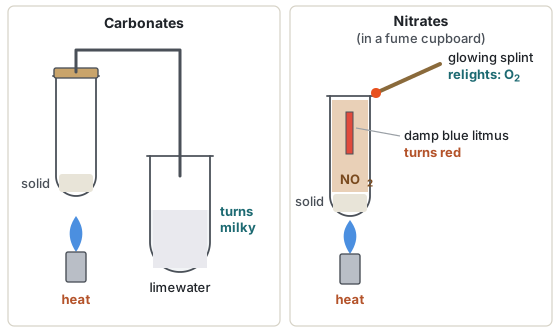
PracticalHeating Group 2 carbonates
- Put the same mass (about 1 g) of one carbonate in a dry boiling tube. Fit a bung and delivery tube, with the end under limewater in a test tube.
- Heat strongly with the same Bunsen flame. Start a stopwatch. Record the time until the limewater first turns cloudy.
- Repeat for each carbonate with a fresh tube and fresh limewater, keeping the mass, the tube, the distance of the flame and the volume of limewater the same.
- Remove the delivery tube from the limewater before you stop heating, so the limewater cannot be sucked back into the hot tube.
The time for limewater to turn cloudy is shortest for magnesium carbonate, longer for calcium carbonate, and longest for barium carbonate. Sodium or potassium carbonate gives no change. The shorter the time, the less stable the carbonate.
Practical: comparing the nitrates 8.188.18(i)
PracticalHeating nitrates (in a fume cupboard)
- In a fume cupboard, put a small amount of the dry nitrate in a boiling tube and heat it gently, then more strongly.
- Watch for brown fumes. Hold a piece of damp blue litmus paper in the gas.
- Hold a glowing splint at the mouth of the tube. Record whether it relights.
- Compare Group 1 with lithium and Group 2. The brown gas is toxic, so keep the tube in the fume cupboard.
| Nitrate | Brown fumes | Glowing splint | Residue |
|---|---|---|---|
| Sodium, potassium | none | relights (oxygen) | white or pale yellow nitrite |
| Lithium | yes | relights | white oxide |
| Magnesium | yes, quickly | relights | white oxide |
| Calcium, barium | yes, more slowly | relights | white oxide |
The brown fumes (NO₂) appear sooner for magnesium than for barium, which agrees with the trend: more stable down the group.
Check yourself
- Write the equation for the thermal decomposition of calcium carbonate, and state how you would test for the gas.
- Write the equation for the thermal decomposition of potassium nitrate and describe what you would observe.
- Describe what you would observe when magnesium nitrate is heated, and write the equation.
- Name two variables you must control when comparing the thermal stability of Group 2 carbonates.
- Explain, using the cation, why barium carbonate needs a higher temperature to decompose than magnesium carbonate.
- Why must the delivery tube be taken out of the limewater before heating is stopped?
Answers cover these until you have tried the questions
- . Bubble the gas through limewater, which turns milky.
- . The solid melts; a glowing splint relights (oxygen). There are no brown fumes.
- Brown fumes (NO₂) are seen, a glowing splint relights, and a white solid (MgO) remains.
- Any two of: mass of carbonate, heating (same flame and distance), volume of limewater, size and type of tube.
- Ba²⁺ is larger than Mg²⁺ with the same charge, so its charge density is lower. It polarises the carbonate ion less, so a C–O bond is weakened less, and more energy is needed.
- As the gas cools, it contracts and the pressure falls, so limewater could be sucked back into the hot tube, which could crack the glass.