Topic 8 · page 21 of 29
Core Practical 4: a standard solution from a solid acid
Weigh a solid acid by difference, dissolve it and make it up to 250 cm³ in a volumetric flask to give a standard solution, then use it to find the concentration of a solution of sodium hydroxide.
Read first: Core Practical 3: concentration of hydrochloric acid
Aim and idea 8.23
To make a solution of accurately known concentration from a pure solid acid, and then use that solution to find the concentration of sodium hydroxide solution by titration.
The solid used here is ethanedioic acid dihydrate, H₂C₂O₄·2H₂O ( = 126.0). It is a good choice because it is a solid that is stable, pure, easy to weigh, soluble in water and has a fairly high molar mass, so the mass weighed out is large enough to measure accurately. Sodium hydroxide itself is not a good standard: it absorbs water and carbon dioxide from the air, so its concentration is never known exactly.
The ratio is 1 : 2.
Part 1: making the standard solution 8.23
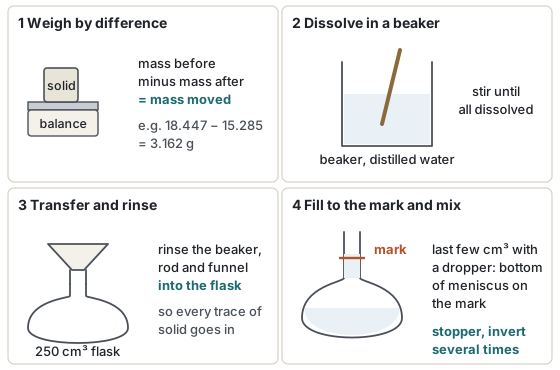
PracticalPreparing 250 cm³ of standard solution
- Weigh by difference. Weigh a bottle with the solid acid (about 3 g). Tip the solid into a beaker without spilling any. Weigh the bottle again. The difference is the mass of acid transferred.
- Dissolve the solid in about 100 cm³ of distilled water in the beaker. Stir with a glass rod until it has all dissolved.
- Pour the solution through a funnel into a 250 cm³ volumetric flask. Rinse the beaker, rod and funnel with distilled water and pour all the rinsings into the flask.
- Add distilled water until the liquid is near the mark. Add the last few cm³ with a dropper until the bottom of the meniscus is on the mark. Stopper the flask and invert it several times to mix.
| Step | Why |
|---|---|
| Weigh by difference | Any solid left on the weighing bottle or paper is not counted, so the mass is the mass that reached the beaker |
| Dissolve in the beaker first | The solid is dissolved fully before the volume is made up, and you can see that none is left |
| Rinse beaker, rod and funnel into the flask | All the solid must reach the flask, or the concentration will be too low |
| Add water to the mark with a dropper | A drop too much cannot be removed, so the concentration would be too low |
| Invert several times | So the solution is mixed evenly before use |
Calculation. Illustrative values: mass of bottle plus solid 18.447 g; mass of bottle after tipping 15.285 g.
- Mass of acid = 18.447 − 15.285 = 3.162 g
- n = 3.162 ÷ 126.0 = 0.025095 mol
- c = 0.025095 ÷ 0.250 = 0.10038 = 0.1004 mol dm⁻³ (4 s.f., because the mass is to 4 s.f.)
Part 2: titrating the sodium hydroxide 8.23
PracticalFinding the concentration of sodium hydroxide
- Rinse the pipette with the standard acid and use it to put 25.0 cm³ in a conical flask. Add 2–3 drops of phenolphthalein: the solution is colourless.
- Rinse the burette with the sodium hydroxide solution and fill it. Titrate until the colour changes from colourless to the first permanent pale pink.
- Do a rough titration, then repeat until two or more titres are within 0.10 cm³.
Phenolphthalein is used because the alkali is strong and the acid is weak: the end point is on the alkaline side of neutral.
The results are illustrative.
| Rough | 1 | 2 | 3 | |
|---|---|---|---|---|
| Titre of NaOH / cm³ | 25.80 | 25.30 | 25.25 | 25.35 |
- Concordant titres: 25.30, 25.25, 25.35 (spread 0.10). Mean = 25.30 cm³
- n(acid) in 25.0 cm³ = 0.10038 × 0.0250 = 2.5095 × 10⁻³ mol
- Ratio 1 : 2, so n(NaOH) = 2 × 2.5095 × 10⁻³ = 5.019 × 10⁻³ mol
- c(NaOH) = 5.019 × 10⁻³ ÷ 0.02530 = 0.1984 = 0.198 mol dm⁻³ (3 s.f.)
Check yourself
- Why is the acid weighed by difference rather than directly into the flask?
- Calculate the mass of ethanedioic acid dihydrate needed to make 250 cm³ of a 0.0500 mol dm⁻³ solution.
- Why must the beaker and funnel be rinsed into the volumetric flask?
- 25.0 cm³ of 0.0500 mol dm⁻³ ethanedioic acid needs 24.90 cm³ of sodium hydroxide solution. Calculate the concentration of the sodium hydroxide.
- A student uses 90.0 g mol⁻¹ instead of 126.0 g mol⁻¹ in the calculation. State the effect on the calculated concentration of the sodium hydroxide, with reasoning.
- Give two reasons why ethanedioic acid dihydrate is suitable for making a standard solution, and say why sodium hydroxide is not.
Answers cover these until you have tried the questions
- Weighing by difference gives the mass that actually reached the beaker. Solid left on the weighing bottle or spilled is not counted, so the mass is accurate. Solid cannot easily be put directly into the neck of a volumetric flask, either.
- n = 0.0500 × 0.250 = 0.0125 mol. m = 0.0125 × 126.0 = 1.575 g (1.58 g to 3 s.f.).
- So that all the solid reaches the flask. Any acid left in the beaker or on the funnel would make the concentration too low.
- . n(acid) = 0.0500 × 0.0250 = 1.25 × 10⁻³ mol, so n(NaOH) = 2.50 × 10⁻³ mol. c = 2.50 × 10⁻³ ÷ 0.02490 = 0.1004 = 0.100 mol dm⁻³.
- The calculated amount of acid would be too large, because 90.0 is smaller than 126.0 (n = m ÷ M). So the calculated concentration of acid and then of the sodium hydroxide would be too high, by a factor of 126.0 ÷ 90.0 = 1.40 (40 %).
- Any two: it is a pure, stable solid that does not absorb water or CO₂ from the air; it has a high molar mass, so a larger mass is weighed and the weighing uncertainty is small; it is soluble in water. Sodium hydroxide absorbs water and carbon dioxide from the air, so its mass does not tell you the amount of NaOH.